Spitting is a design consequence, not a defect — which means it is a thing you can buy your way out of, once you know what to look at.
By Scooter M., enthusiast, crease control · Published
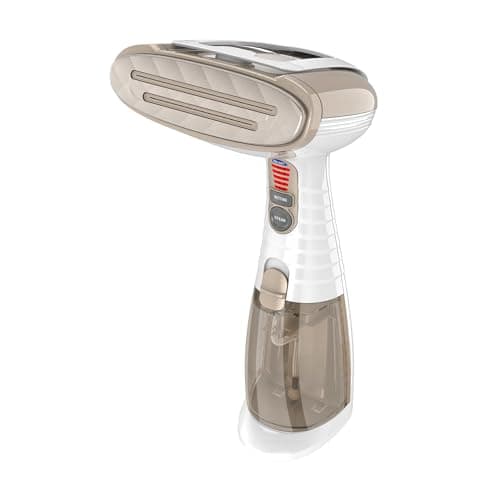
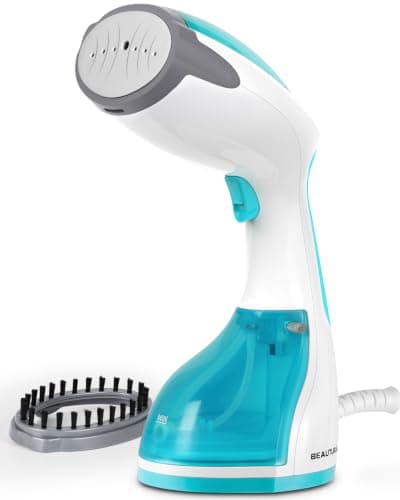
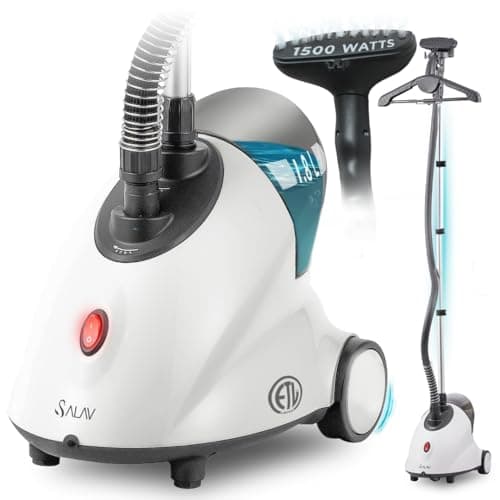
If spitting is your deciding factor, buy a standing steamer — the SALAV GS18 — because it is the only design here that physically cannot spit on a garment. Its boiler sits on the floor and the steam travels up a hose, so condensate runs back down the hose under gravity instead of out of the head. Among handhelds, which all share the opposite geometry, three units put an anti-drip claim in writing: the Conair Turbo ExtremeSteam GS59, the Beautural 1200W, and the Conair GS81. The honest ranking below is a ranking of mechanisms, because we have not tested a single one of these for spitting and neither has anyone else whose results you can check.
We earn a commission if you buy through the links on this page, at no extra cost to you. It does not change which steamer we rank first — the ranking comes from published specifications and the arithmetic on our method page. We have not tested these units. Full disclosure.
Why steamers spit: three causes, and what each one tells you to buy
Water leaves a steam head as droplets rather than vapor for three reasons, and they are separable. Knowing which one you are facing is the whole of this decision, because two of the three can be bought away and the third cannot.
The head is not hot enough for the water passing through it. This is condensate, and it is the commonest cause. An under-powered element, or a powerful one in its first seconds, delivers water that has not fully flashed to steam. It shows up worst at close range, which is exactly where a frustrated user holds the head.
Geometry. A handheld carries its water above or beside a heating element and relies on you keeping it roughly upright. Tilt it past the angle its internals expect and liquid water reaches the steam path directly. This is why the same unit spits for one person and not another.
Scale and overfilling. Mineral deposit narrows the steam path and raises the pressure behind it, and a tank filled past its line leaves no expansion space. Both are maintenance, not purchase — descaling and the distilled-water question cover them, and no machine is immune.
Cause one is a power question and cause two is a shape question. That is the useful insight here: the anti-spitting purchase is a purchase of power and geometry, not of a feature. A 1,875 W head reaches a temperature that flashes water to dry steam almost immediately; a 700 W head does not, and no marketing name changes that. If you want the full diagnostic for a machine you already own, the spitting-water page is the troubleshooting route rather than this one.
The one design that cannot spit, and why
A standing steamer separates the boiler from the head. Water boils in a tank at floor level, steam rises through a flexible hose, and the head you hold contains no reservoir at all. Any vapor that condenses in the hose runs downhill, back toward the boiler, because that is the direction gravity points — it does not arrive at the garment. The head can also be held at any angle you like, because there is no tank in it to tip.
That is a structural property rather than a claim, which is why it sits first on this page. The trade is just as structural: a standing unit is nine to twelve pounds, it occupies floor space permanently, and it takes 45 seconds or so to raise a liter of water. You are not buying a better handheld. You are buying a different machine, and the handheld-versus-standing comparison weighs the whole trade rather than this one slice of it.
Which makers put it in writing
This is the only verifiable thing about a handheld's spitting behavior available to anyone who has not taken one apart: whether the maker was willing to make the claim in its own listing copy, where it is accountable for it. Across the 38 units in this registry, three do, in these words:
Published anti-drip claims, quoted from the live listings
Unit
Power
What the listing says
Mechanism named
Conair Turbo ExtremeSteam GS59
1,875 W
"No spitting, leaking, or wet spots... Dry Steam Technology"
Named technology, undefined
Conair GS81
1,100 W
"Fast steam without leaks or spits... helping prevent water spots and drips"
None named
Beautural 1200W
1,200 W
"No leaking, no spilling with leak-proof design enables to steam whether vertically or horizontally"
Electronic pump
Every other handheld here
700-1,875 W
No claim made
—
These are quotations, not findings. "Dry Steam Technology" is a Conair trade name with no published definition, and this site cannot verify any of the three claims. What can be said is that a maker who prints it has chosen to be held to it, and most of this category declined to.
The Beautural claim is the most specific and therefore the most useful, because it names a mechanism and makes a testable promise: an electronic pump, and steaming at any angle including horizontally. A pump-fed design meters water to the element rather than letting gravity decide, which is a real answer to cause two above. It is also the only one of the three that tells you what to do differently — you can use it sideways.
Power is the figure that actually predicts it
If you ignore every claim on this page and buy on one number, buy on watts. Cause one — condensate from a head that is not hot enough — is the cause behind most reports of spitting, and it is purely a function of how much energy is going into the water relative to how fast the water arrives. The 1,875 W units here are the ones least likely to hand you a droplet at six inches, which is why the Conair GS59 sits second on this page despite its claim being the vaguest of the three.
There is a real tension in that advice and this page should state it rather than hide it. The delicates roundup argues that peak power is the wrong specification for silk and chiffon, and it is right: at close range a very hot head drives moisture into a light fabric faster than the fiber can shed it, and water marks are the result. Both things are true because they are answers to different failure modes. The resolution is distance: a powerful head worked at six to eight inches gives you dry steam and no spitting; the same head at two inches gives you a wet patch. Power buys you the right to stand back.
What to avoid if this is your deciding factor
The 700 W tier. The two cheapest machines in this registry sit at the power floor, and a cool head at close range is the exact recipe for condensate. They are knitwear refreshers and they are honest about their wattage; they are not the answer to this question.
Vertical-only handhelds, if you steam collars. A unit that must stay upright will spit the moment you tilt it to reach under a collar. The published anti-drip claims that specify horizontal use are the ones that matter here.
Anything where the maker publishes no wattage at all. Two listings in this registry file a catalog default in the wattage field. If you cannot see the power, you cannot predict the condensate.
Buying a feature name instead of a figure. No trade name on any listing in this category has a published definition or an independent test behind it.
And the honest caveat that belongs above the buy buttons rather than below them: we have not tested these units, for spitting or for anything else. Every figure on this page is read off the product's own listing and every claim is quoted from it. The methodology page states the limits of that plainly. We earn a commission on all four units below; the standing unit is first because gravity is on its side, not because of what it pays.
The four, side by side
Ranked on published specifications. Tap a row for the full write-up; the price button goes to Amazon.
#
Product
Best for
Spec score
Price
1
SALAV GS18 Full-Size Steamer1.8 liters on a 65-inch pole — the point where steaming stops being a chore.
A 1.8 liter tank is roughly nine times what a good handheld carries. That is the entire argument for a standing steamer: fill it once and work through a rail without stopping.
SALAV publishes 60 minutes of steam per fill. Even discounted, that is an order of magnitude more than any handheld here.
Forty-five seconds to heat from 1,500 watts is respectable given the volume of water involved — a handheld is heating 200 ml, this is heating 1,800.
Good
1.8 liter tank — about an hour of continuous steam per the maker
65-inch pole holds a full-length dress or coat clear of the floor
1,500W with a published one-year warranty
Not good
Nine pounds and pole-mounted — this lives in one room
45-second heat-up is slower than the best handhelds
Assembly required, and the pole is what people complain about
Who should not buy it. Skip this if you steam two shirts a week. A standing unit you assemble and store is more machine than that job needs.
2. Handheld · The default handheld
Conair Turbo ExtremeSteam GS59
The most-bought handheld in the category, and its published specs explain that rather than contradict it.
1,875 watts is the practical ceiling for a plug-in appliance on a US 15-amp circuit, and this unit sits right at it. Power is what turns water into dry steam fast enough to relax a fiber instead of soaking it, so on a handheld this is the figure that matters most.
The trade is the tank. 7.3 fluid ounces is a shade over 200 ml, which Conair pairs with a stated 20 minutes of run time. Call it two or three shirts before a refill.
40 seconds to heat is ordinary for this power class, not fast. The Rowenta Pure Force publishes a tenth of that at the same wattage.
Good
1,875W is the most power available in a handheld on a US circuit
Three attachments in the box, including a fabric brush for wool and a crease tool
Two-year limited warranty, which is unusual at this price
Not good
The tank is small for the power — high output empties it faster
40-second heat-up is beaten by several cheaper units
Over two pounds in the hand, which tells after a few garments
Who should not buy it. Skip this if you steam a whole rail at a time. At full output the tank runs dry before you get through a week of shirts, and a standing unit with a two-liter tank costs about the same.
3. Handheld · The biggest tank in the class
Beautural 1200W Handheld Steamer
260 ml on a 1,200W handheld — the most run time per fill here, bought with output.
Tank capacity decides whether steaming is pleasant or annoying, and this carries 260 ml against the 190 to 216 ml the 1,875W units manage. More minutes per fill, fewer trips to the sink.
1,200 watts is a real step down from 1,875. On linen and heavy cotton you will feel it — the steam is wetter and you will make more passes. On the synthetics and knits that make up most wardrobes the difference is small.
Two pounds and 30 seconds to heat are both mid-table. Nothing here is remarkable except the tank, and the tank is the point.
Good
260 ml — the largest handheld tank in this set
30-second published heat-up, faster than the 1,875W Conair
Auto shut-off published as part of a nine-point safety design
Not good
1,200W struggles where 1,875W does not — linen especially
Filling means carrying the whole unit to the tap
Two pounds in the hand, the same as the far more powerful Conair
Who should not buy it. Skip this if linen or heavy cotton is most of what you own. Below about 1,500 watts you make three passes where a stronger unit makes one.
4. Handheld · Small spaces
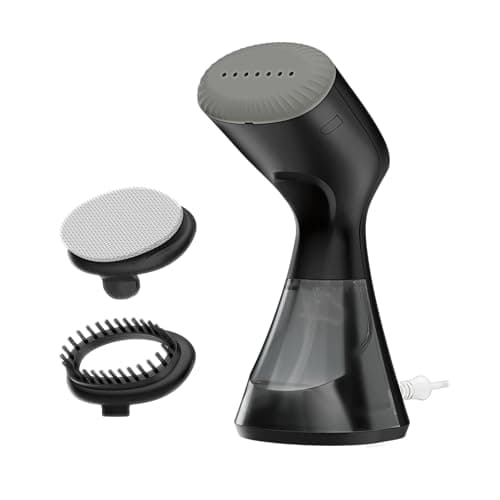
Conair 1100W Compact Steamer GS81
1.3 pounds and 30 seconds to steam — with a tank figure Conair does not publish.
Conair does not publish tank capacity for this model, so that figure is excluded from the score rather than estimated.
What the numbers mean
At 1.3 pounds this is the lightest full-size handheld here, and 1,100 watts handles the knits, synthetics and light cotton that make up most wardrobes.
Conair publishes no tank capacity for this model. That is a real hole in a spec sheet — tank size is the single best predictor of whether a session is pleasant — and it costs the unit a metric in our scoring rather than earning it a guess.
Nine inches tall. It fits in a drawer, which is most of the argument for a compact steamer.
Good
1.3 pounds, the lightest non-travel handheld here
30-second published heat-up
Nine inches tall — genuinely drawer-sized
Not good
No published tank capacity, so run time is unknowable from the specs
1,100W is mid-table output
Compact bodies mean small tanks, and the silence is not reassuring
Who should not buy it. Skip this if run time matters to you. Until Conair publishes a tank figure there is no way to know what you are buying.
Questions people actually ask
+Which garment steamer does not spit water?
A standing steamer is the only design that structurally cannot spit on a garment: its boiler sits at floor level and condensate drains back down the hose instead of out of the head. The SALAV GS18 is the cheapest such unit here. Among handhelds, three listings carry an explicit anti-drip claim — the Conair Turbo ExtremeSteam GS59, the Conair GS81 and the Beautural 1200W.
+Why do handheld steamers spit water?
Three reasons. The head is not hot enough to flash all the water to vapor, which is condensate and the commonest cause. The unit is tilted past the angle its internals expect, so liquid water reaches the steam path. Or scale has narrowed that path and raised the pressure behind it. The first two are design and power; the third is maintenance.
+Does a more powerful steamer spit less?
Generally yes, for the dominant cause. More watts means the water flashes to dry steam faster, so less of it arrives as droplets. That is why the 1,875 W units are the handhelds least likely to spit at a normal working distance. It does not help with tilting or with scale, and at very close range a powerful head will still wet a light fabric.
+Can you use a handheld steamer sideways?
Only if the maker says so. Most handhelds carry water above or beside the element and rely on staying roughly upright. The Beautural 1200W is the one unit here whose listing explicitly states it steams vertically or horizontally, which it attributes to a pump-fed rather than gravity-fed design.
+Is a leak-proof garment steamer a real thing?
The claim is real in the sense that three makers print it and are accountable for it. It is not independently verified, none of the trade names attached to it has a published definition, and this site has not tested any of them. The only claim about spitting that rests on physics rather than copy is the standing steamer's hose geometry.
+My steamer already spits — can I fix it?
Often, yes, and it costs nothing to try: descale it, fill only to the line, let it reach full temperature before the first pass, and work at six to eight inches rather than two. The troubleshooting page covers the full diagnostic. Buying a different machine is the last step, not the first.