Care
How to Steam Clothes Properly
Six steps, one of which almost everybody skips — and it is the one that matters most.
By Scooter M., enthusiast, crease control · Published
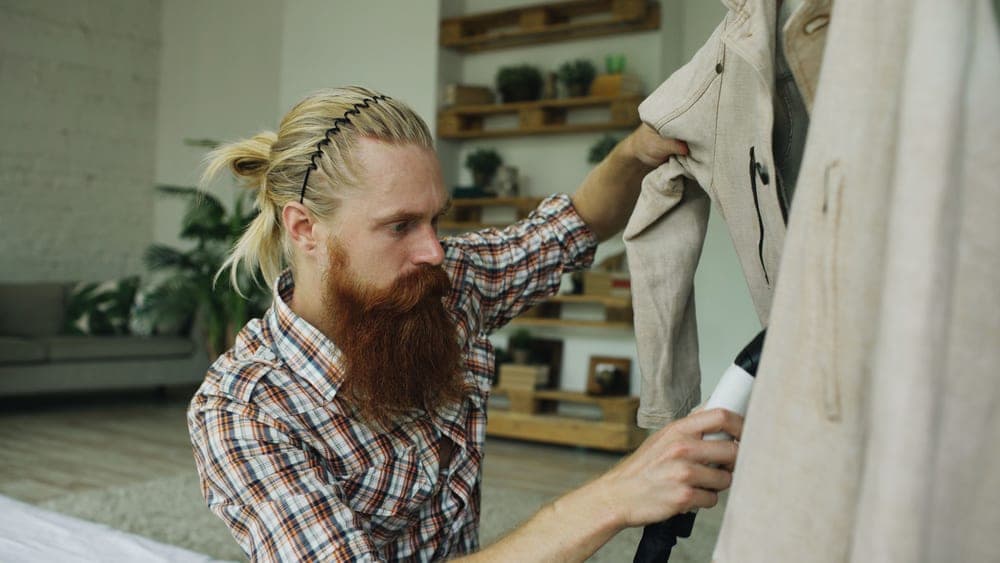
Fill, heat fully, hang the garment, and work top to bottom from four to six inches while holding the fabric taut with your free hand. That last part is the step people skip and it is the one that decides the result: steam relaxes the fiber, and something has to pull it straight while it is relaxed. Let the garment dry before wearing it.
We earn a commission if you buy through the links on this page, at no extra cost to you. It does not change which steamer we rank first — the ranking comes from published specifications and the arithmetic on our method page. We have not tested these units. Full disclosure.
The sequence
- 1Fill the tank with the right waterCold, to the marked line, and no further — overfilling is a leading cause of spitting. Whether that water should be distilled depends on your machine and your area; this page settles it.
- 2Let it reach temperature fullyTwenty seconds to two minutes depending on the machine. Using it early is the other leading cause of spitting, and on silk that means a water spot rather than a wrinkle removed.
- 3Hang the garment properlyOn a hanger with some shape to it, clear of the wall, buttoned at the top if it has buttons. A garment hanging straight has tension in it already.
- 4Hold the fabric taut and work downwardOne hand on the hem or the cuff, light tension, no pulling. Run the head down in long passes at four to six inches. This is the step that matters and it is why steaming a garment lying on a bed does not work.
- 5Work from the inside where the fabric is delicateSatin, silk and anything with a visible sheen: turn it inside out first, so any water spotting lands where nobody looks. Velvet must be steamed from the reverse, always.
- 6Let it dry before wearing itTwenty minutes minimum, longer for wool and much longer for anything padded. Damp wool stretches under load, which is how a jacket loses its shape at the elbows.
How far to hold it
| Fabric | Distance | Why |
|---|---|---|
| Cotton, denim, wool | 4-6" | Dense fibers need the vapor concentrated |
| Polyester and blends | 6" | Relaxes readily; closer risks nothing but achieves nothing |
| Silk, satin | 6-8" | Condensate at close range leaves a permanent-looking ring |
| Chiffon, tulle | 8-10" | Light enough to lift toward the head |
| Down and puffers | 8-10" | Keep moisture out of the fill |
Common mistakes
- Steaming a garment lying flat. There is no tension, so nothing pulls the fiber straight. It is the single most common reason people report that a steamer 'does nothing'.
- Circular motions. They redeposit moisture over ground you have already covered. Long, straight, downward passes.
- Getting closer to compensate for a weak machine. Closer delivers water, not steam. If the machine is too weak for the fabric, the fabric page will tell you so.
- Wearing it immediately. Warm damp fabric takes the shape of whatever it is on. Give it twenty minutes.
- Steaming over buttons and hardware. They get hot, they hold heat, and plastic ones can distort.
Machines that make this easy
Ranked on published specifications. Tap a row for the full write-up; the price button goes to Amazon.
| # | Product | Best for | Spec score | Price |
|---|---|---|---|---|
| 1 | 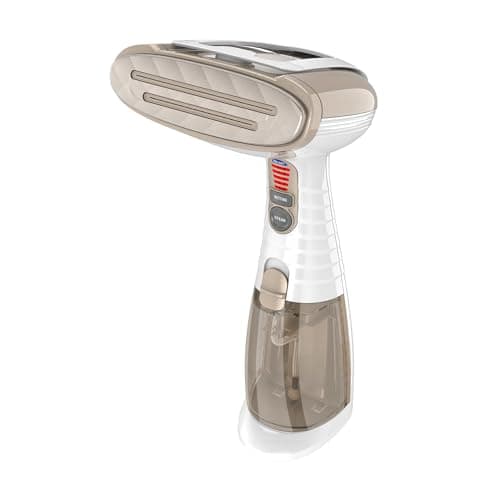 Conair Turbo ExtremeSteam GS59The most-bought handheld in the category, and its published specs explain that rather than contradict it. Conair Turbo ExtremeSteam GS59The most-bought handheld in the category, and its published specs explain that rather than contradict it. | The default handheld | 6.5/10 | |
| 2 | 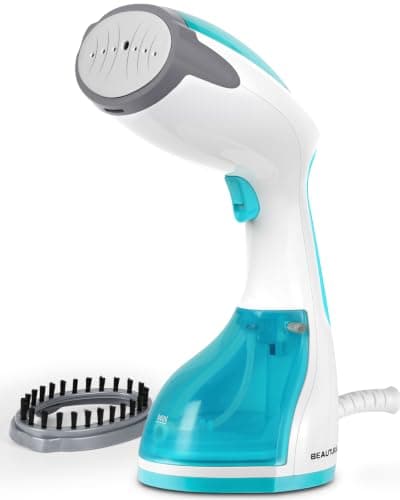 Beautural 1200W Handheld Steamer260 ml on a 1,200W handheld — the most run time per fill here, bought with output. Beautural 1200W Handheld Steamer260 ml on a 1,200W handheld — the most run time per fill here, bought with output. | The biggest tank in the class | 5.7/10 |
Questions people actually ask
+How do you steam clothes properly?
Fill with cold water, let the machine reach temperature fully, hang the garment, then work top to bottom at four to six inches while holding the fabric taut with your free hand. Let it dry for twenty minutes before wearing.
+How far should you hold a steamer from clothes?
Four to six inches for cotton, wool and denim; six to eight for silk and satin; eight to ten for chiffon and down. Closer is not more effective — it delivers water instead of vapor.
+Should you steam clothes inside out?
For satin, silk and anything with a sheen, yes — it puts any spotting where nobody sees it. For velvet it is not optional; the reverse is the only safe side.
+How do you put water in a garment steamer?
Unplug it and let it cool first, then fill the tank with cold water to the marked line and reseat it until it clicks. Never open or fill a hot machine — the vessel is pressurized and the water inside is above boiling point.