The machines built for daily use — and an honest answer about whether you need one.
By Scooter M., enthusiast, crease control · Published
Commercial pricing buys three things and none of them is steam output: a metal boiler instead of a molded plastic tank, a larger capacity (2 to 2.84 liters), and a three-year warranty against a category norm of one. The Jiffy J-2000 is the standard against which the rest are measured. If the machine will run weekly rather than daily, a domestic upright at a third of the price is the honest recommendation.
We earn a commission if you buy through the links on this page, at no extra cost to you. It does not change which steamer we rank first — the ranking comes from published specifications and the arithmetic on our method page. We have not tested these units. Full disclosure.
The warranty is the specification
Across the twenty-five models on this site, published warranty terms run: no term at all on sixteen listings, one year on five, two years on two, and three years on the two Jiffy machines. That spread tells you more about expected service life than any wattage figure does, because a warranty is a maker putting money behind a claim rather than printing one.
Jiffy publishes three years on a machine it builds in Tennessee. That is the argument for the price, and it is a real one for a business. It is a weak one for a household that steams on Sundays.
Metal boiler versus plastic tank
Domestic steamers heat water in a molded plastic reservoir with an element in it. Commercial machines use a metal boiler. The practical differences are scale tolerance and thermal cycling: a metal boiler survives being brought to temperature and back down several times a day for years, and it can be descaled aggressively without crazing. If you are running a machine continuously, that is what you are buying.
Two minutes to heat, and why that is fine here
The Jiffy's published heat-up is two minutes, the slowest figure on this site. Heating 2.84 liters in a metal boiler simply takes longer than heating 200 ml of water in plastic. In a commercial setting the machine is switched on at opening and stays on, so the figure is close to irrelevant. In a household where it is switched on for one shirt, it is the most annoying number in the category.
Who should actually buy one
Alterations, tailoring and dry cleaning — daily use over years is exactly the case the price is built for.
Event and rental businesses — costume, bridal and uniform stock that has to look right after being stored folded.
Households with genuinely heavy laundry volume, where a domestic upright has already failed once.
Not the household steaming a week of shirts on a Sunday. A standing steamer does that job for a third of the money.
The ranking
Ranked on published specifications. Tap a row for the full write-up; the price button goes to Amazon.
#
Product
Best for
Spec score
Price
1
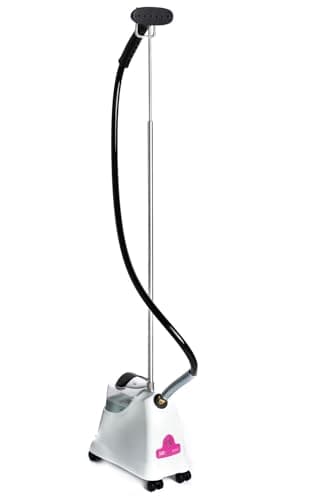
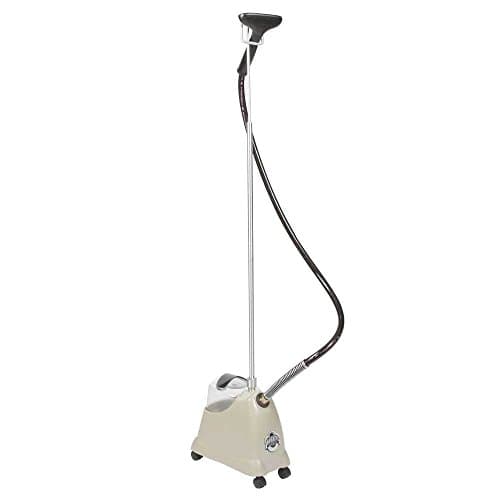
Jiffy J-2000 Commercial Steamer2.84 liters, a metal boiler and a three-year warranty — the machine the dry cleaner owns.
The three-year warranty is the specification that separates this from everything else on the site. Every other unit here publishes one or two years, or nothing at all.
2.84 liters is the largest published tank in this set, and Jiffy rates the machine at roughly two hours of continuous steam.
Two minutes to heat is slow, and that is what heating nearly three liters in a metal boiler costs. This is a machine you switch on and then go and sort the rail.
Good
2.84 liter tank — the largest here
Three-year warranty, three times the category norm
Metal boiler rather than a molded plastic tank
Not good
Two-minute heat-up, the slowest here
1,300W is lower than the 1,800W domestic uprights
Costs several times what a good handheld costs
Who should not buy it. Skip this if the machine will sit idle most weeks. It is built for daily use and the price only makes sense against that.
2. Commercial · The same machine, a shorter body
Jiffy J-2000 Pink Series
Jiffy's two-liter variant — same boiler, same three-year warranty, stores in a cupboard.
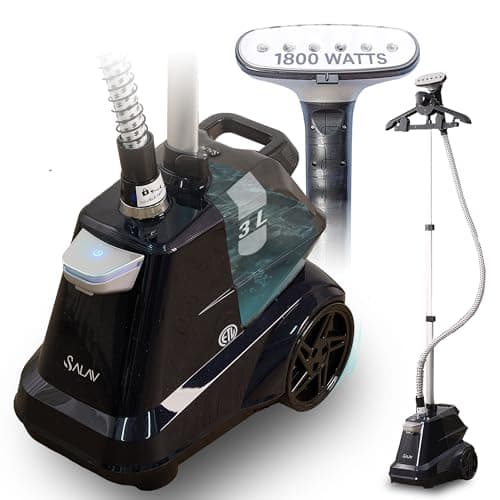
Three liters is the largest tank we found outside the true commercial machines, and 1,800 watts is the practical ceiling for a US household circuit at this size.
Foot pedals matter more than they sound. Steaming a rail means constantly starting and stopping, and doing that without setting the head down is the difference between an hour and ninety minutes.
Seventy and a half inches tall. Measure the ceiling before you buy — this is nearly six feet of assembled pole.
Good
3 liter tank, the largest here outside the Jiffy
1,800W — the most power of any standing unit in this set
Foot pedal control, rare below commercial prices
Not good
Twelve pounds and 70.5 inches — it does not get put away
45 seconds to heat three liters, so it is not a grab-and-go
One-year warranty against the Jiffy's three
Who should not buy it. Skip this if your ceilings are low or your storage is a closet. Seventy inches assembled is a piece of furniture.
The one to skip
Skip the Jiffy J-2000 Pink Series unless floor space is genuinely the constraint. It gives up 840 ml of tank against the full-size J-2000 for a shorter body, at broadly the same price. If you can stand a 64-inch machine in a corner, the extra liter is the better trade.
Questions people actually ask
+What is the difference between a commercial and a domestic garment steamer?
A metal boiler rather than a plastic tank, a larger capacity, and a longer warranty. Not more power — the Jiffy J-2000 draws 1,300 W against 1,800 W on domestic uprights. You are buying service life, not steam.
+Is a Jiffy steamer worth the money?
If it runs daily, yes: three years of published warranty against a category norm of one, and a build designed for continuous use. If it runs weekly, a domestic upright with a 3-liter tank costs a fraction and produces more steam.
+How long does a commercial garment steamer run for?
Jiffy rates the J-2000's 2.84-liter tank at roughly two hours of continuous steam. That matches the arithmetic for a 1,300 W element boiling around 22 ml a minute.