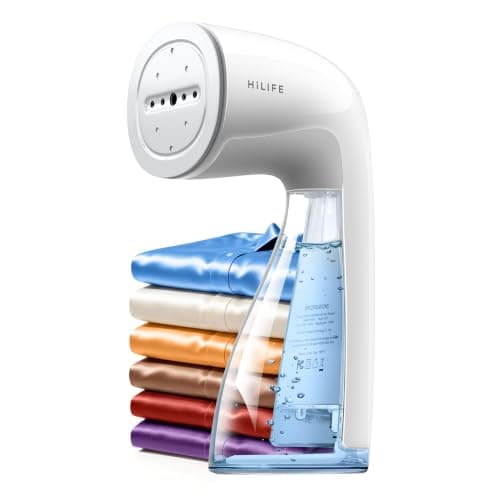
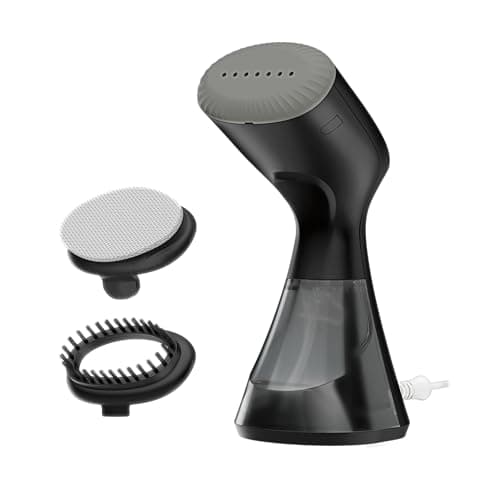
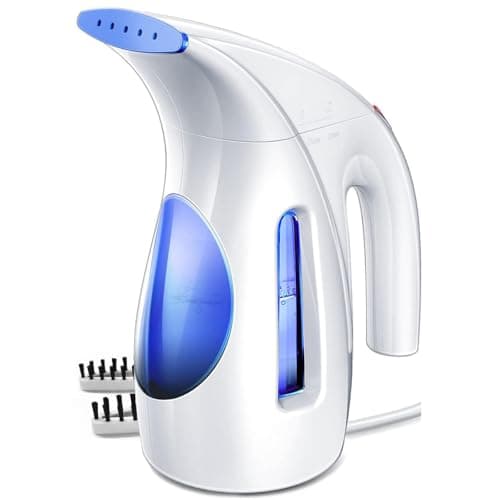
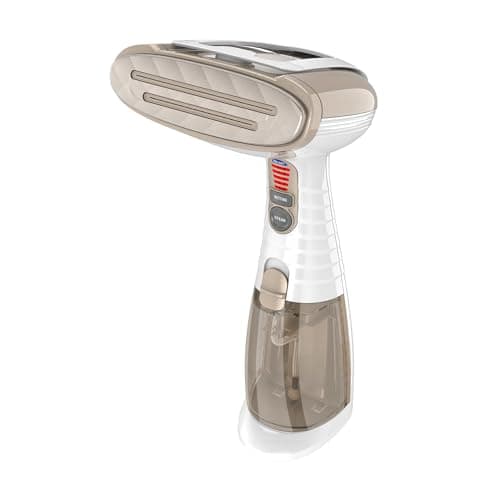
The form factor most people mean by garment steamer — and the two specifications that decide whether yours gets used or shelved.
By Scooter M., enthusiast, crease control · Published
A handheld steamer is right for two or three garments at a time and wrong for a wardrobe. Within that, two published figures decide everything: wattage, which sets which fabrics it can handle, and tank capacity, which sets how long you can work before refilling. The Conair Turbo ExtremeSteam wins on the first at 1,875 W; the HiLIFE HL9 wins on the second at 300 ml; the Rowenta XCEL wins the ratio nobody else competes on, delivering the full 1,875 W at 1.4 pounds.
We earn a commission if you buy through the links on this page, at no extra cost to you. It does not change which steamer we rank first — the ranking comes from published specifications and the arithmetic on our method page. We have not tested these units. Full disclosure.
The power floor
Handhelds span 700 to 1,875 watts, which is a wider range than it looks. At the bottom of it you have a fabric refresher: enough to relax a jersey T-shirt or lift the fold marks out of a polyester blouse, not enough for a cotton shirt you actually want to look pressed. At the top you have something that will do one pass where the cheap unit does three. Buying at the bottom of that range expecting the top of it is the most common first-steamer mistake — the beginner's guide sets out the floor worth paying for.
What each power band can honestly do
Published power
Handles
Struggles with
Example here
700-900 W
Jersey, polyester, light knits
Cotton shirts, anything structured
HiLIFE HL7 (700 W)
1,000-1,200 W
Most everyday cotton and synthetics
Linen, heavy twill, tailoring
Beautural (1,200 W)
1,500-1,875 W
Cotton, wool, most tailoring
Linen still wants an iron
Conair Turbo ExtremeSteam (1,875 W)
Note the last row: even 1,875 watts does not settle linen. Linen's stiffness comes from cellulose fibers that need heat plus pressure to reset, and vertical steam supplies no pressure at all. That is a fiber property rather than a product failure, and it is worked through on the linen verdict page.
The tank problem, and why 1,875 W makes it worse
The two most powerful handhelds here carry 216 ml and 189 ml. The two least powerful carry 240 ml. That inversion is not an accident: high output consumes water faster, so the units that empty a tank quickest are also the ones given the smallest tanks. A 1,875 W steamer with 200 ml is a genuinely short session.
The HiLIFE HL9's 300 ml on 1,100 watts is the most sensible pairing in this set — moderate output against the biggest tank, which turns into real run time rather than a heavier device you refill just as often. If you find yourself needing more than that, you do not need a better handheld. You need a standing steamer, and it probably costs less than you think.
Weight, and why it matters more than the spec sheet suggests
Two pounds sounds trivial until you have held it at shoulder height for the third shirt. The spread here runs from 1.3 to 3 pounds, and it does not track power the way you would expect: the Rowenta XCEL delivers the full 1,875 W at 1.4 pounds while the CHI manages 1,000 W at 2.9. If you steam standing up, in front of a rail, weight is the specification you will notice most — and if what you are steaming is coats and heavy cloth, a standing unit removes the question entirely.
Two-in-one units: worth it, with one condition
Three of the picks here carry a press plate as well as a steam head. That combination is genuinely useful, because a vertical steamer cannot create a crease — it can only remove one. A collar point, a cuff and a trouser crease all need contact and pressure. The condition is that a plate adds weight and, in every case here, costs you tank capacity. If you own an iron you like, the plate is a travel convenience rather than a reason to buy. The 2-in-1 roundup ranks them on their own terms and measures what the plate costs.
The ranking
Ranked on published specifications. Tap a row for the full write-up; the price button goes to Amazon.
#
Product
Best for
Spec score
Price
1
Conair Turbo ExtremeSteam GS59The most-bought handheld in the category, and its published specs explain that rather than contradict it.
1,875 watts is the practical ceiling for a plug-in appliance on a US 15-amp circuit, and this unit sits right at it. Power is what turns water into dry steam fast enough to relax a fiber instead of soaking it, so on a handheld this is the figure that matters most.
The trade is the tank. 7.3 fluid ounces is a shade over 200 ml, which Conair pairs with a stated 20 minutes of run time. Call it two or three shirts before a refill.
40 seconds to heat is ordinary for this power class, not fast. The Rowenta Pure Force publishes a tenth of that at the same wattage.
Good
1,875W is the most power available in a handheld on a US circuit
Three attachments in the box, including a fabric brush for wool and a crease tool
Two-year limited warranty, which is unusual at this price
Not good
The tank is small for the power — high output empties it faster
40-second heat-up is beaten by several cheaper units
Over two pounds in the hand, which tells after a few garments
Who should not buy it. Skip this if you steam a whole rail at a time. At full output the tank runs dry before you get through a week of shirts, and a standing unit with a two-liter tank costs about the same.
2. Handheld · Dress shirts and tailoring
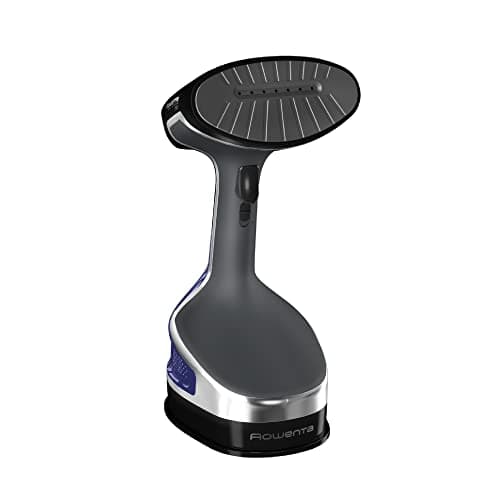
Rowenta XCEL Steam Force DR2020
Full 1,875W at 1.4 pounds — the best power-to-weight ratio on this site.
The interesting number here is a ratio. Every other 1,875W handheld we looked at is published between two and three pounds; this one is 1.4. Over a rail of shirts that difference is the whole experience.
Note a conflict inside Rowenta's own published data: the listing title advertises a 25-second heat-up, while the structured specification field on the same page reads 0.66 minutes — about 40 seconds. We score the specification field, because that is the figure Rowenta files rather than the one it markets. If you buy it expecting 25 seconds, expect to be disappointed by fifteen.
The 190 ml tank is small, and Rowenta pairs it with a stated 10 minutes of continuous steam — an honest figure rather than an optimistic one.
Good
1,875W at 1.4 pounds — the best power-to-weight figure here
Removable tank, so you refill at the tap rather than over the sink
10.8 inches tall, so it lives in a closet rather than a cupboard
Not good
190 ml is a small tank even by handheld standards
Rowenta's own title and specification field disagree about heat-up time
One-year warranty against Conair's two
Who should not buy it. Skip this if you want one machine that presses as well as steams. It is a pure vertical steamer with no plate — the Pure Force is the Rowenta that does both.
3. Handheld · One machine instead of two
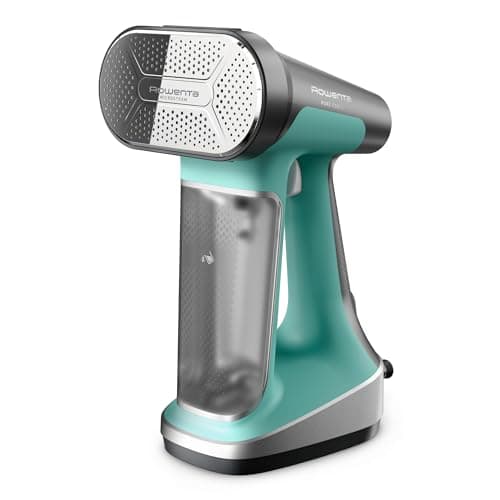
Rowenta Pure Force 2-in-1 DR8822
Steams vertically, presses horizontally, and publishes the fastest heat-up in this set by a factor of three.
Ten seconds to steam is the lowest published heat-up of anything on this page. If the thing that stops you steaming is the wait, this is the answer to it.
The horizontal plate is the real argument. A steamer relaxes a wrinkle; only contact and pressure will put a crease into a trouser leg or flatten a collar point. This does both, which is why for most wardrobes it genuinely replaces an iron and a board.
Three pounds is heavy for a handheld, and that weight is the soleplate. Judge it as a small iron that also steams, not as a light steamer that also presses.
Good
10-second published heat-up, the fastest on this site
Vertical steam and a horizontal press plate in one body
210 ml tank, larger than most 1,875W handhelds
Not good
Three pounds — the heaviest handheld here
A plate needs a surface, so it is not purely hang-and-go
Wider footprint than a pure steamer to store
Who should not buy it. Skip this if you only ever steam hanging garments. You would be carrying the weight of a soleplate you never put down.
4. Handheld · The biggest tank in the class
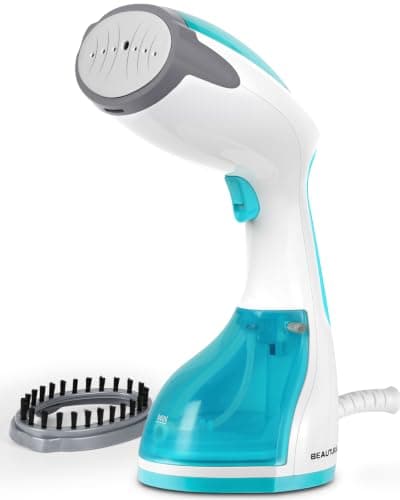
Beautural 1200W Handheld Steamer
260 ml on a 1,200W handheld — the most run time per fill here, bought with output.
Tank capacity decides whether steaming is pleasant or annoying, and this carries 260 ml against the 190 to 216 ml the 1,875W units manage. More minutes per fill, fewer trips to the sink.
1,200 watts is a real step down from 1,875. On linen and heavy cotton you will feel it — the steam is wetter and you will make more passes. On the synthetics and knits that make up most wardrobes the difference is small.
Two pounds and 30 seconds to heat are both mid-table. Nothing here is remarkable except the tank, and the tank is the point.
Good
260 ml — the largest handheld tank in this set
30-second published heat-up, faster than the 1,875W Conair
Auto shut-off published as part of a nine-point safety design
Not good
1,200W struggles where 1,875W does not — linen especially
Filling means carrying the whole unit to the tap
Two pounds in the hand, the same as the far more powerful Conair
Who should not buy it. Skip this if linen or heavy cotton is most of what you own. Below about 1,500 watts you make three passes where a stronger unit makes one.
5. Handheld · The largest tank on a mid-power handheld
HiLIFE HL9 1100W Steamer
300 ml, 1,100 watts and 30 seconds — the HL7's three weaknesses answered.
HiLIFE does not publish weight for this model, so that figure is excluded from the score rather than estimated.
What the numbers mean
This is what the HL7 should have been: four hundred more watts, sixty more milliliters of tank, and a quarter of the heat-up time.
300 ml is the biggest handheld tank in this set. On a mid-power unit that is the right pairing — lower output empties a tank more slowly, so a big tank becomes real run time rather than a heavier device you refill just as often.
HiLIFE publishes no weight for this model. That is a gap, not something to infer: we have not held one and will not estimate it, so portability goes unscored.
Good
300 ml — the largest handheld tank here
30-second published heat-up, four times faster than the HL7
Leak-proof design published explicitly, which matters on a horizontal pass
Not good
No published weight, so portability cannot be scored
1,100W still sits below what linen wants
120V only
Who should not buy it. Skip this if you plan to travel with it. It is 120V only, and a dual-voltage travel unit costs less than the transformer you would otherwise need.
6. Handheld · Small spaces
Conair 1100W Compact Steamer GS81
1.3 pounds and 30 seconds to steam — with a tank figure Conair does not publish.
Conair does not publish tank capacity for this model, so that figure is excluded from the score rather than estimated.
What the numbers mean
At 1.3 pounds this is the lightest full-size handheld here, and 1,100 watts handles the knits, synthetics and light cotton that make up most wardrobes.
Conair publishes no tank capacity for this model. That is a real hole in a spec sheet — tank size is the single best predictor of whether a session is pleasant — and it costs the unit a metric in our scoring rather than earning it a guess.
Nine inches tall. It fits in a drawer, which is most of the argument for a compact steamer.
Good
1.3 pounds, the lightest non-travel handheld here
30-second published heat-up
Nine inches tall — genuinely drawer-sized
Not good
No published tank capacity, so run time is unknowable from the specs
1,100W is mid-table output
Compact bodies mean small tanks, and the silence is not reassuring
Who should not buy it. Skip this if run time matters to you. Until Conair publishes a tank figure there is no way to know what you are buying.
7. Handheld · A first steamer, cheaply
HiLIFE HL7 700W Steamer
A 240 ml tank on 700 watts, and an honest reason it costs what it costs.
700 watts is the floor for a device that can still be called a garment steamer. It will relax a jersey T-shirt or a polyester blouse. It will not persuade a linen shirt, and no amount of technique changes that.
The tank is genuinely generous for the money at 240 ml, and that is a large part of why the listing reviews as well as it does — it runs a long time at a low output.
Two minutes to heat is the slowest published handheld figure here. That is what low wattage means: the same water, less energy per second, more waiting.
Good
240 ml tank at the bottom of the price range
1.7 pounds — light enough for a long one-handed session
Among the most-bought steamer listings in the category
Not good
700W is not enough for linen, heavy cotton or a structured jacket
Two-minute published heat-up, the slowest handheld here
No published warranty term on the listing
Who should not buy it. Skip this if you bought it to handle dress shirts. It is a refresher for knits and synthetics, and expecting more is exactly how people conclude that steamers do not work.
The one to skip
Not on this page, but adjacent to it: the CHI Deluxe Digital 3-in-1, covered on the main roundup. It is heavier than every more powerful handheld here while producing about half the steam of the Conair. Nothing on its specification sheet argues for it over the Beautural at a similar price.
Questions people actually ask
+What is the best handheld garment steamer?
On published specifications, the Conair Turbo ExtremeSteam at 1,875 W. If weight matters more than raw output, the Rowenta XCEL delivers the same wattage at 1.4 pounds. If run time matters most, the HiLIFE HL9's 300 ml tank is the largest here.
+Are handheld steamers any good?
For two or three garments of knit, synthetic, silk, wool or light cotton, yes. For a full wardrobe or for linen, no — and that mismatch, rather than any product defect, is why people conclude steamers do not work.
+How long does a handheld steamer run for?
Published run times here range from about 10 to 20 minutes, which matches the tank arithmetic: a 1,875 W element boils roughly 30 ml a minute, so a 200 ml tank is about seven minutes of continuous steam and considerably more in real use, because nobody holds the trigger down constantly.
+Can you use a handheld steamer on curtains?
Yes, but you will refill several times for a single pair. The curtains page explains why a standing unit is the better tool for anything hanging full-length.