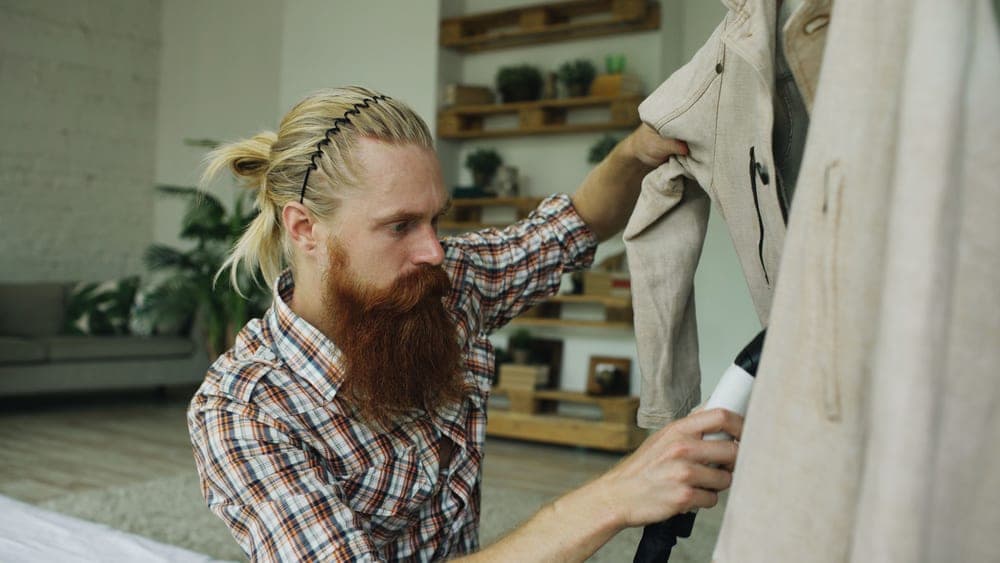
How to Steam Clothes Properly
The full sequence, the correct distance, and the tension habit that changes everything.
Top pick
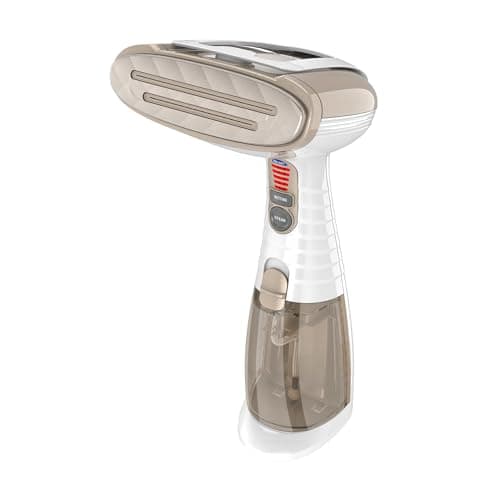
Conair Turbo ExtremeSteam GS59
$69.73 · View on Amazon
#ad · how this is funded · price as of September 16, 2026
Hub
Technique, water, scale, and the three failures that account for almost every dead steamer.
By Scooter M., enthusiast, crease control · Published
Almost every steamer that stops working has one of three problems, and none of them is a broken machine. Scale blocks the outlet, which is the leading cause of both no steam and reduced output. An air lock after a refill stops water reaching the element. Using it before it reaches temperature produces spitting and water spots. All three are preventable, and the prevention is mostly about water.
| Symptom | Most likely cause | Fix |
|---|---|---|
| No steam at all | Scale in the outlet, or an air lock | Diagnosis in order |
| Spitting water | Used before temperature, or overfilled | Ranked causes |
| Weak or intermittent steam | Scale narrowing the passage | Descale it |
| White deposits on fabric | Mineral carry-over from hard water | Water choice |
| Wet fabric rather than smooth | Too little power for the fabric | Technique and power |
We earn a commission if you buy through the links on this page, at no extra cost to you. It does not change which steamer we rank first — the ranking comes from published specifications and the arithmetic on our method page. We have not tested these units. Full disclosure.
The full sequence, the correct distance, and the tension habit that changes everything.
Top pick
Conair Turbo ExtremeSteam GS59
#ad · how this is funded · price as of September 16, 2026
It depends on your water and your manual. When it matters, when it does not, and why.
White vinegar or citric acid, the full sequence, and how often to do it.
Ranked causes and fixes for spitting, leaking and water marks on fabric.
Ranked diagnosis for a steamer that has stopped, from air locks to thermal cut-outs.
Top pick
Conair Turbo ExtremeSteam GS59
#ad · how this is funded · price as of September 16, 2026
What each wattage band can do, and the running cost computed from the current US average rate.
Top pick
Conair Turbo ExtremeSteam GS59
#ad · how this is funded · price as of September 16, 2026
Pressure, temperature and purpose — why these two machines are not interchangeable.
Top pick
Conair Turbo ExtremeSteam GS59
#ad · how this is funded · price as of September 16, 2026
Seven no-iron methods for fabric wrinkles, ranked by how well each actually works.
Top pick
Conair Turbo ExtremeSteam GS59
#ad · how this is funded · price as of September 16, 2026
What the spray does, where it helps, where it does not, and the DIY version that costs nothing.
Why steam burns worse than boiling water, the outlet rules people skip, and steaming around children and pets.
Empty the tank every time, dry the head, store it cool and open. The two-minute habit that doubles a steamer's life.
Which fabrics the bathroom-steam trick actually helps, and the dual-voltage rule that matters abroad.
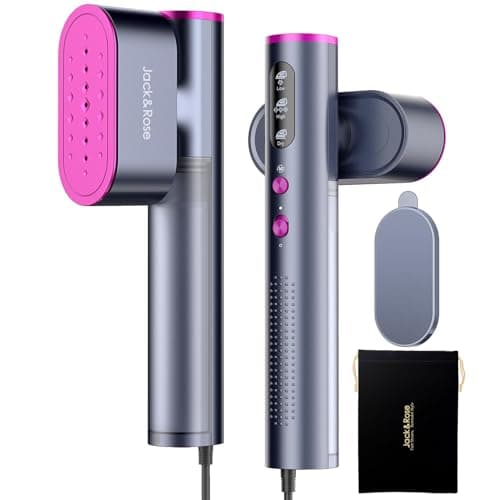
Top pick
Jack & Rose K1 Travel Steamer
#ad · how this is funded · price as of September 16, 2026
Six causes ranked. Five cost nothing to fix; the sixth is a power mismatch you can diagnose in a minute.
Top pick
Conair Turbo ExtremeSteam GS59
#ad · how this is funded · price as of September 16, 2026
Steam refreshes and presses; dry cleaning cleans. Which trips a steamer genuinely replaces, and which it never can.
Top pick
Conair Turbo ExtremeSteam GS59
#ad · how this is funded · price as of September 16, 2026
A garment steamer boils water in a small vessel and pushes vapor through a narrow outlet. Every mineral in that water stays behind when the water leaves as steam, and it accumulates. In a hard-water area a steamer used weekly can measurably lose output within a year, and the failure looks like a dying machine rather than a dirty one.
Two things prevent it: choosing the right water and descaling on a schedule. Neither is difficult and together they are most of the difference between a steamer that lasts and one that does not.
The single most common mistake is not holding the fabric taut. Steam relaxes the fiber; something has to pull it straight, and on hanging fabric that is either the garment's own weight or your free hand. A loose panel simply moves away from the vapor. The technique page goes through the sequence.
The second most common is working too close. Closer is not stronger — it delivers water rather than vapor, which is exactly how a silk blouse acquires a water spot.
Less than almost anyone expects. A 1,875 W steamer used for ten minutes is under six cents at the current US average residential electricity price — the arithmetic is shown in full, with the rate cited. Running cost is not a reason to choose one steamer over another; the reason to care about wattage is which fabrics it can handle.
Ranked on published specifications. Tap a row for the full write-up; the price button goes to Amazon.
| # | Product | Best for | Spec score | Price |
|---|---|---|---|---|
| 1 | Conair Turbo ExtremeSteam GS59The most-bought handheld in the category, and its published specs explain that rather than contradict it. | The default handheld | 6.5/10 | |
| 2 | 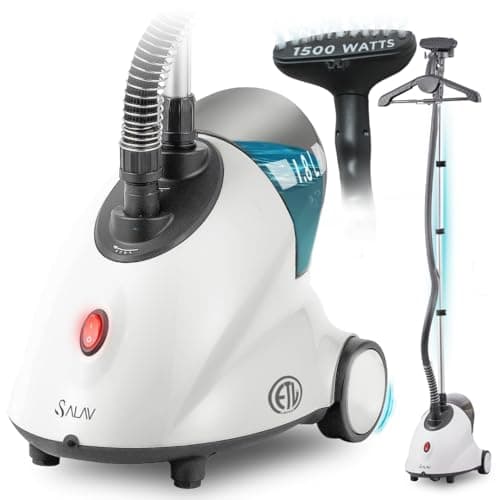 SALAV GS18 Full-Size Steamer1.8 liters on a 65-inch pole — the point where steaming stops being a chore. SALAV GS18 Full-Size Steamer1.8 liters on a 65-inch pole — the point where steaming stops being a chore. | A whole wardrobe at once | 4.4/10 | |
| 3 | 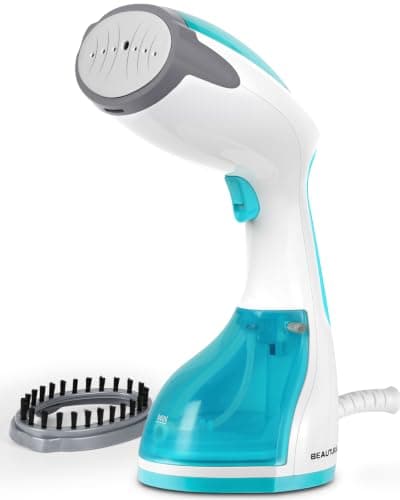 Beautural 1200W Handheld Steamer260 ml on a 1,200W handheld — the most run time per fill here, bought with output. Beautural 1200W Handheld Steamer260 ml on a 1,200W handheld — the most run time per fill here, bought with output. | The biggest tank in the class | 5.7/10 |
1. Handheld · The default handheld
The most-bought handheld in the category, and its published specs explain that rather than contradict it.
Computed from published specifications only — the rubric is published in full.
#ad · how this is funded · price as of September 16, 2026
| Model | GS59L |
|---|---|
| Power | 1,875 W |
| Tank | 216 ml |
| Heat-up | 40 s |
| Weight | 2.27 lb |
| Voltage | 110V |
| Dimensions | 8"L x 5.6"W x 13.6"H |
| Warranty | Limited 2 year. |
Source: Conair published specifications (Amazon listing), accessed September 2026.
1,875 watts is the practical ceiling for a plug-in appliance on a US 15-amp circuit, and this unit sits right at it. Power is what turns water into dry steam fast enough to relax a fiber instead of soaking it, so on a handheld this is the figure that matters most.
The trade is the tank. 7.3 fluid ounces is a shade over 200 ml, which Conair pairs with a stated 20 minutes of run time. Call it two or three shirts before a refill.
40 seconds to heat is ordinary for this power class, not fast. The Rowenta Pure Force publishes a tenth of that at the same wattage.
Who should not buy it. Skip this if you steam a whole rail at a time. At full output the tank runs dry before you get through a week of shirts, and a standing unit with a two-liter tank costs about the same.
2. Standing · A whole wardrobe at once
1.8 liters on a 65-inch pole — the point where steaming stops being a chore.
Computed from published specifications only — the rubric is published in full.
#ad · how this is funded · price as of September 16, 2026
| Model | GS18-DJ/120 |
|---|---|
| Power | 1,500 W |
| Tank | 1,800 ml |
| Heat-up | 45 s |
| Weight | 9 lb |
| Voltage | 110-120V |
| Dimensions | 14.2"L x 11.4"W x 65"H |
| Warranty | 1 Year Warranty |
Source: SALAV published specifications (Amazon listing), accessed September 2026.
A 1.8 liter tank is roughly nine times what a good handheld carries. That is the entire argument for a standing steamer: fill it once and work through a rail without stopping.
SALAV publishes 60 minutes of steam per fill. Even discounted, that is an order of magnitude more than any handheld here.
Forty-five seconds to heat from 1,500 watts is respectable given the volume of water involved — a handheld is heating 200 ml, this is heating 1,800.
Who should not buy it. Skip this if you steam two shirts a week. A standing unit you assemble and store is more machine than that job needs.
3. Handheld · The biggest tank in the class
260 ml on a 1,200W handheld — the most run time per fill here, bought with output.
Computed from published specifications only — the rubric is published in full.
#ad · how this is funded · price as of September 16, 2026
| Model | 722NA-0001 |
|---|---|
| Power | 1,200 W |
| Tank | 260 ml |
| Heat-up | 30 s |
| Weight | 2 lb |
| Voltage | 120V |
| Dimensions | 6"L x 4.3"W x 10.7"H |
| Warranty | Manufacture warranty |
Source: BEAUTURAL published specifications (Amazon listing), accessed September 2026.
Tank capacity decides whether steaming is pleasant or annoying, and this carries 260 ml against the 190 to 216 ml the 1,875W units manage. More minutes per fill, fewer trips to the sink.
1,200 watts is a real step down from 1,875. On linen and heavy cotton you will feel it — the steam is wetter and you will make more passes. On the synthetics and knits that make up most wardrobes the difference is small.
Two pounds and 30 seconds to heat are both mid-table. Nothing here is remarkable except the tank, and the tank is the point.
Who should not buy it. Skip this if linen or heavy cotton is most of what you own. Below about 1,500 watts you make three passes where a stronger unit makes one.
Technique: how to steam clothes properly. Water: distilled or tap, descaling. Faults: no steam, spitting water, steam but no result. Understanding the machine: wattage and running cost, steamer against steam cleaner, steamer against dry cleaning. Safety and upkeep: steamer safety, cleaning and storage. Away from home: steaming in a hotel room. Without a steamer: wrinkles without an iron, wrinkle release spray.
Use appropriate water for your machine and your area, descale on a schedule, empty the tank after each session rather than storing water in it, and let it cool before putting it away. Scale is the cause of most reduced-output complaints.
In order of likelihood: scale blocking the outlet, an air lock after a refill, not waiting for it to reach temperature, or a tank that is not seated properly. The diagnosis page works through each.
Every one to three months with hard water and moderate use; less often with soft or distilled water. If output has dropped noticeably, descale before assuming the machine is failing.