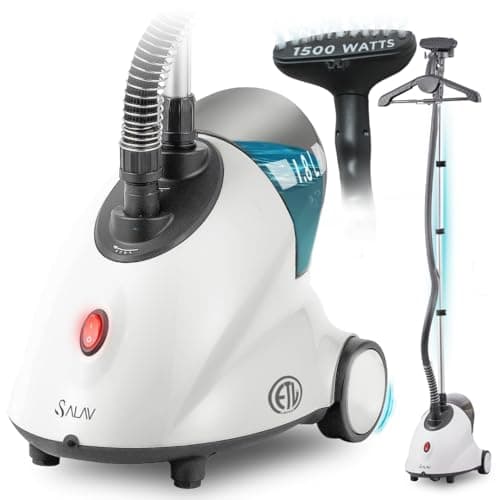
Nine times the tank of a handheld, for roughly the same money. This is the form factor people wish they had bought first.
By Scooter M., enthusiast, crease control · Published
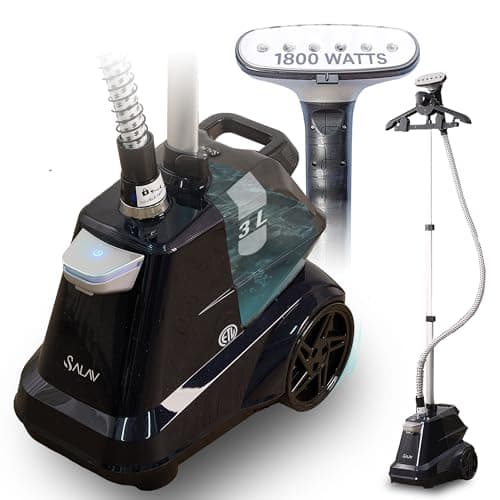
A standing steamer carries 1.8 to 3 liters against a handheld's 150 to 300 ml, which is the whole argument: one fill instead of nine. The SALAV GS18 is the sensible domestic choice at 1.8 liters and 1,500 W. If you want the biggest tank available below commercial pricing, the SALAV X3A carries 3 liters at 1,800 W with foot pedals. Measure your ceiling first — the three-liter uprights stand 70.5 inches assembled.
We earn a commission if you buy through the links on this page, at no extra cost to you. It does not change which steamer we rank first — the ranking comes from published specifications and the arithmetic on our method page. We have not tested these units. Full disclosure.
What the tank actually buys you
SALAV rates the GS18 at 60 minutes of continuous steam from one 1.8-liter fill. Even discounted for optimism, that is an order of magnitude more than any handheld on this site. In practical terms it is the difference between steaming a week of shirts in one uninterrupted pass and steaming three, refilling, steaming three more, refilling again.
Published specifications, uprights
Model
Tank
Power
Heat-up
Weight
Height
SALAV GS18
1,800 ml
1,500 W
45 s
9 lb
65"
SALAV X3A
3,000 ml
1,800 W
45 s
12 lb
70.5"
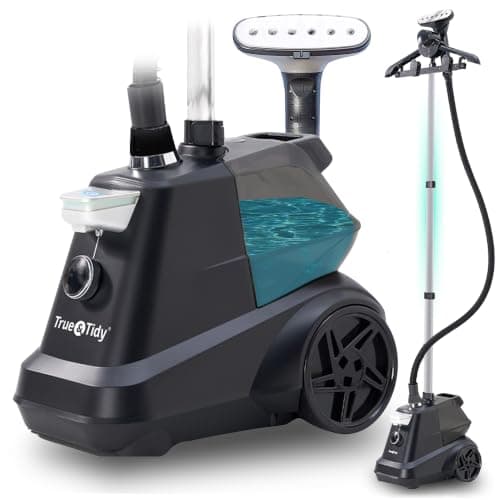
True & Tidy SX3
3,000 ml
1,800 W
50 s
12.1 lb
70.5"
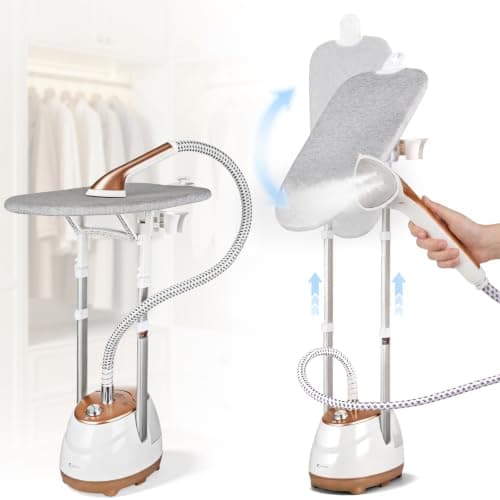
prvite GTJ-PRO01
2,000 ml
1,800 W
30 s
Not published
62.88"
All figures read from each product's own Amazon listing, September 2026.
The two three-liter machines are near-identical
The SALAV X3A and the True & Tidy SX3 publish the same tank, the same wattage and the same height. The differences are a 45-second heat-up against 50, and 12 pounds against 12.1 — margins well inside how differently two makers might measure the same thing. Choose on price and availability.
One difference is real: SALAV publishes a one-year warranty and True & Tidy publishes no warranty term at all. At this price that is the tiebreaker.
Foot pedals are not a gimmick
Steaming a rail means constantly starting, stopping and moving to the next garment. Doing that with a hand control means setting the head down between every item. A foot pedal keeps both hands on the fabric, which is where they are useful — you want one hand pulling the hem taut while the other works the head. Over an afternoon it is the difference between an hour and ninety minutes.
Measure the ceiling and the storage
Seventy and a half inches is nearly six feet of assembled pole. It does not fold, it does not go in a drawer, and in most homes it stays wherever you build it. That is the genuine cost of the form factor, and it is why a standing unit is the wrong purchase for someone who steams two shirts a week. If you want the tank without the tower, the Jiffy J-2000 Pink Series puts two liters into a 16-inch body — at commercial pricing.
The ranking
Ranked on published specifications. Tap a row for the full write-up; the price button goes to Amazon.
#
Product
Best for
Spec score
Price
1
SALAV GS18 Full-Size Steamer1.8 liters on a 65-inch pole — the point where steaming stops being a chore.
A 1.8 liter tank is roughly nine times what a good handheld carries. That is the entire argument for a standing steamer: fill it once and work through a rail without stopping.
SALAV publishes 60 minutes of steam per fill. Even discounted, that is an order of magnitude more than any handheld here.
Forty-five seconds to heat from 1,500 watts is respectable given the volume of water involved — a handheld is heating 200 ml, this is heating 1,800.
Good
1.8 liter tank — about an hour of continuous steam per the maker
65-inch pole holds a full-length dress or coat clear of the floor
1,500W with a published one-year warranty
Not good
Nine pounds and pole-mounted — this lives in one room
45-second heat-up is slower than the best handhelds
Assembly required, and the pole is what people complain about
Who should not buy it. Skip this if you steam two shirts a week. A standing unit you assemble and store is more machine than that job needs.
2. Standing · Volume, at home
SALAV X3A Commercial-Style Steamer
Three liters, 1,800 watts and foot pedals — a commercial layout at a domestic price.
Three liters is the largest tank we found outside the true commercial machines, and 1,800 watts is the practical ceiling for a US household circuit at this size.
Foot pedals matter more than they sound. Steaming a rail means constantly starting and stopping, and doing that without setting the head down is the difference between an hour and ninety minutes.
Seventy and a half inches tall. Measure the ceiling before you buy — this is nearly six feet of assembled pole.
Good
3 liter tank, the largest here outside the Jiffy
1,800W — the most power of any standing unit in this set
Foot pedal control, rare below commercial prices
Not good
Twelve pounds and 70.5 inches — it does not get put away
45 seconds to heat three liters, so it is not a grab-and-go
One-year warranty against the Jiffy's three
Who should not buy it. Skip this if your ceilings are low or your storage is a closet. Seventy inches assembled is a piece of furniture.
3. Standing · The fastest standing heat-up
prvite GTJ-PRO01 Standing Steamer
Thirty seconds to steam from a two-liter tank — the quickest start of any upright here.
prvite does not publish weight for this model, so that figure is excluded from the score rather than estimated.
What the numbers mean
Thirty seconds to bring a standing steamer to temperature is fifteen faster than the SALAV and twenty faster than the True & Tidy, from the same 1,800 watts. That is a boiler difference, not a marketing one.
Two liters is a liter less than the three-liter pair. For a household that is still an hour of work between fills.
The maker publishes no weight, so portability goes unscored. On a 62-inch pole it hardly matters, but the gap is the gap.
Good
30-second published heat-up, fastest standing unit here
1,800W
One-year published warranty
Not good
2 liters against the three-liter class leaders
No published weight
A newer listing with far fewer buyers behind it than the SALAV
Who should not buy it. Skip this if you steam in long sessions. The extra liter on the SALAV X3A is worth more over an afternoon than thirty seconds at the start.
4. Standing · The SALAV X3A's closest match
True & Tidy SX3 Standing Steamer
The same three liters and 1,800 watts, five seconds slower to heat, no published warranty.
Spec for spec this sits alongside the SALAV X3A: 1,800 watts, three liters, seventy and a half inches. The published differences are a 50-second heat-up against 45, and 12.1 pounds against 12.
Those margins are inside the noise of how a maker measures. Choose on price and stock, not on the spec sheet.
True & Tidy publishes no warranty term on this listing where SALAV does. That is the one difference we would actually act on.
Good
3 liter tank and 1,800W, matching the class leaders
Slightly narrower footprint than the SALAV
Straightforward pole-and-hanger design
Not good
No published warranty term
50-second heat-up, the slowest standing unit here
12.1 pounds
Who should not buy it. Skip this if the SALAV X3A is available at a similar price. Same specifications, and SALAV publishes a warranty.
The one to skip
Skip the True & Tidy SX3 if the SALAV X3A is available at a similar price. It matches the SALAV on every published specification, is five seconds slower to heat, and publishes no warranty term where SALAV publishes one year. There is no figure on its listing that argues for it.
Questions people actually ask
+Is a standing garment steamer better than a handheld?
For volume, decisively — 1.8 to 3 liters against 150 to 300 ml. For a quick touch-up before leaving the house, no: a handheld heats in 20 to 40 seconds and lives in a drawer, while an upright takes 30 to 50 seconds and takes up a corner of a room permanently.
+How long does a standing steamer run on one tank?
SALAV publishes 60 minutes for the 1.8-liter GS18. The three-liter models run proportionally longer. That matches the arithmetic: a 1,500 W element boils roughly 25 ml a minute, so 1.8 liters is over an hour of continuous output.
+Are standing steamers good for curtains?
They are the right tool for it. Curtains hang full-length and a handheld's tank will not survive a single pair. The curtains page covers the technique and what to watch for on lined fabric.
+Do standing steamers need distilled water?
More than handhelds do, because they hold water hot for longer and scale accumulates in a larger boiler. The distilled water page sets out when it genuinely matters, and descaling covers what to do if you have not been using it.