The shower trick, the hotel iron, and the case for carrying your own 1.5-pound machine.
By Scooter M., enthusiast, crease control · Published
The shower trick works, but only on the fabrics that were going to recover anyway. Hanging a garment in a steamy bathroom for fifteen to twenty minutes relaxes light wrinkles in wool, polyester and knits. It does almost nothing to cotton or linen, because ambient humidity delivers a fraction of the heat a steam head does. If you travel with clothes that need to look pressed, carry a dual-voltage travel steamer — the good ones weigh under two pounds.
We earn a commission if you buy through the links on this page, at no extra cost to you. It does not change which steamer we rank first — the ranking comes from published specifications and the arithmetic on our method page. We have not tested these units. Full disclosure.
How to do the shower trick properly
Most people do a version of this and get a worse result than the method deserves. The two things that matter are that the bathroom actually gets saturated, and that the garment does not get wet.
1Hang the garment before you turn the water onOn the back of the door or a hook, as far from the shower as the room allows, and never inside the shower enclosure or over the curtain rail. It should meet vapor, not spray.
2Run the shower as hot as it goes, with the door shutYou are trying to saturate the air. A partially closed door halves the effect.
3Give it fifteen to twenty minutesFive minutes is not enough, and this is the most common reason people conclude it does not work.
4Smooth the fabric by hand while the room is still humidThis is the step nearly everyone skips and it does most of the work. Steam relaxes the fiber; something has to pull it straight, and here that is your hand.
5Hang it somewhere dry and give it an hourThe garment has taken on moisture. Wearing it damp puts new wrinkles into relaxed fabric, which is worse than where you started.
What it will and will not fix
The shower method, by fabric
Fabric
Result
Why
Wool suit or jacket
Good
Wool recovers its own shape with very little help
Polyester and blends
Good
Light synthetics relax at low heat
Knitwear
Good
Steam plus hand-smoothing is exactly the right treatment
Silk and satin
Fair
Works, but watch for water spotting from droplets on the door
Cotton shirt
Poor
Needs real heat and tension; ambient humidity supplies neither
Linen
None
Flax needs to be held flat while it dries. Nothing else works
Set-in packing creases
Poor
A hard fold that has been compressed for hours needs directed steam
The pattern is the same one as everywhere on this site: fibers with elastic recovery do well, fibers without it need an iron.
The hotel iron, and why it is usually a bad idea
There is an iron in the closet in most hotel rooms, and it is a genuinely risky object. It has been used by hundreds of strangers, it has never been descaled, and its tank has been sitting full of tap water for an indeterminate period. The specific failure is a brown or white deposit spat onto your shirt on the first pass — mineral scale and whatever the last guest melted onto the plate.
If you use one anyway: wipe the plate with a damp towel first, empty the tank and refill it, run it for a minute over the ironing board cover or a towel before it touches your clothes, and start on the least visible part of the garment. Steam settings on an unknown iron deserve particular suspicion.
Packing so there is less to fix
The most effective wrinkle strategy happens before the suitcase closes.
Roll knits and casual clothes, fold structured ones. Rolling avoids hard creases; a tailored jacket wants to be folded along its own seams, inside out, shoulder into shoulder.
Put tissue or a plastic dry-cleaning bag between folds. The slippery layer stops fabric gripping itself, which is what sets a crease.
Pack tightly. A full case moves less, and movement is what works a fold into a permanent one.
Unpack the moment you arrive. Two hours on a hanger removes a surprising share of what you were going to steam out.
Choose the fabric for the trip. A wool or polyester-blend shirt arrives looking fine; a linen one never will, and there is no fix for that on the road.
Carrying your own steamer
For anyone who travels for work, this is the answer, and the machines are smaller than most people expect. The lightest unit on this site weighs 0.8 pounds and the heaviest of the picks below is 1.6. The specifications that matter for travel are different from the ones that matter at home:
What to look for in a travel steamer
Specification
Why it matters on a trip
Dual voltage (110-240 V)
The one non-negotiable if you leave the US. A 120 V-only unit on 220 V will destroy itself
Weight under two pounds
It is competing with everything else in the bag
Fast heat-up
Fifteen to thirty seconds is realistic; you are working before a meeting, not on a Sunday
Small tank, accepted
70 to 150 ml is normal at this size. It covers a shirt or two, which is the job
Any-angle operation
Hotel rooms rarely offer a good place to hang anything
Tank capacity is the deliberate trade. A 70 ml tank sounds absurd next to the 300 ml handhelds on the handheld page, and it is the reason those units are so small. For one shirt in a hotel room it is enough; for a wardrobe at home it is not, which is why a travel steamer should be a second machine rather than your only one.
Voltage, and the mistake that ends a trip
This deserves its own heading because it is expensive to get wrong. A plug adapter changes the shape of the pins. It does not change the voltage. Plugging a 120 V-only steamer into a 230 V European or Asian outlet through an adapter puts roughly double the intended voltage across a heating element designed for half of it, and the result is immediate and permanent.
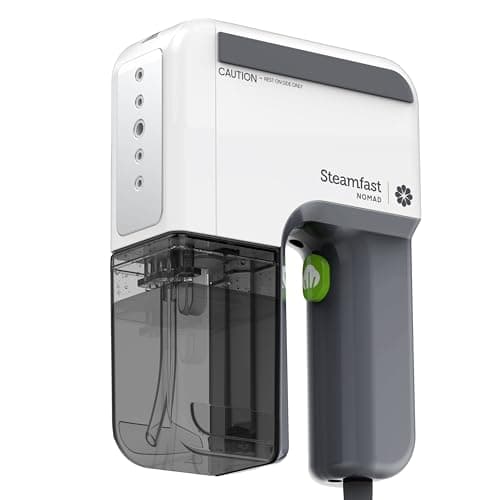
Check the unit itself for a 110-240 V or 100-240 V marking before you pack it. Of the picks below, the Jack & Rose K1 publishes 100-240 V and the OGHom GH02 publishes 110-240 V. The nesugar G3 Pro says only "global voltage adaptation" in the maker's own wording, which is worth confirming before you fly. The Steamfast Nomad publishes 120 V and is a domestic travel item rather than an international one. The travel page has the published figures side by side.
If you have nothing at all
The genuinely equipment-free options are limited, and honest about it: hang the garment and give it time, smooth it firmly with damp hands, or use the hotel hairdryer on a slightly dampened area while you pull the fabric taut. That last one is a reasonable emergency fix on a collar or a lapel and nothing more. The wrinkles-without-an-iron page works through the rest, including what actually happens in a dryer.
Travel steamers worth the space
Ranked on published specifications. Tap a row for the full write-up; the price button goes to Amazon.
#
Product
Best for
Spec score
Price
1
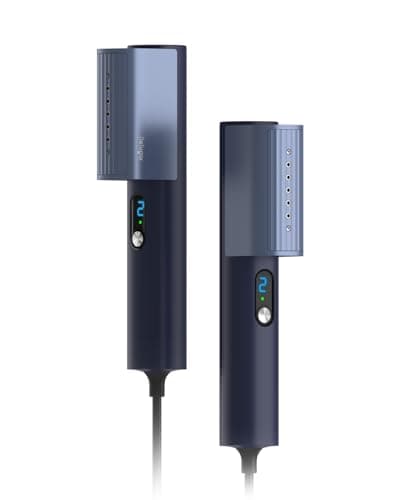
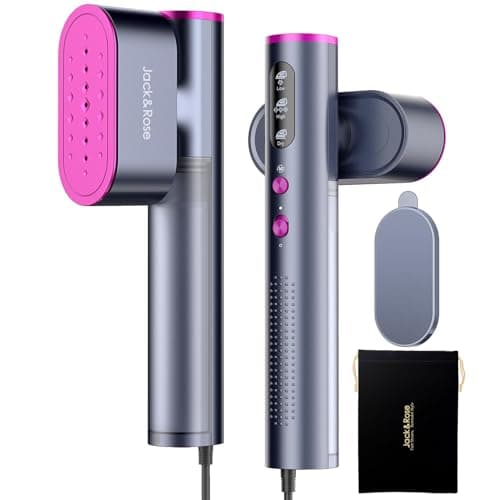
Jack & Rose K1 Travel SteamerTrue 100-240V, 15 seconds to steam, 1.6 pounds — the travel spec sheet done right.
Dual voltage is the entire question for a travel steamer, and this one publishes 100-240V rather than the 120V-only that most compact units quietly ship with. In a European socket it works; a 120V unit on 230V is a fire.
Fifteen seconds is the joint-fastest published heat-up on this site. In a hotel room, before a dinner you are already late for, that is the number that matters.
150 ml is a hotel-room tank, not a wardrobe tank. Judge it as two garments per fill.
Good
Genuine 100-240V dual voltage, published on the listing
15-second published heat-up, joint-fastest here
Steamer and press plate in one 1.6 pound body
Not good
150 ml means refilling for anything beyond two garments
1,000W is modest — it will not fight linen
You still need the physical plug adapter for the country
Who should not buy it. Skip this if it will be your only steamer at home. It is built for a suitcase, and the tank says so.
2. Travel · Dual voltage on a budget
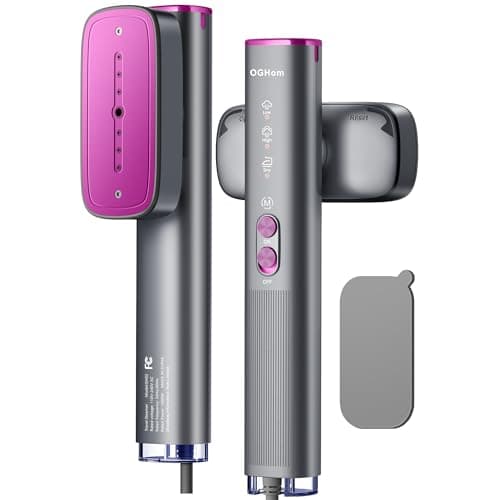
OGHom GH02 Travel Steamer
110-240V and a 15-second heat-up in the cheapest dual-voltage body here.
Nine and a half inches long, an inch and a half deep, and under a pound. It is closer to a large marker pen than an appliance.
The tank is 70 ml, the smallest in this set by a distance — roughly one shirt front. The size is the feature and the tank is the price of it.
900 watts in something this small is a genuinely good ratio, and the 15-second heat-up matches the best here.
Good
0.8 pounds — the lightest unit on this site
15-second published heat-up
Global voltage adaptation published by the maker
Not good
70 ml tank — about one garment per fill
Small tanks mean frequent refills, which slows a session badly
Not enough for anything structured
Who should not buy it. Skip this if you steam more than one or two things at a time. You will spend the session at the tap.
Questions people actually ask
+Does hanging clothes in the bathroom while you shower remove wrinkles?
On wool, polyester and knits, yes -- give it fifteen to twenty minutes with the door shut and smooth the fabric by hand while the room is humid. On cotton and linen it does very little, because ambient humidity supplies a fraction of the heat a steam head does.
+How do you get wrinkles out of clothes in a hotel room?
In order: ask the front desk for a steamer, use the shower method on wool and synthetics, or carry a dual-voltage travel steamer. The in-room iron is a last resort -- it has never been descaled and can deposit scale on your shirt.
+Can you take a garment steamer on a plane?
Airline and security rules vary and change, so check your carrier and destination before you fly. Whatever the rule, empty the tank completely before packing -- a full tank leaks into your clothes and cannot dry inside a closed bag.
+Do you need a dual voltage steamer for travel?
If you are leaving the US, yes. A plug adapter changes the pin shape, not the voltage, and a 120 V-only steamer on a 230 V supply will destroy itself immediately. Look for 110-240 V marked on the unit.
+Are hotel irons safe to use on clothes?
They work, but they are unmaintained and shared. Wipe the plate, empty and refill the tank, run it over a towel first, and start on a part of the garment nobody will see.