Most of what is sold as a cordless steamer either has a cord, has no real steam, or runs for seconds at a time. There is a reason, and there is a better answer.
By Scooter M., enthusiast, crease control · Published
A genuinely cordless garment steamer that works like a corded one does not really exist, and physics is the reason. Steam takes a lot of energy: a real steamer draws 700 to 1,875 watts, and a battery small enough to hold in one hand stores enough for a minute or two at that rate. What you can buy is a base-charged cordless steam iron — the Rowenta Freemove steams for up to 30 seconds per charge, by Rowenta's own listing, then goes back on its dock. For most people the better answer is a steamer whose cord stays out of the way.
We earn a commission if you buy through the links on this page, at no extra cost to you. It does not change which steamer we rank first — the ranking comes from published specifications and the arithmetic on our method page. We have not tested these units. Full disclosure.
How this page was judged
What "cordless" actually means for each product, read off its own listing — not what the title implies.
Run time per charge, where it is published. A cordless claim with no run time is not a claim you can buy on.
Whether the energy arithmetic supports the steam claim. Stated below in full, so you can check it.
The real reason you want no cord — tangling while steaming a hanging garment, portability, or genuinely no cord at all — because each has a different best answer.
Currently purchasable, verified against the live listing before publication.
Is there a cordless clothes steamer?
Technically, yes. Usefully, barely. The query is one of the most common in this whole category precisely because a cord is the single most annoying thing about using a steamer, and the honest answer disappoints people: the thing that makes steam — boiling water fast — is exactly the thing batteries are worst at.
A search for cordless garment steamers mostly returns ordinary corded handhelds, matched on words like "portable" and "handheld" rather than on having no cord. The products that are genuinely cordless fall into three groups, and none of them is a battery steamer you can walk down a rail with.
The arithmetic, shown
This is worth doing properly because it settles the question. Turning water into steam takes about 0.72 watt-hours per milliliter — around 335 joules to heat each gram from room temperature to boiling, plus about 2,257 joules to turn it into vapor. That second figure is the latent heat of vaporization, and it is why steam is so energy-hungry.
Battery capacity in watt-hours = milliampere-hours × volts ÷ 1,000. A 5,200 mAh pack is about 19 Wh at 3.7 V, or about 38 Wh if it is a two-cell 7.4 V pack. At a perfect 0.72 Wh per ml, that boils roughly 27 to 53 ml of water — before any losses at all.Arithmetic from the physical properties of water. Pack voltage is not always published, so both common configurations are shown.
Twenty-seven to fifty-three milliliters, at perfect efficiency, is a quarter of one ordinary handheld's tank at best. Put another way: run that same battery at 700 watts — the lowest power a real steamer uses — and it is empty in roughly one and a half to three and a quarter minutes. A 1,000-watt steamer would drain it faster still. That is why battery units that advertise steam either deliver very little of it, or run at a fraction of a corded steamer's power, and why no mainstream maker sells a battery handheld that competes with a plug-in one.
What "cordless" actually means on a listing
The four things sold as cordless
What it is
How it works
Real steam?
Worth it?
Base-charged cordless steam iron
Heats on a plugged-in dock, lifts off, runs on stored heat
Yes, in short bursts
Yes, if you genuinely want no cord and mostly press
USB-rechargeable mini iron
A small heated plate on a battery
Little or none
For a collar on a trip, at most
Battery "steamer"
A small boiler on a battery pack
Limited by the arithmetic above
Rarely — check the energy claim first
"Cordless" in the title, cord in the box
An ordinary corded handheld, keyword-matched
Yes
Fine — but it is not cordless
The first row is the only one that is both genuinely cordless and genuinely a steam appliance. It is also an iron rather than a garment steamer, and that distinction matters for what you can do with it.
What you probably actually want
"Cordless" is usually shorthand for one of three different frustrations, and each has a better answer than a battery.
The frustration, and what solves it
If the problem is
The better answer
Why
The cord tangles or drags while you steam a hanging garment
A [standing steamer](/steamers/standing)
The cord stays at the base on the floor. You hold only a light hose and head, which is effectively cordless in the hand — with a real tank
You want something small to carry and use anywhere
The lightest corded handheld
Under a pound exists. A six-foot cord is a minor nuisance next to a steamer that actually steams
You travel and hate packing a cord
A [dual-voltage travel steamer](/steamers/travel)
The cord coils into the bag. What matters abroad is voltage, not the cord
You genuinely want no cord at all, and mostly press flat
A base-charged cordless steam iron
The only genuinely cordless steam appliance from a mainstream maker, with published run times
The first row is the one most people have not considered. A standing steamer's cord plugs in once and stays on the floor; what you move around is a hose and a head. For steaming a hanging dress, a rail of shirts or a pair of curtains, that is closer to the cordless experience people are imagining than any battery product — and it comes with an hour of steam instead of a minute.
Making a corded steamer less annoying
Steam near the outlet. Hang the garment on a door or a hook within reach of the socket rather than carrying the steamer to the garment.
Drape the cord over your shoulder. It keeps the cord off the fabric and out of the steam path, which also protects the cord's insulation.
If you use an extension, use a heavy one. A 1,500 W steamer on a thin cord heats that cord along its whole length. A short, appliance-rated cord rated for at least 15 amps only — the safety page explains why this matters.
Never a power strip. High-wattage heating appliances are exactly what they are not built for.
Pick the form factor for the job. A handheld for two garments; a standing unit for anything more. Most cord frustration is a handheld being asked to do a standing steamer's work.
Why the picks are what they are
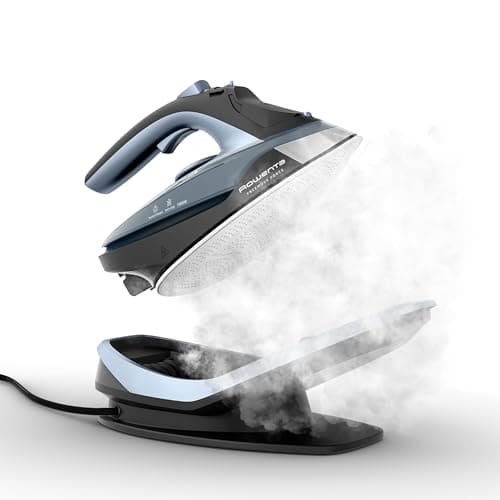
The Rowenta Freemove DE6730 is the only genuinely cordless steam appliance on this site, from a mainstream maker, with its limits published honestly. It heats on its dock in a published 30 seconds, draws 1,600 watts, and by Rowenta's own listing delivers steam for up to 30 seconds before returning to the base, where it reheats in about 10. It steams vertically as well as pressing flat. The honest costs: it is an iron, so the 30-second bursts suit a board and a touch-up rather than a rail; it weighs 3.84 pounds, heavy to hold up to a hanging garment; and Rowenta publishes no tank capacity and no warranty term on the listing.
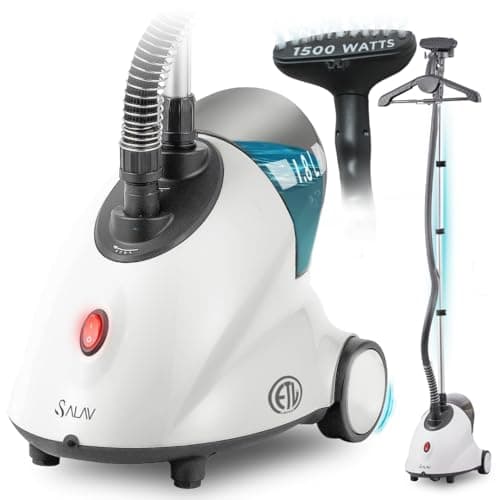
The SALAV GS18 is here because for most people it is the right answer to the question behind the question. The cord plugs in at the base and stays there; you move a hose and a head. 1.8 liters at 1,500 watts is about an hour of continuous steam, with a published one-year warranty. It is nine pounds and 65 inches tall and does not fold — a piece of household equipment, not something you carry.
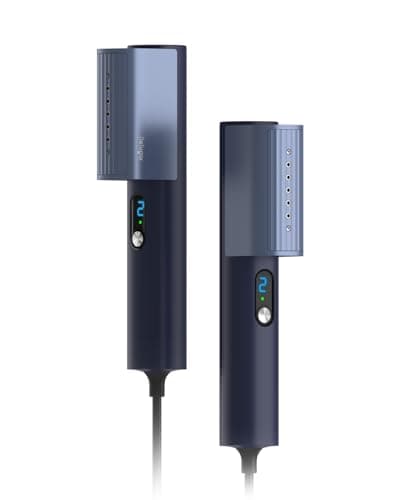
The nesugar G3 Pro is the lightest steamer on this site at 0.8 pounds, with a published 15-second heat-up. If "cordless" means "tiny and easy to grab", this is what that looks like with a cord attached. The trade is real: a 70 ml tank, roughly one garment per fill, 900 watts, and a listing that says only "global voltage adaptation" without publishing a range, so confirm before flying.
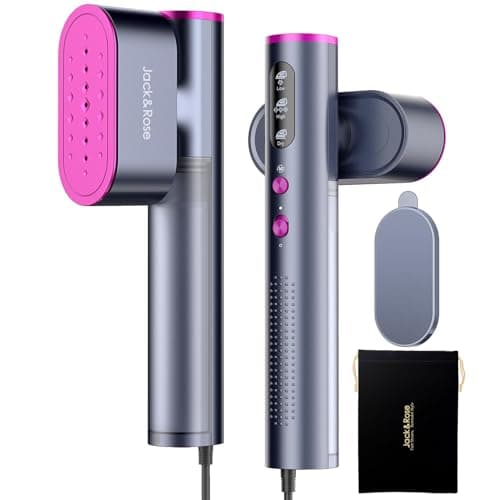
The Jack & Rose K1 is the travel answer: genuine 100-240 V dual voltage, a published 15-second heat-up, 150 ml and 1.6 pounds. The cord coils into a bag and the voltage is what actually matters abroad. It publishes no warranty term.
By what you actually want
Ranked on published specifications. Tap a row for the full write-up; the price button goes to Amazon.
#
Product
Best for
Spec score
Price
1
Rowenta Freemove Cordless Iron DE6730The honest answer to 'cordless steamer': a base-charged steam iron that steams for up to 30 seconds per charge, then goes back on its dock.
Rowenta does not publish tank capacity for this model, so that figure is excluded from the score rather than estimated.
What the numbers mean
Rowenta's own listing says it 'delivers powerful steam for up to 30 seconds' before it needs the base again, and reheats in about 10 seconds once docked. That is not a weakness of this model — it is what 1,600 watts without a cord physically looks like, and it is published plainly rather than hidden.
It steams vertically as well as pressing flat, which is why it belongs on a steamer site at all. Think of it as a cordless iron that will do a quick touch-up on a hanging shirt, not as a steamer you can walk a rail with.
3.84 pounds is iron weight, not steamer weight — the mass helps when you press and works against you when you hold it up to a hanging garment. Rowenta publishes no tank capacity and no warranty term on this listing, so both are stated as gaps.
Good
Genuinely cordless, from a mainstream maker — rare in this category
Steams vertically as well as pressing, so it covers touch-ups on hanging garments
Published 30-second heat-up and roughly 10-second reheat on the base
Not good
Up to 30 seconds of steam per charge, then back on the base
3.84 pounds — heavy to hold up to a hanging garment
No published tank capacity or warranty term
Who should not buy it. Skip this if you want to steam a rail of clothes or a pair of curtains. Thirty-second bursts suit a board and a touch-up, not continuous vertical work.
2. Standing · A whole wardrobe at once
SALAV GS18 Full-Size Steamer
1.8 liters on a 65-inch pole — the point where steaming stops being a chore.
A 1.8 liter tank is roughly nine times what a good handheld carries. That is the entire argument for a standing steamer: fill it once and work through a rail without stopping.
SALAV publishes 60 minutes of steam per fill. Even discounted, that is an order of magnitude more than any handheld here.
Forty-five seconds to heat from 1,500 watts is respectable given the volume of water involved — a handheld is heating 200 ml, this is heating 1,800.
Good
1.8 liter tank — about an hour of continuous steam per the maker
65-inch pole holds a full-length dress or coat clear of the floor
1,500W with a published one-year warranty
Not good
Nine pounds and pole-mounted — this lives in one room
45-second heat-up is slower than the best handhelds
Assembly required, and the pole is what people complain about
Who should not buy it. Skip this if you steam two shirts a week. A standing unit you assemble and store is more machine than that job needs.
3. Travel · A jacket pocket
nesugar G3 Pro Palm Steamer
Twelve point eight ounces and 15 seconds — the smallest thing here that makes real steam.
Dual voltage is the entire question for a travel steamer, and this one publishes 100-240V rather than the 120V-only that most compact units quietly ship with. In a European socket it works; a 120V unit on 230V is a fire.
Fifteen seconds is the joint-fastest published heat-up on this site. In a hotel room, before a dinner you are already late for, that is the number that matters.
150 ml is a hotel-room tank, not a wardrobe tank. Judge it as two garments per fill.
Good
Genuine 100-240V dual voltage, published on the listing
15-second published heat-up, joint-fastest here
Steamer and press plate in one 1.6 pound body
Not good
150 ml means refilling for anything beyond two garments
1,000W is modest — it will not fight linen
You still need the physical plug adapter for the country
Who should not buy it. Skip this if it will be your only steamer at home. It is built for a suitcase, and the tank says so.
Questions people actually ask
+Is there a cordless clothes steamer?
Technically yes, usefully barely. Turning water into steam takes about 0.72 watt-hours per milliliter, and a handheld-sized battery stores enough to boil only a few tens of milliliters. The genuinely cordless option worth buying is a base-charged steam iron such as the Rowenta Freemove, which steams for up to 30 seconds per charge before going back on its dock.
+Do battery-powered clothes steamers work?
Not like a corded one. A 5,200 mAh battery holds roughly 19 to 38 watt-hours depending on its voltage — enough to boil about 27 to 53 ml of water at perfect efficiency, or to run a 700 W steamer for roughly one and a half to three and a quarter minutes. Units that claim more are either producing much less steam or not running continuously.
+What is the best cordless steamer for clothes?
If you genuinely want no cord, a base-charged cordless steam iron like the Rowenta Freemove DE6730 — 1,600 W, a published 30-second heat-up, and up to 30 seconds of steam per charge. If what you actually want is no cord in your way while steaming a hanging garment, a standing steamer is better: the cord stays on the floor and you move only the hose.
+How long does a cordless steam iron steam for?
Rowenta's own listing for the Freemove DE6730 says it delivers steam for up to 30 seconds, then reheats in about 10 seconds once returned to its base. That is a stored-heat design rather than a battery one, and short bursts are inherent to it.
+Why do so many cordless steamer search results have cords?
Because the search is matching words like portable, handheld and travel rather than the absence of a cord. Read the listing's own description of how it is powered before buying, and look for a published run time per charge.