Almost every disappointing first steamer failed for the same two reasons — and both are visible on the spec sheet before you buy.
By Scooter M., enthusiast, crease control · Published
Buy at least 1,000 watts and at least 240 ml of tank, and most of the ways a first steamer disappoints you disappear. Under-power it and you get damp, still-wrinkled cotton; under-size the tank and you spend the session at the sink. The Beautural 1200W hits both without overspending. If your wardrobe is mostly linen, buy an iron instead — this page will tell you that before it tries to sell you anything.
We earn a commission if you buy through the links on this page, at no extra cost to you. It does not change which steamer we rank first — the ranking comes from published specifications and the arithmetic on our method page. We have not tested these units. Full disclosure.
Why first steamers disappoint
There is a very consistent story behind "I bought a steamer and it did nothing". It is almost never a broken machine and almost never bad technique. It is a mismatch between what the buyer wanted the steamer to do and what the specification on the box could ever have delivered.
Two mismatches account for nearly all of it. Someone buys the cheapest unit on the page — typically 700 watts — and tries it on a cotton dress shirt, which needs roughly double that to release properly. Or someone buys a perfectly capable handheld with a 200 ml tank and tries to do a week of laundry with it, refilling five times before giving up. Neither person bought a bad product. Both bought the wrong one for the job they had in mind.
The four specs that decide it
Ignore attachment counts, ignore the marketing adjectives, and read these four figures. Every one of them is published on the listing, and together they predict how a first steamer will feel to live with better than any review.
1. Power — this sets which fabrics you can handle
Wattage decides how much water becomes dry steam per second, and that decides whether a fiber relaxes or merely gets wet. It is the single most consequential number for a beginner because it sets a hard ceiling on what the machine can ever do, and no technique raises it.
1,875 W is the practical ceiling for a plug-in appliance on a US 15-amp circuit, so nothing on the market goes meaningfully higher.
For a first steamer, 1,000 watts is the floor worth paying for and 1,200 is comfortable. Below that you are buying a fabric refresher — a genuinely useful thing for knits and synthetics, but not the shirt-rescuing machine most beginners have in mind.
2. Tank size — this sets whether you keep using it
Tank capacity is the spec nobody reads and everybody regrets. It does not change what the machine can do to one garment; it changes how many garments you get through before stopping. That is what determines whether a steamer lives on the shelf or in the cupboard.
Handhelds run from about 70 ml to 300 ml. Aim for 240 ml or more as a beginner, because it roughly doubles the run time of the small-tank units and costs very little extra. There is also a mild inversion worth knowing: the most powerful handhelds often carry the *smallest* tanks, because high output empties a reservoir faster. A 1,200 W unit with 260 ml will frequently give you more usable minutes than an 1,875 W unit with 216 ml.
3. Heat-up time — this sets whether you bother
Published heat-up across this category runs from 10 seconds to 3 minutes. That sounds like a triviality and it is not: the difference between a machine that is ready in twenty seconds and one that takes two minutes is the difference between using it on a weekday morning and deciding the shirt looks fine.
Anything at 40 seconds or under is fine. Be a little skeptical of the number in a listing title, though — makers sometimes advertise one figure while filing a different one in the structured specification field, and where the two disagree we score the filed specification and say so on the product's card.
4. Auto shut-off — the one safety feature to insist on
A steamer is a heating element boiling water, and a beginner is by definition someone still building the habit of switching it off. Auto shut-off after a period of inactivity is published by most reputable makers and is worth treating as a requirement rather than a bonus. It matters even more in a shared space — see the dorm room guide, where a shared circuit adds a second constraint.
What you can safely ignore
Attachment counts. Nearly every brand ships a fabric brush and a crease tool. The number in the bullet points tells you nothing about the machine.
"Professional" and "heavy duty" in the product name. These are not regulated terms and they do not correlate with any published figure.
Star ratings as a comparison tool. They move constantly and are not comparable across listings of different ages. Read the specs, then check the current rating at the retailer yourself.
Steam output in grams per minute, unless the maker also publishes how it was measured. Without a method it is not a comparable number.
Before you buy anything: do you want a steamer at all?
This is the most useful question on the page and the one most buying guides skip, because the honest answer sometimes costs the guide a sale.
Mostly knitwear, synthetics, dresses and wool tailoring? A steamer is the right tool and better than an iron for all of them. Read on.
Mostly linen? Buy an iron. Flax has almost no elastic recovery, so steam relaxes it without setting it and the wrinkles return as it dries. The full reasoning is here, and there is nothing on that page for us to earn from.
You need crisp collars and cuffs? Steam cannot create a sharp edge — that needs contact and pressure. Either keep an iron for the collar or buy a 2-in-1 with a press plate. The dress shirt split is here.
A whole rail at a time? Skip handhelds entirely and go straight to a standing unit. Its tank is roughly nine times larger.
The picks
Ranked on published specifications. Tap a row for the full write-up; the price button goes to Amazon.
#
Product
Best for
Spec score
Price
1
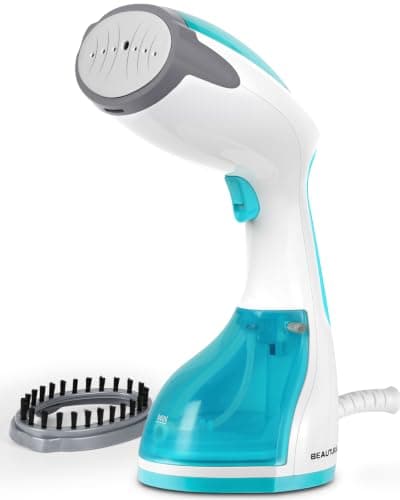
Beautural 1200W Handheld Steamer260 ml on a 1,200W handheld — the most run time per fill here, bought with output.
Tank capacity decides whether steaming is pleasant or annoying, and this carries 260 ml against the 190 to 216 ml the 1,875W units manage. More minutes per fill, fewer trips to the sink.
1,200 watts is a real step down from 1,875. On linen and heavy cotton you will feel it — the steam is wetter and you will make more passes. On the synthetics and knits that make up most wardrobes the difference is small.
Two pounds and 30 seconds to heat are both mid-table. Nothing here is remarkable except the tank, and the tank is the point.
Good
260 ml — the largest handheld tank in this set
30-second published heat-up, faster than the 1,875W Conair
Auto shut-off published as part of a nine-point safety design
Not good
1,200W struggles where 1,875W does not — linen especially
Filling means carrying the whole unit to the tap
Two pounds in the hand, the same as the far more powerful Conair
Who should not buy it. Skip this if linen or heavy cotton is most of what you own. Below about 1,500 watts you make three passes where a stronger unit makes one.
2. Handheld · The largest tank on a mid-power handheld
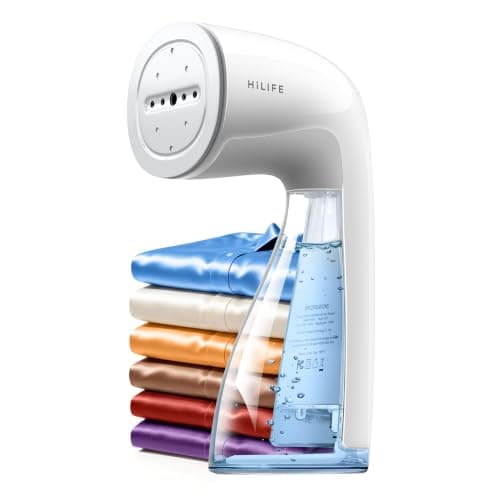
HiLIFE HL9 1100W Steamer
300 ml, 1,100 watts and 30 seconds — the HL7's three weaknesses answered.
HiLIFE does not publish weight for this model, so that figure is excluded from the score rather than estimated.
What the numbers mean
This is what the HL7 should have been: four hundred more watts, sixty more milliliters of tank, and a quarter of the heat-up time.
300 ml is the biggest handheld tank in this set. On a mid-power unit that is the right pairing — lower output empties a tank more slowly, so a big tank becomes real run time rather than a heavier device you refill just as often.
HiLIFE publishes no weight for this model. That is a gap, not something to infer: we have not held one and will not estimate it, so portability goes unscored.
Good
300 ml — the largest handheld tank here
30-second published heat-up, four times faster than the HL7
Leak-proof design published explicitly, which matters on a horizontal pass
Not good
No published weight, so portability cannot be scored
1,100W still sits below what linen wants
120V only
Who should not buy it. Skip this if you plan to travel with it. It is 120V only, and a dual-voltage travel unit costs less than the transformer you would otherwise need.
3. Handheld · The default handheld
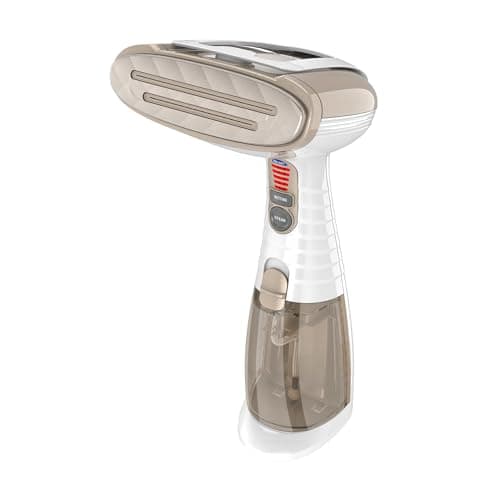
Conair Turbo ExtremeSteam GS59
The most-bought handheld in the category, and its published specs explain that rather than contradict it.
1,875 watts is the practical ceiling for a plug-in appliance on a US 15-amp circuit, and this unit sits right at it. Power is what turns water into dry steam fast enough to relax a fiber instead of soaking it, so on a handheld this is the figure that matters most.
The trade is the tank. 7.3 fluid ounces is a shade over 200 ml, which Conair pairs with a stated 20 minutes of run time. Call it two or three shirts before a refill.
40 seconds to heat is ordinary for this power class, not fast. The Rowenta Pure Force publishes a tenth of that at the same wattage.
Good
1,875W is the most power available in a handheld on a US circuit
Three attachments in the box, including a fabric brush for wool and a crease tool
Two-year limited warranty, which is unusual at this price
Not good
The tank is small for the power — high output empties it faster
40-second heat-up is beaten by several cheaper units
Over two pounds in the hand, which tells after a few garments
Who should not buy it. Skip this if you steam a whole rail at a time. At full output the tank runs dry before you get through a week of shirts, and a standing unit with a two-liter tank costs about the same.
4. Handheld · One machine instead of two
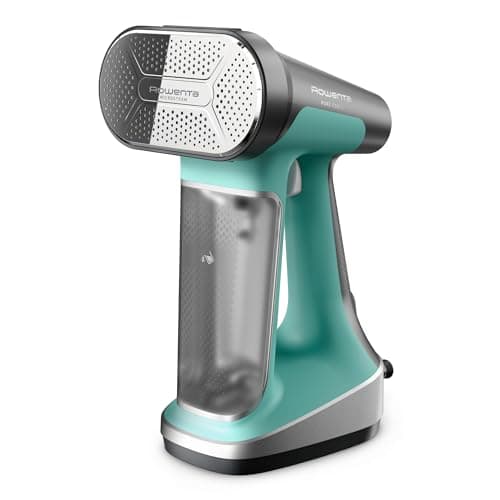
Rowenta Pure Force 2-in-1 DR8822
Steams vertically, presses horizontally, and publishes the fastest heat-up in this set by a factor of three.
Ten seconds to steam is the lowest published heat-up of anything on this page. If the thing that stops you steaming is the wait, this is the answer to it.
The horizontal plate is the real argument. A steamer relaxes a wrinkle; only contact and pressure will put a crease into a trouser leg or flatten a collar point. This does both, which is why for most wardrobes it genuinely replaces an iron and a board.
Three pounds is heavy for a handheld, and that weight is the soleplate. Judge it as a small iron that also steams, not as a light steamer that also presses.
Good
10-second published heat-up, the fastest on this site
Vertical steam and a horizontal press plate in one body
210 ml tank, larger than most 1,875W handhelds
Not good
Three pounds — the heaviest handheld here
A plate needs a surface, so it is not purely hang-and-go
Wider footprint than a pure steamer to store
Who should not buy it. Skip this if you only ever steam hanging garments. You would be carrying the weight of a soleplate you never put down.
5. Standing · A whole wardrobe at once
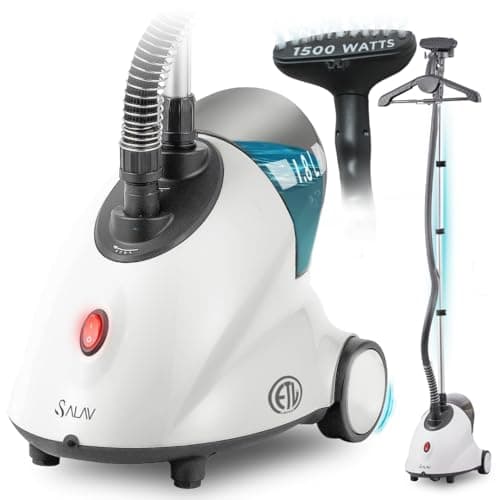
SALAV GS18 Full-Size Steamer
1.8 liters on a 65-inch pole — the point where steaming stops being a chore.
A 1.8 liter tank is roughly nine times what a good handheld carries. That is the entire argument for a standing steamer: fill it once and work through a rail without stopping.
SALAV publishes 60 minutes of steam per fill. Even discounted, that is an order of magnitude more than any handheld here.
Forty-five seconds to heat from 1,500 watts is respectable given the volume of water involved — a handheld is heating 200 ml, this is heating 1,800.
Good
1.8 liter tank — about an hour of continuous steam per the maker
65-inch pole holds a full-length dress or coat clear of the floor
1,500W with a published one-year warranty
Not good
Nine pounds and pole-mounted — this lives in one room
45-second heat-up is slower than the best handhelds
Assembly required, and the pole is what people complain about
Who should not buy it. Skip this if you steam two shirts a week. A standing unit you assemble and store is more machine than that job needs.
6. Handheld · A first steamer, cheaply
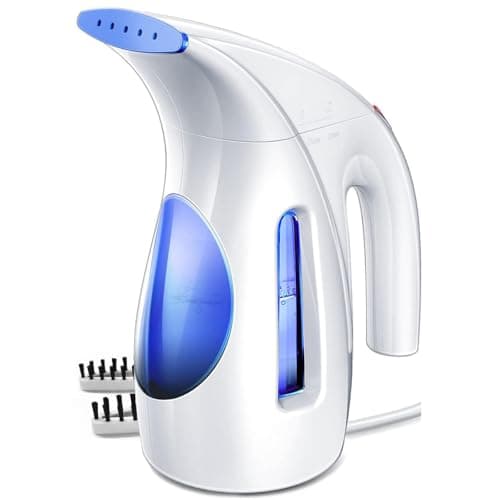
HiLIFE HL7 700W Steamer
A 240 ml tank on 700 watts, and an honest reason it costs what it costs.
700 watts is the floor for a device that can still be called a garment steamer. It will relax a jersey T-shirt or a polyester blouse. It will not persuade a linen shirt, and no amount of technique changes that.
The tank is genuinely generous for the money at 240 ml, and that is a large part of why the listing reviews as well as it does — it runs a long time at a low output.
Two minutes to heat is the slowest published handheld figure here. That is what low wattage means: the same water, less energy per second, more waiting.
Good
240 ml tank at the bottom of the price range
1.7 pounds — light enough for a long one-handed session
Among the most-bought steamer listings in the category
Not good
700W is not enough for linen, heavy cotton or a structured jacket
Two-minute published heat-up, the slowest handheld here
No published warranty term on the listing
Who should not buy it. Skip this if you bought it to handle dress shirts. It is a refresher for knits and synthetics, and expecting more is exactly how people conclude that steamers do not work.
The classic beginner mistake
The HiLIFE HL7 is last on this page deliberately, and it is the unit we would steer a beginner away from — not because it is badly made, but because it is the one most often bought for the wrong reason. It is the cheap, heavily-bought entry point, and at 700 watts with a published two-minute heat-up it is a refresher for knits and light synthetics.
Bought as that, it is fine and the generous 240 ml tank is genuinely good value. Bought as a first steamer to press cotton shirts, it produces exactly the damp, still-wrinkled result that convinces people steamers do not work. The HL9 is the same brand's answer to that: four hundred more watts, sixty more milliliters and a quarter of the heat-up time.
Your first ten minutes with it
Two habits separate a good first session from a frustrating one, and neither is obvious.
1Wait for the full heat-up before you startUsing a steamer before it reaches temperature is the single most common cause of spitting and water spots, because water arrives at the nozzle before it has become vapor. Wait the published time, then ten seconds more.
2Hold the fabric taut with your free handThis is the technique nobody mentions and it does half the work. Steam relaxes the fiber; something has to pull it straight while it is relaxed. A loose hanging panel just moves away from the vapor. Grip the hem or the cuff, apply light tension, and work downward.
Work about four to six inches from the fabric for cotton and wool, further for delicates. Closer is not stronger — it delivers water instead of steam. The full technique page covers the sequence, and the fabric guide tells you which of your clothes can take steam at all before you point anything at them.
What it costs to run
Almost nothing, and it is worth saying so because new buyers occasionally worry about it. Ten minutes on even the most powerful handheld here costs a few cents at the US average residential electricity rate. The arithmetic is shown in full, with the rate cited so you can substitute your own. Running cost is not a reason to choose one steamer over another — the reason to care about wattage is which fabrics it can handle.
Questions people actually ask
+What should I look for in my first garment steamer?
Four published figures: at least 1,000 watts, at least 240 ml of tank, a heat-up time of 40 seconds or less, and auto shut-off. Those four predict how a steamer feels to live with better than any other information on the listing.
+Is 1,000 watts enough for a garment steamer?
For knits, synthetics, silk, wool and everyday cotton, yes. For heavy cotton twill and canvas you want 1,500 W or more, and linen needs an iron at any wattage because flax has to be held in shape under pressure while it dries.
+Are garment steamers hard to use?
No, but two habits make the difference. Wait for the full published heat-up before starting, and hold the fabric taut with your free hand while you work. Steam relaxes the fiber; the tension is what pulls it straight.
+Why does my new steamer just make clothes damp?
Almost always insufficient power for the fabric. Below about 1,000 watts the water reaches the garment before enough heat does, so cotton gets wet rather than smooth. It is a specification mismatch rather than a technique problem or a fault.
+Should a beginner buy a steamer or an iron?
A steamer for knitwear, synthetics, dresses and wool tailoring, where it is genuinely the better tool. An iron for linen, heavy cotton and any crease you actually want. Most households want both eventually, and a 2-in-1 with a press plate covers the gap in one machine.
+How long does it take to steam a shirt?
About two minutes for the body and sleeves once the machine is hot, on a unit with enough power for the fabric. Collars and cuffs need contact and pressure, so those take an iron or a press plate rather than more steaming time.