The one job where a handheld genuinely runs out of road — and where the most powerful unit is not the one with the biggest wattage number.
By Scooter M., enthusiast, crease control · Published
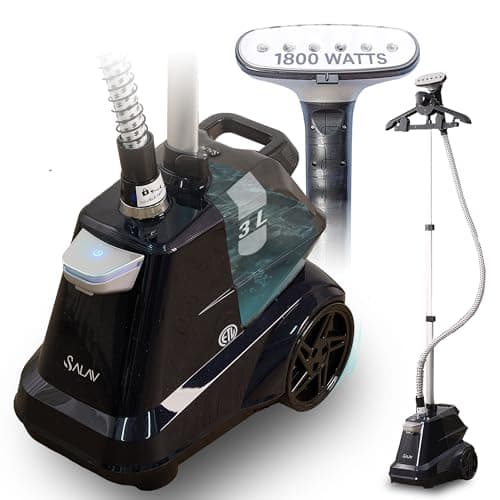
Buy on sustained output, not peak wattage — which usually means a standing steamer. Heavy fabric is not harder because it resists steam; it is harder because there is so much more of it and it needs repeated passes. An 1,875 W handheld has the power and runs dry in about seven minutes of continuous use. A 1,500 W upright has less peak power and works for an hour. On a wool overcoat or a pair of interlined drapes, the upright wins every time. The SALAV X3A at 3 liters is the pick.
We earn a commission if you buy through the links on this page, at no extra cost to you. It does not change which steamer we rank first — the ranking comes from published specifications and the arithmetic on our method page. We have not tested these units. Full disclosure.
How this list was judged
Tank capacity above everything. Heavy fabric means long sessions, and a refill on a hot handheld means waiting for it to cool first.
Sustained rather than peak output. A 1,500 W element running for an hour delivers vastly more total steam than an 1,875 W one running for seven minutes.
Working height. A coat on a rail at chest height is a different job from a shirt held in your free hand. Uprights hold the garment for you.
Published specifications, complete. Every figure here is read off the product's own live listing; a gap is recorded as a gap, never estimated.
Currently purchasable, verified against the live listing before publication.
Why peak wattage is the wrong number here
This is the counterintuitive part and it is worth the paragraph. Wattage tells you how fast a machine can turn water into steam. It does not tell you how much steam you can get out of it before you stop to refill, and on heavy fabric the second number is the one that constrains you.
The arithmetic: a 1,875 W element boils roughly 30 ml of water per minute at full output. A 216 ml handheld tank is therefore about seven minutes of continuous steam. A 1.8 liter upright at 1,500 W is about an hour, and a 3 liter one longer still. A wool overcoat is not a seven-minute job. Neither is a pair of lined curtains, and the curtains page makes the same argument from the other direction.
What counts as heavy, and what each needs
Heavy fabrics and what they want
Fabric
Tool
Approach
Wool overcoat
Standing
Full length on a rail, top to bottom, several passes
Off-category. That is a steam cleaner, a different machine entirely
Two rows say the honest answer is not a garment steamer. Heavy cotton canvas genuinely wants an iron, and we would rather say so than sell you an upright that will not fix it.
Technique changes on heavy cloth
Three things differ from steaming a shirt, and getting them wrong is the usual reason someone concludes their machine is underpowered when it is not:
1Work closer, at four to six inchesThe distances this site recommends for silk and knits are about protecting the fabric. Heavy wool and canvas have no such fragility, and steam loses heat fast across an air gap.
2Make more passes, not slower onesDwelling in one spot saturates the face of the cloth without reaching its core. Several moderate passes put more total energy in and leave the garment drier.
3Use the garment's own weightA heavy coat on a hanger is already pulling itself straight — far more effectively than your hand can on a shirt. Let it hang and work down the length.
4Give it real drying timeA thick garment holds a lot of moisture and dries slowly. Wearing a damp wool coat is how it stretches at the elbows and seat. The wool page is specific about this.
Why the picks are what they are
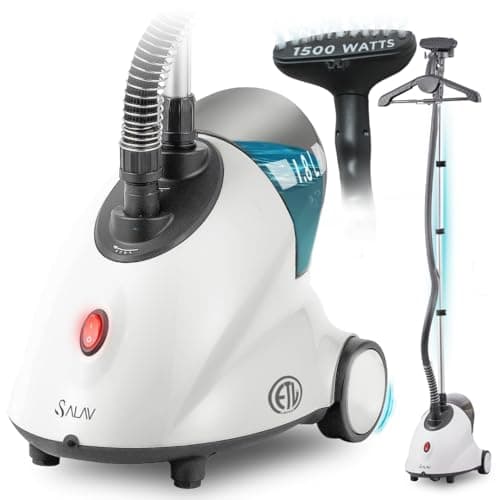
The SALAV X3A leads on the only specification that really matters here: 3 liters at 1,800 watts, which is the most tank and the most power of any domestic machine on this site. It also has foot pedals and a full-height pole, so a coat hangs at working height. The costs are blunt — it is seventy and a half inches assembled, it does not fold, and at twelve pounds it stays in whichever room you build it.
The SALAV GS18 is the same argument at a smaller scale: 1.8 liters at 1,500 watts and a published one-year warranty, in a nine-pound body. About an hour of continuous work, which covers a coat and a pair of curtains in one session. If your ceilings are low, this is the one to buy.
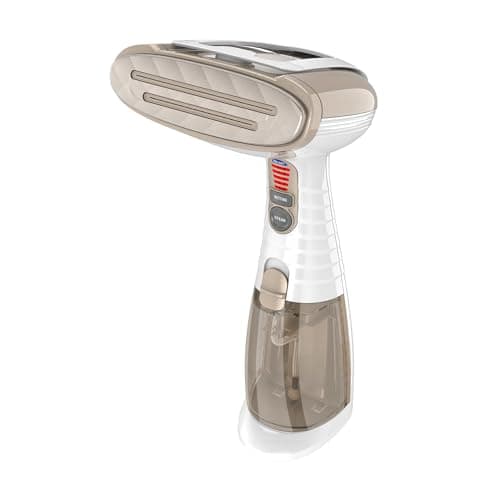
The Conair Turbo ExtremeSteam is here as the handheld that copes best, not as a recommendation to use a handheld for this. At 1,875 watts it has the most peak power available on a US circuit, three attachments and a published two-year warranty. Its 216 ml tank is the whole limitation: expect to refill, and expect to wait for it to cool before you do.
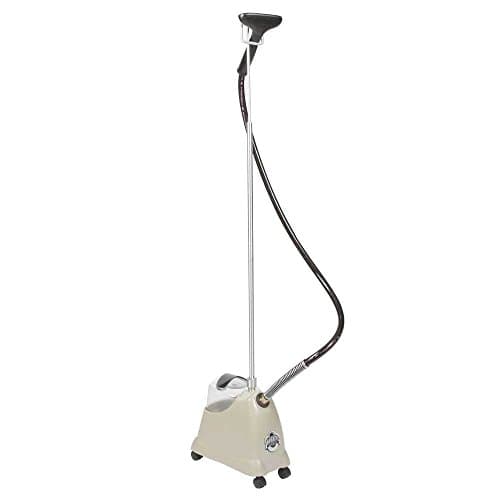
The Jiffy J-2000 is included because it is the machine the trade actually buys, with a 2.84-liter metal boiler and a three-year warranty against a category norm of one. It draws only 1,300 watts and costs several times the SALAV. For daily professional use that is the right trade. For a coat twice a winter it is emphatically not, and we would not buy it for that.
The picks
Ranked on published specifications. Tap a row for the full write-up; the price button goes to Amazon.
#
Product
Best for
Spec score
Price
1
SALAV X3A Commercial-Style SteamerThree liters, 1,800 watts and foot pedals — a commercial layout at a domestic price.
Three liters is the largest tank we found outside the true commercial machines, and 1,800 watts is the practical ceiling for a US household circuit at this size.
Foot pedals matter more than they sound. Steaming a rail means constantly starting and stopping, and doing that without setting the head down is the difference between an hour and ninety minutes.
Seventy and a half inches tall. Measure the ceiling before you buy — this is nearly six feet of assembled pole.
Good
3 liter tank, the largest here outside the Jiffy
1,800W — the most power of any standing unit in this set
Foot pedal control, rare below commercial prices
Not good
Twelve pounds and 70.5 inches — it does not get put away
45 seconds to heat three liters, so it is not a grab-and-go
One-year warranty against the Jiffy's three
Who should not buy it. Skip this if your ceilings are low or your storage is a closet. Seventy inches assembled is a piece of furniture.
2. Standing · A whole wardrobe at once
SALAV GS18 Full-Size Steamer
1.8 liters on a 65-inch pole — the point where steaming stops being a chore.
A 1.8 liter tank is roughly nine times what a good handheld carries. That is the entire argument for a standing steamer: fill it once and work through a rail without stopping.
SALAV publishes 60 minutes of steam per fill. Even discounted, that is an order of magnitude more than any handheld here.
Forty-five seconds to heat from 1,500 watts is respectable given the volume of water involved — a handheld is heating 200 ml, this is heating 1,800.
Good
1.8 liter tank — about an hour of continuous steam per the maker
65-inch pole holds a full-length dress or coat clear of the floor
1,500W with a published one-year warranty
Not good
Nine pounds and pole-mounted — this lives in one room
45-second heat-up is slower than the best handhelds
Assembly required, and the pole is what people complain about
Who should not buy it. Skip this if you steam two shirts a week. A standing unit you assemble and store is more machine than that job needs.
3. Handheld · The default handheld
Conair Turbo ExtremeSteam GS59
The most-bought handheld in the category, and its published specs explain that rather than contradict it.
1,875 watts is the practical ceiling for a plug-in appliance on a US 15-amp circuit, and this unit sits right at it. Power is what turns water into dry steam fast enough to relax a fiber instead of soaking it, so on a handheld this is the figure that matters most.
The trade is the tank. 7.3 fluid ounces is a shade over 200 ml, which Conair pairs with a stated 20 minutes of run time. Call it two or three shirts before a refill.
40 seconds to heat is ordinary for this power class, not fast. The Rowenta Pure Force publishes a tenth of that at the same wattage.
Good
1,875W is the most power available in a handheld on a US circuit
Three attachments in the box, including a fabric brush for wool and a crease tool
Two-year limited warranty, which is unusual at this price
Not good
The tank is small for the power — high output empties it faster
40-second heat-up is beaten by several cheaper units
Over two pounds in the hand, which tells after a few garments
Who should not buy it. Skip this if you steam a whole rail at a time. At full output the tank runs dry before you get through a week of shirts, and a standing unit with a two-liter tank costs about the same.
4. Commercial · Buying once
Jiffy J-2000 Commercial Steamer
2.84 liters, a metal boiler and a three-year warranty — the machine the dry cleaner owns.
The three-year warranty is the specification that separates this from everything else on the site. Every other unit here publishes one or two years, or nothing at all.
2.84 liters is the largest published tank in this set, and Jiffy rates the machine at roughly two hours of continuous steam.
Two minutes to heat is slow, and that is what heating nearly three liters in a metal boiler costs. This is a machine you switch on and then go and sort the rail.
Good
2.84 liter tank — the largest here
Three-year warranty, three times the category norm
Metal boiler rather than a molded plastic tank
Not good
Two-minute heat-up, the slowest here
1,300W is lower than the 1,800W domestic uprights
Costs several times what a good handheld costs
Who should not buy it. Skip this if the machine will sit idle most weeks. It is built for daily use and the price only makes sense against that.
Questions people actually ask
+What is the most powerful garment steamer?
On peak wattage, the 1,875 W handhelds from Conair and Rowenta — that is the ceiling for a plug-in appliance on a US 15-amp circuit. On total steam delivered in a session, a standing unit wins easily: a 3-liter upright at 1,800 W works for well over an hour where a 216 ml handheld manages about seven minutes.
+What is the best steamer for thick fabric?
A standing steamer, chosen on tank capacity. Thick fabric is not harder to steam so much as there is far more of it, needing repeated passes over a long session. The SALAV X3A's 3 liters is the most capacity of any domestic machine on this site.
+Can a garment steamer handle a winter coat?
A standing one, comfortably — hang it full length and work top to bottom, letting the coat's own weight pull the drop straight. A handheld will manage it but will need refilling partway, which means waiting for the unit to cool first.
+Will a steamer work on canvas or heavy cotton twill?
Not really, and this is one of the places we say so plainly. Those fabrics are too dense for vertical steam to reach the middle of the cloth. An iron with pressure is the right tool, and no amount of extra wattage changes it.
+Is a commercial steamer more powerful than a domestic one?
Usually the opposite. The Jiffy J-2000 draws 1,300 watts against 1,800 on a domestic SALAV upright of similar tank size. Commercial machines are built for continuous daily duty with a metal boiler and a three-year warranty, not for higher output.