Steam refreshes a sofa. It does not shampoo one. Getting that distinction right is most of the buying decision.
By Scooter M., enthusiast, crease control · Published
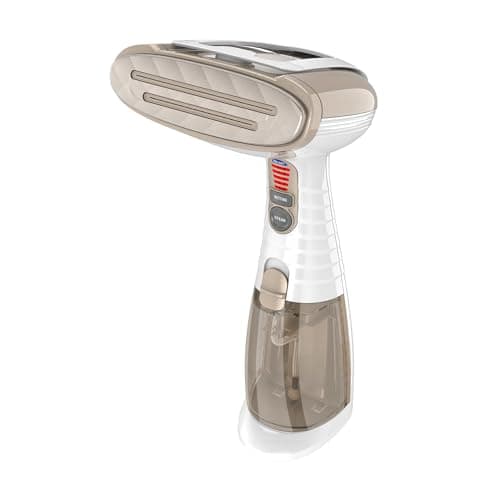
Buy a handheld with a fabric-brush attachment, and buy it knowing what it does. A garment steamer refreshes upholstery — it relaxes creases in slipcovers, lifts crushed pile on velvet furniture, knocks back odor and applies heat to a surface — but it is not an upholstery cleaner and will not extract a stain. For that distinction to make sense of the specs: you want a brush attachment, a 1,000 W-plus heater and a tank you are not refilling every ten minutes. The Conair Turbo ExtremeSteam is the obvious pick because it is the one unit here whose own listing names upholstery.
We earn a commission if you buy through the links on this page, at no extra cost to you. It does not change which steamer we rank first — the ranking comes from published specifications and the arithmetic on our method page. We have not tested these units. Full disclosure.
Refreshing is not cleaning, and the difference is extraction
This is the single most misunderstood thing in the category, and it is worth being blunt about because it decides whether you are happy with your purchase. A garment steamer produces vapor and puts it on a surface. An upholstery cleaner produces vapor or solution and then sucks it back out, carrying the dirt with it. The second machine has a vacuum; the first does not.
So a garment steamer on a sofa will: relax wrinkles in a loose cover, raise crushed nap, apply enough heat to be useful against dust mites, and reduce the smell of a room. It will not: remove a coffee ring, lift ground-in dirt from a seat cushion, or make a grubby armrest look new. Steam without extraction just moves a stain around and wets it, and on some fabrics that makes the mark bigger. The steamer versus steam cleaner page sets out the machine difference in full.
What actually decides this purchase
Upholstery flips the usual priority order. On clothes, power decides what fabrics you can handle; on furniture, most of the fabric is polyester, microfiber or a cotton blend that a mid-range unit relaxes without difficulty. What changes is the geometry of the job — you are working on horizontal surfaces, into corners, under cushions and around arms, for a long stretch at a time.
What matters, in order, for furniture rather than clothes
Specification
Why it matters here
What to look for
Brush attachment
A brush holds the fabric under light tension and lets you agitate the nap — the thing that actually revives a flattened cushion
A fabric or upholstery brush in the box
Tank capacity
A three-seat sofa is far more square footage than a shirt; refills are the whole frustration
200 ml minimum handheld, or a standing tank
Horizontal operation
Furniture is not vertical. Many handhelds spit when tilted past level
A listing that states any-angle or 360-degree use
Weight
You will hold it for twenty minutes, not two
Under two pounds if you can get it
Cord length
Sofas sit in the middle of rooms, away from outlets
Check it, or plan on an extension cord
Wattage matters less here than almost anywhere else on this site — which is why the cheapest pick on this page is still a sensible buy.
Not every sofa can be steamed
Furniture carries a cleaning code, usually on a tag under a cushion or beneath the frame, and it governs this decision more than any specification does. Read it before you plug anything in.
Upholstery cleaning codes
Code
Means
Steam?
W
Water-based cleaning is safe
Yes — the straightforward case
WS
Water or solvent
Yes, with a light hand
S
Solvent only — water will mark it
No. Water rings are the exact failure this code warns about
X
Vacuum only — no liquid of any kind
No. Nothing wet, ever
No tag? Test on the back of the sofa or the underside of a cushion, wait for it to dry fully, and look at it in daylight before committing.
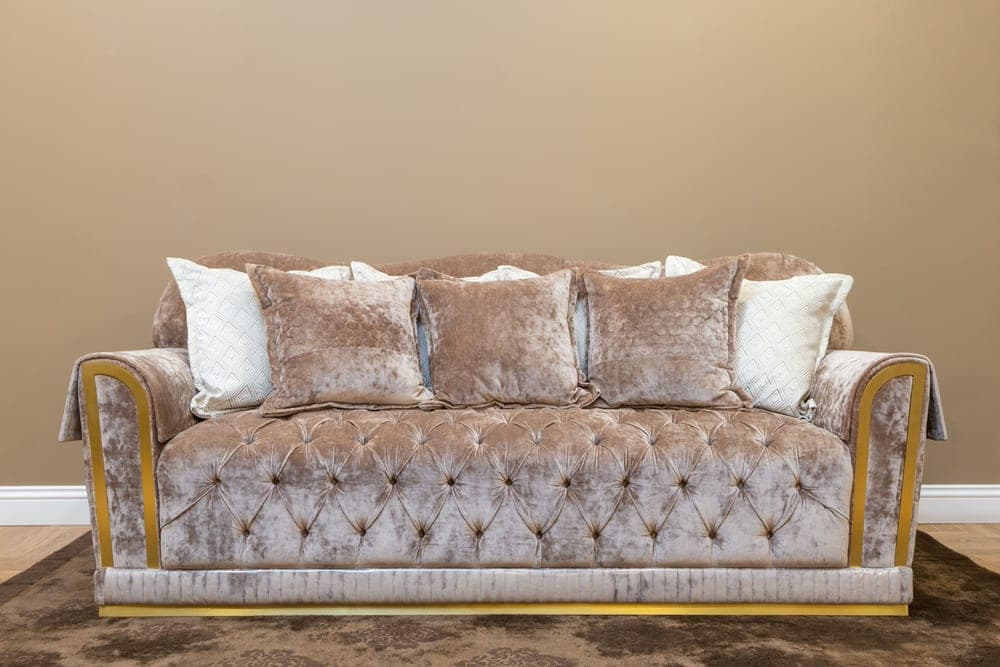
Beyond the code, three materials need naming. Leather must not be steamed — heat and moisture together dry out the finish and can lift it, and the leather page explains why. Suede is worse still, for the same reasons as on a jacket. Velvet and velour furniture can be steamed but only at a distance and never with the head touching, because crushed pile on a sofa is a large and very visible area of damage; the velvet page has the method.
Slipcovers are the best case, and the easiest win
If your furniture wears removable covers, this is the job a garment steamer does best and the reason many people buy one. A washed slipcover comes out of the dryer creased and fits terribly; it also shrinks slightly and fights you going back on.
Put the cover back on the furniture while it is very slightly damp, then steam it in place. The cover relaxes, stretches to the frame and dries in exactly the shape of the piece — which no amount of ironing on a board will achieve, because a board is flat and a sofa is not. That is the whole trick, and it works on dining-chair covers, headboard covers and fitted sheets on a mattress too.
How to do it
1Vacuum first, thoroughlySteam turns loose surface dust into damp grime that then sits in the weave. Vacuum the whole piece, including under the cushions, before any moisture goes near it.
2Find the code tag and testUnder a cushion or under the frame. If there is no tag, test somewhere hidden and let it dry completely before you judge the result.
3Fit the brush attachment and let the unit heat fullyA head that has not reached temperature spits water, and a water droplet on upholstery is a ring. Wait for the ready light or the full stated heat-up.
4Work in overlapping passes, keeping movingTwo to four inches away with the brush touching lightly. Never dwell — dwelling is how you saturate the foam underneath rather than treating the surface.
5Brush the nap back while it is warmOn velvet, microfiber and chenille the pile is directional. Sweep it one way with the brush as you go, and the finish stays even.
6Dry it before anyone sits downOpen a window or run a fan. Damp foam is slow to dry and it is where furniture smells come from, so this step is not optional.
Mattresses, car seats and the rest
The same machine and the same rules cover most soft furnishings. A mattress takes steam well for freshening — vacuum, brief passes, dry completely before you make the bed, because a damp mattress is a genuinely bad outcome. Car upholstery is usually a polyester weave and steams easily, but the enclosed space dries slowly, so do it with the doors open on a warm day. Cushions and throw pillows are the easiest job on the list.
The one thing to be careful with is anything foam-backed or glued — some car headliners and cheap furniture panels use adhesives that soften with sustained heat. Brief passes, not dwelling.
Why the picks are what they are
The Conair Turbo ExtremeSteam leads because it is the only unit on this site whose own product title names upholstery, it ships with three attachments including a fabric brush, and it publishes a two-year warranty — the longest of any handheld here. It is also the heaviest handheld we cover at 2.27 pounds, which is a real cost over a long session.
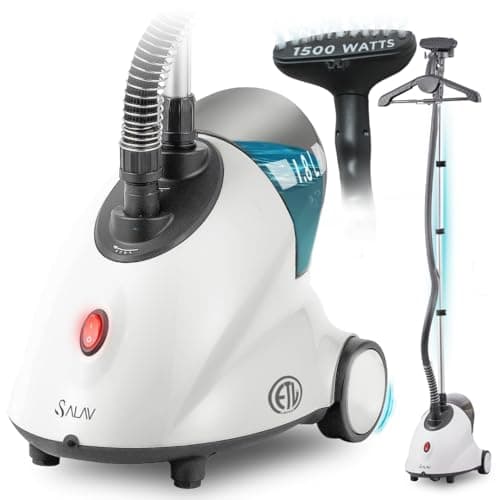
The SALAV GS18 is here for anyone doing a whole room rather than a chair: 1,800 ml of tank against the Conair's 216 means you work for an hour without touching a tap. It is a nine-pound upright on wheels, so it is a piece of household equipment rather than something you keep in a drawer.
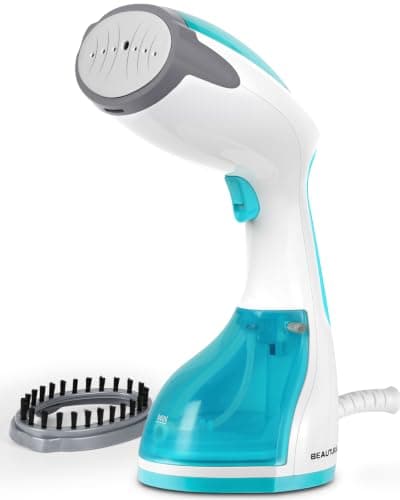
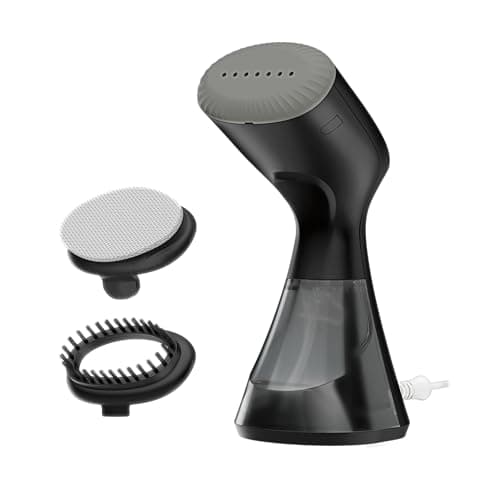
The Beautural 1200W is the balance pick — 260 ml at 1,200 W and two pounds, published warranty, and the most tank of any handheld at its weight. The Conair GS81L is the light-duty option at 1.3 pounds; its listing publishes no tank capacity at all, which costs it in our scoring, but for a chair and a pair of cushions it is the easiest thing here to pick up.
The picks
Ranked on published specifications. Tap a row for the full write-up; the price button goes to Amazon.
#
Product
Best for
Spec score
Price
1
Conair Turbo ExtremeSteam GS59The most-bought handheld in the category, and its published specs explain that rather than contradict it.
1,875 watts is the practical ceiling for a plug-in appliance on a US 15-amp circuit, and this unit sits right at it. Power is what turns water into dry steam fast enough to relax a fiber instead of soaking it, so on a handheld this is the figure that matters most.
The trade is the tank. 7.3 fluid ounces is a shade over 200 ml, which Conair pairs with a stated 20 minutes of run time. Call it two or three shirts before a refill.
40 seconds to heat is ordinary for this power class, not fast. The Rowenta Pure Force publishes a tenth of that at the same wattage.
Good
1,875W is the most power available in a handheld on a US circuit
Three attachments in the box, including a fabric brush for wool and a crease tool
Two-year limited warranty, which is unusual at this price
Not good
The tank is small for the power — high output empties it faster
40-second heat-up is beaten by several cheaper units
Over two pounds in the hand, which tells after a few garments
Who should not buy it. Skip this if you steam a whole rail at a time. At full output the tank runs dry before you get through a week of shirts, and a standing unit with a two-liter tank costs about the same.
2. Standing · A whole wardrobe at once
SALAV GS18 Full-Size Steamer
1.8 liters on a 65-inch pole — the point where steaming stops being a chore.
A 1.8 liter tank is roughly nine times what a good handheld carries. That is the entire argument for a standing steamer: fill it once and work through a rail without stopping.
SALAV publishes 60 minutes of steam per fill. Even discounted, that is an order of magnitude more than any handheld here.
Forty-five seconds to heat from 1,500 watts is respectable given the volume of water involved — a handheld is heating 200 ml, this is heating 1,800.
Good
1.8 liter tank — about an hour of continuous steam per the maker
65-inch pole holds a full-length dress or coat clear of the floor
1,500W with a published one-year warranty
Not good
Nine pounds and pole-mounted — this lives in one room
45-second heat-up is slower than the best handhelds
Assembly required, and the pole is what people complain about
Who should not buy it. Skip this if you steam two shirts a week. A standing unit you assemble and store is more machine than that job needs.
3. Handheld · The biggest tank in the class
Beautural 1200W Handheld Steamer
260 ml on a 1,200W handheld — the most run time per fill here, bought with output.
Tank capacity decides whether steaming is pleasant or annoying, and this carries 260 ml against the 190 to 216 ml the 1,875W units manage. More minutes per fill, fewer trips to the sink.
1,200 watts is a real step down from 1,875. On linen and heavy cotton you will feel it — the steam is wetter and you will make more passes. On the synthetics and knits that make up most wardrobes the difference is small.
Two pounds and 30 seconds to heat are both mid-table. Nothing here is remarkable except the tank, and the tank is the point.
Good
260 ml — the largest handheld tank in this set
30-second published heat-up, faster than the 1,875W Conair
Auto shut-off published as part of a nine-point safety design
Not good
1,200W struggles where 1,875W does not — linen especially
Filling means carrying the whole unit to the tap
Two pounds in the hand, the same as the far more powerful Conair
Who should not buy it. Skip this if linen or heavy cotton is most of what you own. Below about 1,500 watts you make three passes where a stronger unit makes one.
4. Handheld · Small spaces
Conair 1100W Compact Steamer GS81
1.3 pounds and 30 seconds to steam — with a tank figure Conair does not publish.
Conair does not publish tank capacity for this model, so that figure is excluded from the score rather than estimated.
What the numbers mean
At 1.3 pounds this is the lightest full-size handheld here, and 1,100 watts handles the knits, synthetics and light cotton that make up most wardrobes.
Conair publishes no tank capacity for this model. That is a real hole in a spec sheet — tank size is the single best predictor of whether a session is pleasant — and it costs the unit a metric in our scoring rather than earning it a guess.
Nine inches tall. It fits in a drawer, which is most of the argument for a compact steamer.
Good
1.3 pounds, the lightest non-travel handheld here
30-second published heat-up
Nine inches tall — genuinely drawer-sized
Not good
No published tank capacity, so run time is unknowable from the specs
1,100W is mid-table output
Compact bodies mean small tanks, and the silence is not reassuring
Who should not buy it. Skip this if run time matters to you. Until Conair publishes a tank figure there is no way to know what you are buying.
Questions people actually ask
+Can you use a garment steamer on upholstery?
Yes, for refreshing — relaxing creases in covers, lifting crushed pile, knocking back odor. It is not an upholstery cleaner: it has no vacuum, so it cannot extract dirt or a stain. Check the furniture's cleaning code first, and never steam a piece coded S or X.
+Will a steamer clean my sofa?
No. Cleaning requires extraction, which means a machine that sucks the moisture and soil back out. A garment steamer only puts vapor in. Steaming over a stain can set it permanently, so clean first and steam afterward.
+Can you steam a leather sofa?
No. Heat and moisture together dry out the finish on leather and can cause it to crack or lift. The same goes for suede furniture. Use a leather cleaner and conditioner made for the purpose.
+How do you get wrinkles out of a sofa slipcover?
Put the cover back on the furniture slightly damp and steam it in place. It relaxes, stretches to the frame and dries in the shape of the piece, which is something you cannot achieve on a flat ironing board.
+How long does upholstery take to dry after steaming?
It should be barely damp rather than wet, so an hour or two with air moving. If it is still wet after that you used too much steam and dwelled too long in one place.