A daily-worn poly-cotton garment is close to the ideal case for steam. Then there is the crease, which changes the answer completely.
By Scooter M., enthusiast, crease control · Published
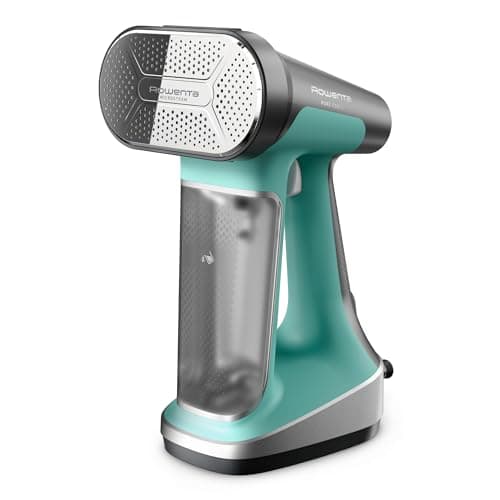
It depends on one question: does your uniform need a crease? If it does not — scrubs, school polos, hospitality, most corporate wear — buy a 1,000 W-plus handheld and you are done in three minutes a morning. If it does — military, police, some security and cadet uniforms — no vertical steamer can make one, because a crease is made by pressure and a steamer applies none. That case wants a 2-in-1 with a press plate, which is why the Rowenta Pure Force leads this page: 1,875 W of vertical steam and a horizontal plate in one body.
We earn a commission if you buy through the links on this page, at no extra cost to you. It does not change which steamer we rank first — the ranking comes from published specifications and the arithmetic on our method page. We have not tested these units. Full disclosure.
What a uniform is, fabric-wise
Uniforms are overwhelmingly polyester-cotton blends, usually somewhere between 65/35 and 50/50, and that is not an accident. The polyester supplies wrinkle resistance, color retention through industrial washing and dimensional stability; the cotton supplies breathability and a surface that does not feel like a bin liner. It is the single most steam-friendly fabric family there is.
The rule that follows is the one used everywhere on this site: treat a blend as the more fragile of its fibers. Polyester is a thermoplastic, so it wants a medium setting and no direct iron contact without a pressing cloth — heat on the surface glazes it, and a glazed patch on a navy uniform shirt is permanent and highly visible. The polyester page has the detail; the practical version is that steam is genuinely the better tool here, not a compromise.
The crease problem, which decides the purchase
This is the part most roundups on this query skip, and it is the only part that changes what you should buy. A steamer cannot make a crease. Steam breaks the hydrogen bonds holding a wrinkle and then lets the fabric's own weight pull it straight — the fiber returns toward its resting shape. A crease is the opposite operation: the fabric is held in a new, deliberate fold under pressure while it cools, so the fiber sets into a shape it did not have before. Only contact and weight do that. The steamer-versus-iron hub works through the mechanism.
So if your uniform is inspected for sleeve creases, a trouser crease or a sharp shirt front, a vertical steamer will get you a clean, relaxed, wrinkle-free garment that still fails inspection. That is not a defective machine; it is the wrong machine, and buying it on the strength of a roundup that never mentions this is how people conclude steamers do not work.
By uniform type
Uniform
Tool
Setting
Watch for
Scrubs and medical
Steamer
Medium
Steam does not sanitize — see below
School polo, shirt, skirt
Steamer
Medium
Heat-transfer crests and printed logos
Hospitality and retail
Steamer
Medium
Name badges left pinned on
Corporate / airline
Steamer, plus a plate for the collar
Medium
Structured jackets need distance
Military and cadet
Plate or iron for the creases; steam the body
Medium
Regulation crease placement, patches
Police and security
Plate or iron for the creases; steam the body
Medium
Badges, embroidery, duty-shirt panels
Hi-vis and safety wear
Steamer, at a distance
Low-medium
Reflective tape — the real hazard
Chef whites and aprons
Steamer or iron
High
Heavy cotton twill needs power
Where a garment carries a care label, the label wins. It is a legal requirement that the maker hold a reasonable basis for the instruction, which is more than can be said for most advice about uniforms.
Badges, patches, name tapes and reflective tape
This is the hazard specific to uniforms, and it is barely covered anywhere. The fabric is usually the most robust thing on the garment. What is attached to it is not.
Heat-applied patches and name tapes are held on by an adhesive film that was activated with heat in the first place. Sustained direct heat softens it again, and a patch that has lifted at one corner does not go back down flat. Steam from six to eight inches and never let the head rest on one.
Reflective and retroreflective tape on hi-vis, fire and EMS wear is a plastic film with a microscopic optical structure in it. That structure is what makes it reflect, and it is the part that heat damages — tape can cloud, shrink or lift, and the garment quietly stops doing its safety job while still looking fine in daylight. Work around it, not over it, and never press it.
Screen-printed and vinyl logos on school and sports kit soften under direct heat and will take an impression from a soleplate. Steam is the safer instrument precisely because it never touches.
Embroidery is generally fine, but steam it from the reverse where you can — the stitching stands proud and a head held close will flatten and shine it.
Metal badges, pins and zip pulls get hot, stay hot, and can mark the fabric under them. Take them off. This costs ten seconds.
Does steaming sanitize a uniform?
No, and it is worth being blunt about because it is the most common assumption people bring to this query — particularly with scrubs. A garment steamer knocks back odor, which is genuinely useful, and it applies heat to a surface briefly. It does not sanitize, disinfect or clean.
The reason is dwell time and temperature at the fabric, not at the nozzle. Steam leaves the head at boiling point and loses heat immediately as it expands and mixes with room air; by the time it reaches fabric six inches away it is a warm, moist plume rather than a sustained thermal load. Disinfection needs a temperature held for a period, which is what a wash cycle does and a passing steam plume does not. The steamer-versus-steam-cleaner page sets out the machine difference — a steam cleaner runs hotter and under pressure, for exactly this kind of reason.
Practically: steam a uniform to make it look right and smell fresh between wears. Wash it to make it clean. If you work somewhere with a laundering protocol, that protocol exists because a steamer is not a substitute for it.
Permanent-press finishes, and why some uniforms barely wrinkle
Many modern uniforms carry a wrinkle-resistant or permanent-press finish — a resin cross-linking treatment applied to the fabric that stops the fibers moving into a wrinkled configuration in the first place. If your uniform comes out of the dryer looking almost ready, that is what you are seeing.
Two consequences. First, those garments need very little steam, and over-working them wastes your morning. Second — and this catches people out — a permanent-press finish resists creases as well as wrinkles. If a treated trouser fights you when you try to press a crease into it, the finish is doing its job. That is a fabric limitation, not a technique failure, and no amount of extra heat will change it.
The three-minute morning routine
1Hang it the night beforeA uniform hung straight overnight loses a surprising amount on its own. This step costs nothing and removes about a third of the work.
2Take the badges and pins offTen seconds, and it removes the only part of the garment that can be permanently marked by heat.
3Let the head reach temperature before it goes near the fabricA head that is not fully hot spits water rather than delivering vapor, and a water spot on a poly-cotton shirt shows. The fast-heating units make this a ten to thirty second wait.
4Work top to bottom, holding the fabric tautFree hand behind the panel, pulling gently. Steam relaxes the fiber and something has to pull it straight — that is the single technique that separates a good result from a damp one.
5Do the collar, cuffs and placket last, with the plateIf you have a 2-in-1, this is where the plate earns its weight. If you do not, this is where you accept a soft collar or reach for an iron.
6Give it five minutes on the hanger before you put it onWarm damp fabric takes the shape of whatever you do next. Five minutes hanging is the difference between a crisp shirt and one creased at the elbows by 9 a.m.
How many sets do you own?
This is the question that decides tank capacity, and uniform wearers answer it differently from everyone else — most own three to five sets and do them in one sitting rather than one garment at a time.
Refilling is not merely inconvenient on a handheld: the vessel is under pressure while hot, so a mid-session refill means a genuine wait. The safety page covers why.
Why the picks are what they are
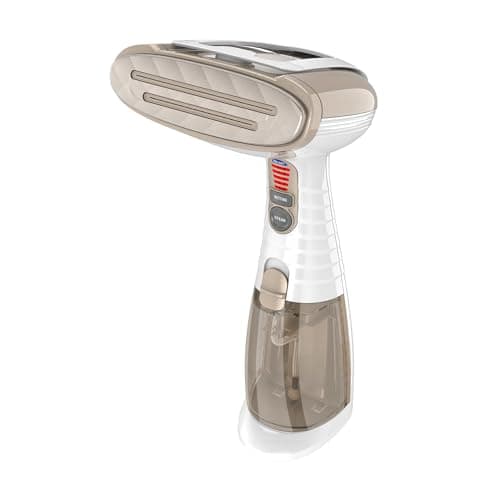
The Rowenta Pure Force 2-in-1 leads because it is the only machine here that answers both halves of the uniform question. It publishes 1,875 W of vertical steam for the body of the garment, a horizontal press plate for the collar, cuffs and any regulation crease, and a 10-second heat-up — the fastest published figure on this site by a factor of three, which matters more on a weekday morning than any other specification. It costs you three pounds in the hand, the heaviest handheld we cover, and a plate needs a surface, so it is not purely hang-and-go.
The Conair Turbo ExtremeSteam is the pick if your uniform needs no crease. Same 1,875 W, a slightly larger 216 ml tank, three attachments including a fabric brush, and a published two-year warranty — the longest of any handheld here, which is worth something on a machine used five mornings a week. It is 2.27 pounds and takes 40 seconds to heat, so it is slower off the mark than the Rowenta.
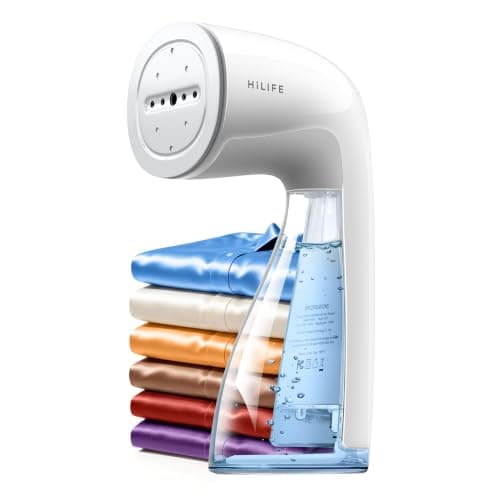
The HiLIFE HL9 is the value option and the best choice for a Sunday session: 300 ml is the largest handheld tank on this site, which is the difference between doing five shirts in one go and stopping halfway. The honest costs are 1,100 W rather than 1,875 — fine for poly-cotton, short of what heavy cotton twill wants — and no published weight at all, which costs it a metric in our scoring and which we will not fill in with a guess.
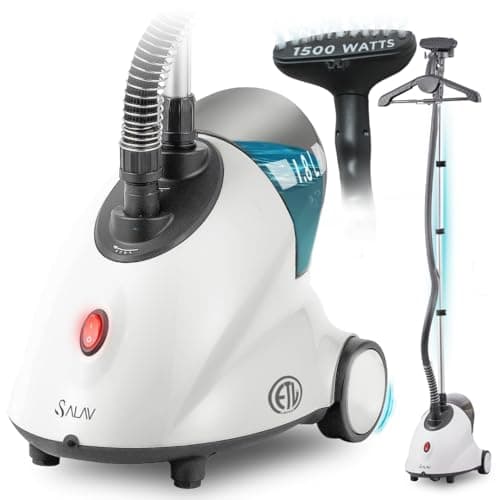
The SALAV GS18 is here for households doing several people's uniforms. 1,800 ml at 1,500 W is roughly an hour of continuous work, and the upright form factor means the garment hangs at working height rather than in your other hand. It is a nine-pound, 65-inch piece of household equipment that does not fold away — that is the real cost, and it is why it is fourth rather than first.
What none of them does is put a crease in a permanent-press trouser that has been treated to resist one, or make a garment clean. Both limits are the fabric and the physics rather than the machine.
The picks
Ranked on published specifications. Tap a row for the full write-up; the price button goes to Amazon.
#
Product
Best for
Spec score
Price
1
Rowenta Pure Force 2-in-1 DR8822Steams vertically, presses horizontally, and publishes the fastest heat-up in this set by a factor of three.
Ten seconds to steam is the lowest published heat-up of anything on this page. If the thing that stops you steaming is the wait, this is the answer to it.
The horizontal plate is the real argument. A steamer relaxes a wrinkle; only contact and pressure will put a crease into a trouser leg or flatten a collar point. This does both, which is why for most wardrobes it genuinely replaces an iron and a board.
Three pounds is heavy for a handheld, and that weight is the soleplate. Judge it as a small iron that also steams, not as a light steamer that also presses.
Good
10-second published heat-up, the fastest on this site
Vertical steam and a horizontal press plate in one body
210 ml tank, larger than most 1,875W handhelds
Not good
Three pounds — the heaviest handheld here
A plate needs a surface, so it is not purely hang-and-go
Wider footprint than a pure steamer to store
Who should not buy it. Skip this if you only ever steam hanging garments. You would be carrying the weight of a soleplate you never put down.
2. Handheld · The default handheld
Conair Turbo ExtremeSteam GS59
The most-bought handheld in the category, and its published specs explain that rather than contradict it.
1,875 watts is the practical ceiling for a plug-in appliance on a US 15-amp circuit, and this unit sits right at it. Power is what turns water into dry steam fast enough to relax a fiber instead of soaking it, so on a handheld this is the figure that matters most.
The trade is the tank. 7.3 fluid ounces is a shade over 200 ml, which Conair pairs with a stated 20 minutes of run time. Call it two or three shirts before a refill.
40 seconds to heat is ordinary for this power class, not fast. The Rowenta Pure Force publishes a tenth of that at the same wattage.
Good
1,875W is the most power available in a handheld on a US circuit
Three attachments in the box, including a fabric brush for wool and a crease tool
Two-year limited warranty, which is unusual at this price
Not good
The tank is small for the power — high output empties it faster
40-second heat-up is beaten by several cheaper units
Over two pounds in the hand, which tells after a few garments
Who should not buy it. Skip this if you steam a whole rail at a time. At full output the tank runs dry before you get through a week of shirts, and a standing unit with a two-liter tank costs about the same.
3. Handheld · The largest tank on a mid-power handheld
HiLIFE HL9 1100W Steamer
300 ml, 1,100 watts and 30 seconds — the HL7's three weaknesses answered.
HiLIFE does not publish weight for this model, so that figure is excluded from the score rather than estimated.
What the numbers mean
This is what the HL7 should have been: four hundred more watts, sixty more milliliters of tank, and a quarter of the heat-up time.
300 ml is the biggest handheld tank in this set. On a mid-power unit that is the right pairing — lower output empties a tank more slowly, so a big tank becomes real run time rather than a heavier device you refill just as often.
HiLIFE publishes no weight for this model. That is a gap, not something to infer: we have not held one and will not estimate it, so portability goes unscored.
Good
300 ml — the largest handheld tank here
30-second published heat-up, four times faster than the HL7
Leak-proof design published explicitly, which matters on a horizontal pass
Not good
No published weight, so portability cannot be scored
1,100W still sits below what linen wants
120V only
Who should not buy it. Skip this if you plan to travel with it. It is 120V only, and a dual-voltage travel unit costs less than the transformer you would otherwise need.
4. Standing · A whole wardrobe at once
SALAV GS18 Full-Size Steamer
1.8 liters on a 65-inch pole — the point where steaming stops being a chore.
A 1.8 liter tank is roughly nine times what a good handheld carries. That is the entire argument for a standing steamer: fill it once and work through a rail without stopping.
SALAV publishes 60 minutes of steam per fill. Even discounted, that is an order of magnitude more than any handheld here.
Forty-five seconds to heat from 1,500 watts is respectable given the volume of water involved — a handheld is heating 200 ml, this is heating 1,800.
Good
1.8 liter tank — about an hour of continuous steam per the maker
65-inch pole holds a full-length dress or coat clear of the floor
1,500W with a published one-year warranty
Not good
Nine pounds and pole-mounted — this lives in one room
45-second heat-up is slower than the best handhelds
Assembly required, and the pole is what people complain about
Who should not buy it. Skip this if you steam two shirts a week. A standing unit you assemble and store is more machine than that job needs.
Questions people actually ask
+What is the best steamer for uniforms?
For most uniforms, a 1,000 W-plus handheld — poly-cotton blends steam easily. If your uniform requires a regulation crease, you need a 2-in-1 with a press plate or an iron, because no vertical steamer can create a crease. A steamer relaxes fabric; only pressure sets a new fold.
+Can you steam a military or police uniform?
You can steam the body of it, and should. What you cannot do is put the regulation creases in with a steamer — that needs contact and pressure. Steam the garment to remove wrinkles, then press the creases with a plate or an iron, and keep heat off badges and heat-applied name tapes.
+Does steaming a uniform sanitize it?
No. A garment steamer reduces odor and relaxes wrinkles, but it does not sanitize, disinfect or clean. Steam cools rapidly over the six inches between the head and the fabric, and disinfection needs a temperature held for a period rather than a passing plume. Wash the garment to clean it.
+Can you steam over a badge or a reflective strip?
Steam near them, not over them. Heat-applied patches and name tapes are held on by an adhesive that softens with heat, and reflective tape is a plastic film whose optical structure is exactly what heat damages. Remove pinned badges first and work around applied ones from six to eight inches.
+How do you get wrinkles out of scrubs?
Hang them, let the steamer reach temperature, then work top to bottom on a medium setting from about six inches with your free hand holding the fabric taut. Scrubs are usually polyester or a poly-cotton blend, which is close to the ideal fabric for steam. Give them five minutes on the hanger before wearing.
+Can you steam a shirt while wearing it to save time?
No. The fabric traps the heat against your skin instead of letting it disperse, and any spitting sends hot water straight through the cloth. It is the most common way people are burned by a steamer. Hang the garment up.