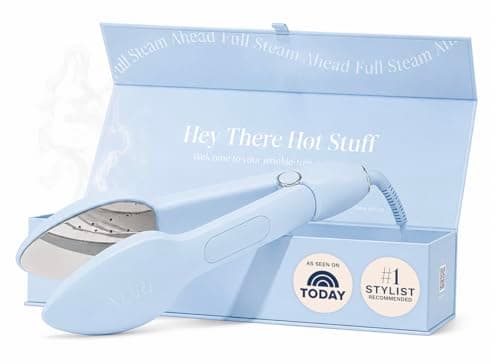
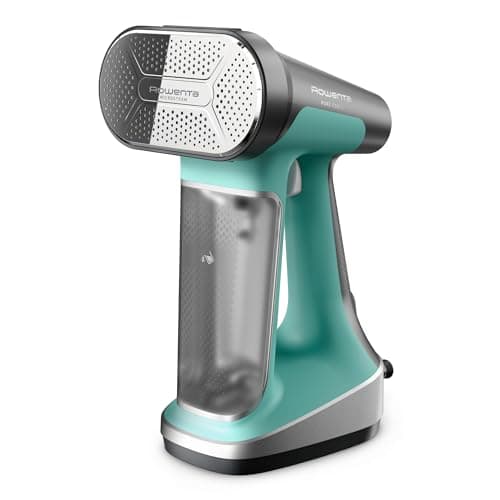
One machine that steams vertically and presses horizontally — and an honest account of what the plate costs you.
By Scooter M., enthusiast, crease control · Published
A 2-in-1 adds a heated press plate to a vertical steamer, which buys you the one thing steam physically cannot do: create a crease. Collars, cuffs, plackets and trouser creases all need contact and pressure. The Rowenta Pure Force is the strongest of them at 1,875 watts with a published 10-second heat-up. The trade is real and worth knowing before you buy — a plate costs you tank capacity and adds weight.
We earn a commission if you buy through the links on this page, at no extra cost to you. It does not change which steamer we rank first — the ranking comes from published specifications and the arithmetic on our method page. We have not tested these units. Full disclosure.
What the plate actually does
A vertical steamer relaxes fibers and lets the garment's own weight pull them straight. That works beautifully on hanging fabric and it cannot, by mechanism, produce a sharp edge — there is no pressure anywhere in the process. A crease is fabric held flat under force while it cools, and only contact supplies that.
So a 2-in-1 is not a more powerful steamer. It is a steamer that can also do the roughly twenty per cent of a garment a steamer has to leave soft.
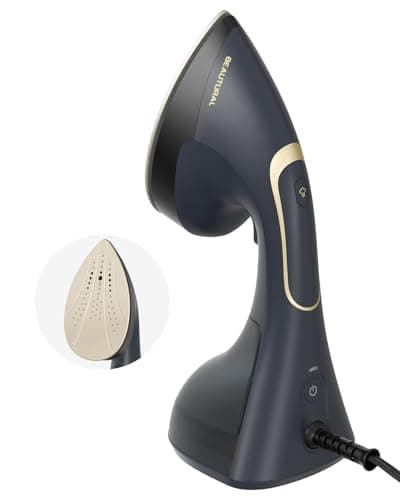
A plate takes up space in a body that also has to hold water, and the water loses. The clearest illustration is a single brand comparing against itself: Beautural's plain handheld publishes 260 ml, and its 2-in-1 sibling — same 1,200 W element, same published 30-second heat-up — publishes 200 ml. Sixty milliliters of run time is what the plate cost, along with about three ounces of extra weight.
That is not an argument against 2-in-1s. It is an argument for knowing what you are trading, and for not expecting one to double as your long-session machine.
2. Plate size against what you actually press
The plate on a handheld 2-in-1 is small — sized for a collar point, a cuff, a lapel edge. That is the job it is good at. Pressing a whole shirt front with one is possible and slow, because you are working a few square inches at a time. If most of what you want is flat cloth by the yard, a full-size press does a shirt back in one closure and a 2-in-1 never will.
3. Weight, because you hold it up
A soleplate is metal and metal is heavy. The 2-in-1s here run from 0.7 to 3 pounds, and the heaviest is the most powerful. Judge the top of that range as a small iron that also steams, rather than as a light steamer that also presses — you will be holding it at shoulder height for the steaming half of the job.
4. Voltage, if it is going in a suitcase
Two of the picks here publish genuine dual voltage, and that matters more than it sounds. A plug adapter changes the pin shape and nothing else; a 120 V heating element on a 230 V socket draws roughly four times its intended power. Check the published voltage rather than the adapter. The travel roundup works through this in full.
One machine or two?
The honest answer depends on whether you already own an iron you like.
No iron, no board, limited storage — a 2-in-1 is genuinely the right buy. It covers a mixed wardrobe in one drawer-sized object and needs no surface for the steaming half.
You already own a decent iron — the plate is a convenience rather than a reason to buy. Your iron has a bigger soleplate, more mass and better temperature control than any handheld plate will.
You travel with formal clothes — a dual-voltage 2-in-1 is close to ideal, because a hotel ironing board is never guaranteed.
Your [uniform needs a regulation crease](/steamers/for-uniforms) — a 2-in-1 is the only single machine that does both halves of that job, because steam alone cannot make a crease.
You steam a whole rail — buy a standing steamer instead and keep an iron for the collars. No 2-in-1's tank survives that job.
Mostly [linen](/steamer-vs-iron/linen) — buy an iron. A small plate on a handheld will not press linen properly, and steam will not either.
A clamping press is not a 2-in-1
One product on this page works differently enough to flag. A clamping press closes two heated plates on the fabric from both sides, rather than pressing one plate against a surface. That gives it more even pressure and lets it work anywhere — no table needed — but it has to be fed the garment a plate-width at a time, and it is slower to heat than anything else here.
It is included because it solves the same problem from the other direction, and for some buyers it is the better answer. It is not a steamer, and we would not have anyone buy it expecting one. The full comparison is here.
The picks
Ranked on published specifications. Tap a row for the full write-up; the price button goes to Amazon.
#
Product
Best for
Spec score
Price
1
Rowenta Pure Force 2-in-1 DR8822Steams vertically, presses horizontally, and publishes the fastest heat-up in this set by a factor of three.
Ten seconds to steam is the lowest published heat-up of anything on this page. If the thing that stops you steaming is the wait, this is the answer to it.
The horizontal plate is the real argument. A steamer relaxes a wrinkle; only contact and pressure will put a crease into a trouser leg or flatten a collar point. This does both, which is why for most wardrobes it genuinely replaces an iron and a board.
Three pounds is heavy for a handheld, and that weight is the soleplate. Judge it as a small iron that also steams, not as a light steamer that also presses.
Good
10-second published heat-up, the fastest on this site
Vertical steam and a horizontal press plate in one body
210 ml tank, larger than most 1,875W handhelds
Not good
Three pounds — the heaviest handheld here
A plate needs a surface, so it is not purely hang-and-go
Wider footprint than a pure steamer to store
Who should not buy it. Skip this if you only ever steam hanging garments. You would be carrying the weight of a soleplate you never put down.
2. Handheld · Pressing without a board
Beautural 2-in-1 Steam and Iron
The 1,200W Beautural with a plate added and 60 ml of tank given up for it.
Same 1,200W element and 30-second heat-up as the plain Beautural, plus a press plate, with 200 ml instead of 260 ml. The tank pays for the plate.
At 2.18 pounds it is about three ounces heavier than the plain version, which is a fair price for the added function.
If you are choosing between the two Beaturals, the only question is whether you need to press. If you do, 60 ml is not the deciding factor.
Good
Vertical steam and horizontal press in a sub-1,500W unit
30-second published heat-up
200 ml is still more tank than the 1,875W handhelds carry
Not good
60 ml less tank than the plain Beautural
1,200W caps what the plate can do on heavy cotton
120V only
Who should not buy it. Skip this if you already own an iron you like. A plate on a handheld is a travel convenience, not a replacement for a proper soleplate at home.
3. Travel · Travel abroad
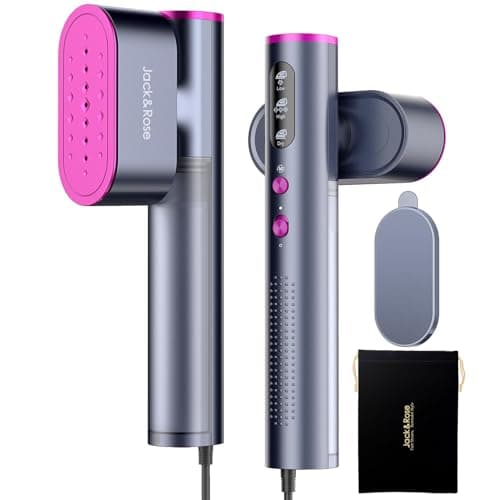
Jack & Rose K1 Travel Steamer
True 100-240V, 15 seconds to steam, 1.6 pounds — the travel spec sheet done right.
Dual voltage is the entire question for a travel steamer, and this one publishes 100-240V rather than the 120V-only that most compact units quietly ship with. In a European socket it works; a 120V unit on 230V is a fire.
Fifteen seconds is the joint-fastest published heat-up on this site. In a hotel room, before a dinner you are already late for, that is the number that matters.
150 ml is a hotel-room tank, not a wardrobe tank. Judge it as two garments per fill.
Good
Genuine 100-240V dual voltage, published on the listing
15-second published heat-up, joint-fastest here
Steamer and press plate in one 1.6 pound body
Not good
150 ml means refilling for anything beyond two garments
1,000W is modest — it will not fight linen
You still need the physical plug adapter for the country
Who should not buy it. Skip this if it will be your only steamer at home. It is built for a suitcase, and the tank says so.
4. Travel · The lightest 2-in-1
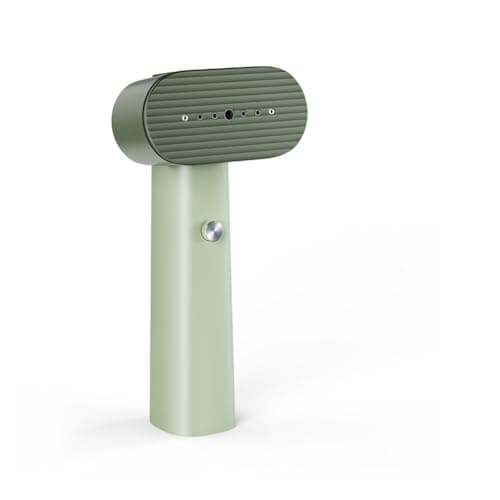
Nexdoo G6 2-in-1 Travel Steamer
0.7 pounds with a press plate on it, and a 15-second heat-up to go with it.
Nexdoo does not publish tank capacity for this model, so that figure is excluded from the score rather than estimated.
What the numbers mean
Seven-tenths of a pound including a plate is a real engineering result. Most 2-in-1 units are over a pound and a half.
Nexdoo publishes no usable tank figure — the capacity field on the listing repeats the item weight, which is a data error rather than a specification. We score what is published and record the gap.
900 watts and 15 seconds put it level with units twice its size on the two specs that decide how a session feels.
Good
0.7 pounds including a press plate
15-second published heat-up
Steam and press in a genuinely pocketable body
Not good
No usable published tank capacity
900W caps what the plate can do
No published warranty term
Who should not buy it. Skip this if you want to know what you are buying. Until the tank figure is published, run time is a guess — and we do not guess.
5. Press · Creases a steamer cannot make
Nori Press
A clamping press, not a steamer — dual voltage, 1.4 pounds, and the only thing here that puts a crease in.
NORI does not publish tank capacity for this model, so that figure is excluded from the score rather than estimated.
What the numbers mean
This is not a steamer and should not be judged as one. Two heated plates close on the fabric, which is the only mechanism on this site that creates a crease rather than removing one.
Dual voltage is published at 120 and 220 volts, which makes it a genuine travel option in a way most presses are not.
Three minutes to heat is the slowest published figure here, and 800 watts is modest. Both follow from heating two plates rather than boiling water.
Good
Puts creases in — no vertical steamer can do this
120V and 220V published, so it travels
1.4 pounds and 14 inches long
Not good
Three-minute published heat-up, the slowest here
800W is low, so thick fabrics take several passes
No published tank capacity
Who should not buy it. Skip this if what you want is to hang a shirt up and hit it with steam. A press is a different job and a slower one.
The one to skip
The Nexdoo G6 is a genuine engineering achievement — seven-tenths of a pound including a plate, with a published 15-second heat-up — and we would still not buy it, for one specific reason. Nexdoo publishes no usable tank capacity. The capacity field on the listing repeats the item weight, which is a data error rather than a specification.
On a machine whose entire selling point is that it is tiny, run time is the figure you most need, because a small body means a small tank. Until it is published there is no way to know whether you are buying two garments per fill or half of one. That is not a claim the unit is bad; it is that you cannot tell, and we will not recommend a purchase we cannot assess.
What a 2-in-1 still cannot do
Press linen properly. Flax needs sustained heat, moisture and a large soleplate. The linen verdict is an iron, and a small plate does not change it.
Touch [velvet](/fabrics/velvet), pile or beading. Pressure is exactly what ruins them. Use the steam head from the reverse, never the plate.
Handle volume. The largest tank on this page is 210 ml. A week of shirts is a standing steamer job.
Replace a board for full pressing. You can press a collar against most flat surfaces; you cannot press a whole shirt that way with any comfort.
If the plate is the only part you actually want, you may not want a steamer at all — the steamer-versus-iron hub settles that fabric by fabric, and the fabric guide tells you which of your clothes can safely take either tool.
Questions people actually ask
+Are 2-in-1 garment steamers any good?
Yes, for a specific job: they do the collars, cuffs and creases a vertical steamer physically cannot, without needing an ironing board. The trade is tank capacity and weight — a plate typically costs 50 to 60 ml of water and a few ounces against the same brand's plain steamer.
+Can a 2-in-1 steamer replace an iron?
For a mixed wardrobe of knitwear, synthetics, dresses and cotton shirts, largely yes. For linen, heavy cotton or pressing whole garments flat, no — the plate on a handheld is sized for a collar, not a shirt front.
+What is the difference between a 2-in-1 steamer and a steam iron?
A 2-in-1 steams vertically on hanging fabric and presses horizontally with a small plate, and needs no board for the steaming half. A steam iron only presses, needs a board, and has a much larger soleplate with better temperature control.
+Do 2-in-1 steamers have smaller tanks?
Usually, because the plate takes space the water would otherwise occupy. Beautural publishes 260 ml for its plain handheld and 200 ml for its 2-in-1 version of the same 1,200 W machine, which is a clean measure of the trade.
+Can you use a 2-in-1 steamer on velvet?
Only the steam head, and only from the reverse. Never the plate — pressure crushes pile permanently and the mark does not recover.