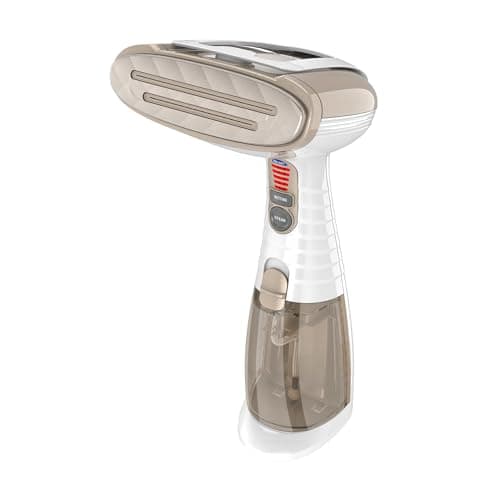
The category's default purchase, and the published figures mostly justify it. The tank is the one number to check against your own laundry pile.
By Scooter M., enthusiast, crease control · Published
The safest handheld purchase in the category, with one specification you should check against your own wardrobe. The GS59 runs at 1,875 watts — the practical ceiling for a plug-in appliance on a US 15-amp circuit — ships with three attachments, and publishes a two-year limited warranty, double the category norm. The catch is the 216 ml tank, which Conair pairs with a stated 20 minutes of run time: two or three garments before a refill. If your actual job is a rail of shirts, this is the wrong form factor at any wattage.
We earn a commission if you buy through the links on this page, at no extra cost to you. It does not change which steamer we rank first — the ranking comes from published specifications and the arithmetic on our method page. We have not tested these units. Full disclosure.
The published specification
Conair Turbo ExtremeSteam GS59L, read from the live listing, September 2026
Specification
Published
Comment
Power
1,875 W
The ceiling on a US 15-amp circuit. Nothing handheld goes higher
Tank
216 ml (7.3 fl oz)
Small for the power — high output empties it faster
Heat-up
40 s
Ordinary for the class. The Rowenta Pure Force publishes 10
Weight
2.27 lb
Heavy in the hand; you notice after a few garments
Dimensions
8" x 5.6" x 13.6"
A tall body — it does not lie flat in a drawer
Voltage
120 V
US and Canada only. Not a travel unit
Warranty
Limited 2 year
Double the norm; matched here only by CHI, beaten only by Jiffy
Every figure above is read off the product's own Amazon listing. We have not tested this unit — nobody sent us one and there is no lab behind this site.
What 1,875 watts actually buys
Power is the specification that decides which fabrics a steamer can handle, and it is worth being concrete about what the top of the range means. Wattage determines how fast the element turns water into vapor, and faster conversion means drier steam. Dry steam relaxes a fiber; wet steam soaks it. That is the whole mechanism, and it is why an under-powered unit leaves a shirt damp and still creased.
At 1,875 W the GS59 handles cotton shirting, wool tailoring, polyester and knitwear in one or two passes where a 1,000 W unit needs four and still leaves the fabric damp. What it will not do is linen, and no steamer at any wattage will — flax has almost no elastic recovery and has to be held flat while it dries. It also cannot make a crease, because a crease needs pressure and no vertical steamer applies any.
The tank is the specification that decides whether you keep using it
This is where the honest criticism sits. A 1,875 W element boils roughly 30 ml of water per minute at full output, so a 216 ml tank is about seven minutes of continuous steam. Conair's own stated run time of 20 minutes lines up with that once you allow for the fact that nobody holds the trigger down the whole time.
Seven to twenty minutes is two or three garments. For the job most people buy a handheld for — a shirt before work, a dress before an event — that is comfortably enough. For nine shirts on a Sunday evening it is not, and you will spend the evening at the sink. There is a real irony here: the power that makes this unit good is what empties its tank, and several cheaper, weaker steamers run longer per fill. The HiLIFE HL9 carries 300 ml and the Beautural 1200W carries 260.
Weight, and the thing spec sheets do not tell you
At 2.27 pounds this is among the heaviest handhelds on this site, and weight is the specification you feel most because you hold the thing at arm's length for the whole session. For comparison, the Rowenta XCEL delivers the identical 1,875 watts at 1.4 pounds — the same power for nearly a pound less, which over a rail of shirts is a real difference.
Conair's answer is the warranty and the attachments, and that is a fair trade rather than a bad one. But if power-to-weight is what you care about, the XCEL wins it outright and the head-to-head works through the choice properly.
The attachments, and whether they matter
Three in the box: a fabric brush, a crease tool and a lint pad. This site does not score attachment counts, because every brand ships a brush and counting them tells you nothing. Two of these three do earn their place:
The fabric brush holds cloth under light tension against the head, which is exactly the thing that makes steaming work — and it is the attachment that makes this unit usable on upholstery and heavy wool.
The crease tool clamps fabric so you can work a placket or a trouser leg. It is not an iron and it will not produce a knife edge, but it is better than nothing on a collar.
The lint pad is a lint pad. It works. It is not a reason to choose a steamer.
The two-year warranty, in context
Across the twenty-five listings on this site, sixteen publish no warranty term at all, five publish one year, two publish two years and the two Jiffy machines publish three. Conair is one of the two at two years, at a price well below the commercial machines.
A warranty is a maker attaching money to its own failure rate, which makes it a more informative signal than a wattage figure printed on a box. It does not prove the unit lasts longer — but somebody with access to the return data was willing to write the number down, and at this price that is unusual.
Who should not buy it
Anyone steaming a rail at a time. The tank runs dry before you finish. A standing steamer holds six to twelve times as much and often costs about the same.
Anyone who travels. It is 120 V only and 2.27 pounds. A plug adapter changes the pin shape, not the voltage — the travel page covers the units that are actually dual voltage.
Anyone who needs a crease. No vertical steamer makes one. That is a 2-in-1 or an iron.
Anyone with a mostly [linen](/fabrics/linen) wardrobe. Buy an iron. We earn nothing from that recommendation and it is still the right one.
Anyone on an old circuit who runs other high-draw appliances in the same room. 15.6 amps is the whole breaker.
Anyone who wants the lightest full-power option. That is the Rowenta XCEL at 1.4 pounds, not this.
The verdict
The GS59 is the most-bought handheld in the category and the published specifications explain that rather than contradict it. It has the most power available on a US circuit, the attachments that make that power usable, and a warranty term that most of its competition does not print. As a default recommendation for someone who steams two or three garments at a time, it is the safe answer and it is why this site ranks it first overall.
The honest caveats are that it is heavy for its class, slow to heat compared with units at the same wattage, and carries a tank that is small precisely because the element is strong. None of those is a defect. They are the trades Conair chose, and whether they suit you comes down to one question: how many garments do you steam in one go?
The unit reviewed
Ranked on published specifications. Tap a row for the full write-up; the price button goes to Amazon.
#
Product
Best for
Spec score
Price
1
Conair Turbo ExtremeSteam GS59The most-bought handheld in the category, and its published specs explain that rather than contradict it.
1,875 watts is the practical ceiling for a plug-in appliance on a US 15-amp circuit, and this unit sits right at it. Power is what turns water into dry steam fast enough to relax a fiber instead of soaking it, so on a handheld this is the figure that matters most.
The trade is the tank. 7.3 fluid ounces is a shade over 200 ml, which Conair pairs with a stated 20 minutes of run time. Call it two or three shirts before a refill.
40 seconds to heat is ordinary for this power class, not fast. The Rowenta Pure Force publishes a tenth of that at the same wattage.
Good
1,875W is the most power available in a handheld on a US circuit
Three attachments in the box, including a fabric brush for wool and a crease tool
Two-year limited warranty, which is unusual at this price
Not good
The tank is small for the power — high output empties it faster
40-second heat-up is beaten by several cheaper units
Over two pounds in the hand, which tells after a few garments
Who should not buy it. Skip this if you steam a whole rail at a time. At full output the tank runs dry before you get through a week of shirts, and a standing unit with a two-liter tank costs about the same.
Questions people actually ask
+Is the Conair Turbo ExtremeSteam any good?
On published specifications, yes — 1,875 watts is the most power available in a handheld on a US circuit, it ships with three usable attachments, and the two-year warranty is double the category norm. The limitation is the 216 ml tank, which is two or three garments before a refill.
+How long does the Conair Turbo ExtremeSteam run for?
Conair states 20 minutes. The arithmetic supports that: a 1,875 W element boils roughly 30 ml of water per minute at full output, so a 216 ml tank is about seven minutes of continuous steam and rather longer in normal use where the trigger is not held down.
+How long does the Conair Turbo ExtremeSteam take to heat up?
Forty seconds, per the published specification. That is ordinary for the power class rather than fast — the Rowenta Pure Force publishes ten seconds at the same 1,875 watts.
+Does the Conair Turbo ExtremeSteam work on cotton shirts?
Yes. At 1,875 watts it produces steam dry enough to relax woven cotton in one or two passes. What it cannot do is make the collar and cuffs crisp, because that needs contact and pressure rather than steam.
+Is the Conair Turbo ExtremeSteam dual voltage?
No. The listing publishes 120 V, which makes it a US and Canada machine. At 2.27 pounds it is not a travel unit in any case.
+Conair Turbo ExtremeSteam or Rowenta XCEL?
Both reach 1,875 watts. Conair publishes a two-year warranty, a larger 216 ml tank and three attachments; Rowenta delivers the same power at 1.4 pounds against Conair's 2.27. It is a warranty-and-tank versus weight decision.