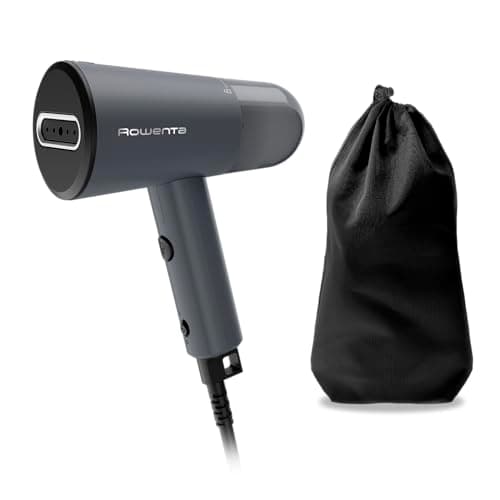
It gets the one specification that actually matters right, in the title, where you can see it. Then it declines to tell you how much water it holds.
By Scooter M., enthusiast, crease control · Published
Buy the Rowenta Origin DR1050 if you want a travel steamer from an established brand and you want the dual-voltage figure printed where you can check it — 120V-240V, in the listing title and the first bullet. That is the one specification that decides this category, and Rowenta publishes it plainly. The costs are real: a 25-second heat-up, the slowest of the five travel steamers here, where the other four all publish fifteen; no published tank capacity at all; and 1.6 pounds against the 0.7 of the lightest unit on this site. It scores 5.9 on three of four figures.
We earn a commission if you buy through the links on this page, at no extra cost to you. It does not change which steamer we rank first — the ranking comes from published specifications and the arithmetic on our method page. We have not tested these units. Full disclosure.
Why this page exists: the travel class had no brand in it
Until today every travel steamer on this site came from a marketplace brand — Jack & Rose, OGHom, nesugar, Nexdoo. Those are not bad machines and two of them score above this one, but none is a name a buyer recognizes or a company with a service network, and the travel roundup has been the busiest page on this site without a single established brand in it. The Rowenta Origin closes that gap, and it also completes Rowenta across every domestic form factor this site covers: a handheld, a suction handheld, an upright, irons, and now travel.
The published specification
Rowenta Origin DR1050, read from the live listing
Figure
Published
Note
Voltage
120V-240V
In the title and the first bullet. The structured field holds only 240 — the top of the range, not the range
Power
1,300 W filed
The third bullet says 1,100 W. We publish the filed field; see below
Tank
Not published
The Capacity field reads 2.3 quarts (~2.2 L) for a 1.6 lb foldable unit
Heat-up
25 s
The slowest in the travel class here — the other four publish 15 s
Weight
1.6 lb
Ties the Jack & Rose; double the 0.7-0.8 lb featherweights
Steam output
20 g/min
A figure most of this class does not give
Warranty
Not published
Model
DR1050 / DR1050U1
Score on published figures
5.9 (3 of 4 metrics)
Power 10, heat-up 7.0, portability 2.7
Figures are read off the product's own Amazon listing and linked back to it. Where a structured field holds something that is not the specification it claims to be, the field is dropped rather than published. We have not handled this machine.
It gets the one pass/fail specification right, and publishes it where you can see it
Dual voltage is not a feature in this category; it is a gate. A 120 V heating element fed a European 230 V supply draws roughly four times its intended power and destroys itself, often spectacularly, and a plug adapter changes the pin shape and nothing else. That single fact is why the travel page checks voltage before it checks anything else, and why most compact steamers sold as travel units are useless abroad.
Rowenta puts 120V-240V in the product title and repeats it in the first feature bullet. That is the most useful thing on this listing, because it is the claim a buyer can verify in two seconds without opening the specification table. Worth noting for completeness: the structured Voltage field holds a bare 240 volts — the top of the range rather than the range itself — so the figure published here comes from the title and the bullet, which agree with each other. That is the same shape of discrepancy the Jack & Rose K1 has, and the same resolution.
The listing disagrees with itself about power, and it happens not to matter
The structured Wattage field reads 1,300 watts. The third feature bullet reads 1,100 W. Both are Rowenta's own copy, 200 watts apart, on one page.
This site publishes the filed structured field when the two disagree — the rule it applies to the Rowenta XCEL, whose title advertises a 25-second heat-up against a filed 40, and to the Steamery Cirrus Icon. So 1,300 W is what appears in the table above.
Twenty-five seconds is the slowest in the class, and this is the class where it shows
Every other travel steamer on this site publishes a 15-second heat-up. Rowenta publishes 25. In absolute terms ten seconds is nothing; in this category it is the one place the established brand is behind the marketplace ones, and it lands on the exact use case travel steamers are bought for — the rushed touch-up in a hotel room before you leave for something you are already late to.
It is still fast by the standards of the site as a whole. Only the Rowenta Pure Force at ten seconds beats the 15-second travel units, and the slowest machine here takes two minutes. Judge the 25 seconds against the class rather than the category: against its direct rivals it is last, and against a full-size steamer it is quick.
The tank is not published, which costs more here than elsewhere
Rowenta files 2.3 quarts in the Capacity field — about 2.2 liters — for a foldable steamer its own data says weighs 1.6 pounds. Water alone at that volume would weigh nearly five pounds. It is not a specification, so it is dropped with the reason recorded, the same treatment the AeroSteam's "5 quarts" and the IS2461's capacity field received.
In the travel class a missing tank figure costs more than it would anywhere else, because travel tanks are small enough that the number decides the purchase. The four units here that publish one run from 70 ml to 150 ml — the nesugar's 70 ml is roughly one shirt front, the Jack & Rose's 150 ml is two garments. Not knowing which end of that range this machine sits at is a genuine gap, and it is why it is scored on three figures rather than four.
Where it sits against the rest of the travel class
Every travel steamer on this site
Machine
Voltage
Power
Tank
Heat-up
Weight
Score
Rowenta Origin DR1050
120-240V
1,300 W
Not published
25 s
1.6 lb
5.9 (3 of 4)
Jack & Rose K1
100-240V
1,000 W
150 ml
15 s
1.6 lb
6.2
OGHom GH02
110-240V
1,000 W
120 ml
15 s
1.76 lb
5.4
nesugar G3 Pro
Maker says "global"
900 W
70 ml
15 s
0.8 lb
6.6
Nexdoo G6
Not published
900 W
Not published
15 s
0.7 lb
8.4 (3 of 4)
Scores come from the rubric on /methodology, computed only over the figures each maker published. The Nexdoo's 8.4 is computed over three metrics with no tank figure, which is why it leads a class it does not obviously lead — a reminder that these numbers are not comparable across different metric counts.
Read that honestly and the Rowenta is fourth of five on the composite and first on the two things the composite handles badly: it publishes the most power in the class, and it publishes its voltage range where a buyer can actually find it. The nesugar and Nexdoo lead on portability because they are half the weight; the Jack & Rose leads on the balance of a real tank figure and a fast heat-up.
If the composite is what you are buying, the travel roundup ranks the class and the Jack & Rose is its pick. If what you want is a recognizable brand behind a dual-voltage machine, this is the only one on this site, and that is a legitimate thing to want from an appliance you will plug into an unfamiliar socket in another country.
One unusually candid line on this listing
Rowenta's last feature bullet reads: "Each Rowenta steam iron is individually tested with water to guarantee superior steam performance. Visible water droplets are a sign of successful quality control."
That is a maker getting ahead of a support ticket, and it is worth repeating because the alternative reading — water in a new box means a leak — is the one most buyers reach for. It is also a reminder of what this category's commonest complaint is. If spitting and droplets are what worries you, the steamers that resist it sets out which designs physically cannot spit and which makers put an anti-drip claim in writing, and the water-marks page covers what to do when a droplet has already landed on something dark.
Who should buy it, and who should not
The decision
If you
Verdict
Want a dual-voltage travel steamer from an established brand
Buy it — the only one on this site
Want the voltage range printed where you can verify it
Buy it — it is in the title, not buried in a field
Want the most power in the travel class
Buy it — 1,300 W filed, the highest here
Want the fastest heat-up
Skip it — 25 s against 15 for all four rivals
Pack by weight
Skip it — 1.6 lb against 0.7-0.8 for the featherweights
The honest summary: this is the travel steamer to buy if the brand and the printed voltage range are what you are paying for, and it is not the best travel steamer on this site on the figures. Rowenta gets the gate specification right and publishes it prominently, which genuinely matters for a machine destined for a foreign socket. It then files an impossible capacity, contradicts its own wattage by 200 W, and takes ten seconds longer to heat than every rival in its class. We earn a commission on all five machines in this class; the Jack & Rose remains the roundup's pick and this one is the answer to a different question.
The machine at a glance
Ranked on published specifications. Tap a row for the full write-up; the price button goes to Amazon.
#
Product
Best for
Spec score
Price
1
Rowenta Origin Travel Steamer DR1050The most power published in the travel class here and the only established brand in it, with the slowest heat-up of the five and no tank figure at all.
The most power published in the travel class here and the only established brand in it, with the slowest heat-up of the five and no tank figure at all.
Rowenta does not publish tank capacity for this model, so that figure is excluded from the score rather than estimated.
What the numbers mean
Dual voltage is the one pass/fail specification for a travel steamer, and Rowenta publishes it in the title and the first feature bullet alike: 120V-240V. That matters more than any other figure here, because a 120 V element fed a European 230 V supply draws roughly four times its intended power and destroys itself, and a plug adapter changes the pin shape and nothing else. Note the structured Voltage field holds only 240 — the top of the range rather than the range — so the figure published here comes from the title and bullet, which agree.
The listing contradicts itself on power. The structured Wattage field reads 1,300 watts; the third feature bullet reads 1,100 W. This site publishes the filed field, as it does for the Rowenta XCEL and the Steamery Cirrus Icon where title and field disagree. The dispute happens not to matter for the score: the travel class is scored against a 400-1,100 W range, so both figures clamp to a full ten out of ten. It matters to a buyer only as a reminder that the number on the box and the number in the catalog are filed by different people.
Twenty-five seconds is the slowest published heat-up of any travel steamer on this site — the other four all state fifteen. Ten seconds is not much in absolute terms, but this is the category where a rushed touch-up before leaving a hotel room is the whole use case, and it is the one figure where the established brand is behind the marketplace ones.
The tank is unpublished. Rowenta files 2.3 quarts in the Capacity field, which would be about 2.2 liters in a foldable unit weighing 1.6 pounds, so it is dropped rather than published and this steamer is scored on three figures instead of four. A sibling Rowenta listing states a 2.3 OUNCE capacity, which would be plausible, but that is an inference about a different product and no figure is published on the strength of it.
Good
120V-240V dual voltage, published in the title and the first bullet — the one specification that decides a travel steamer
1,300 W filed, the most power published in the travel class here
20 g/min continuous steam, a figure most makers in this class do not give
Foldable body with a travel case included
The only established brand in a class otherwise filled with marketplace names
Not good
25-second heat-up is the slowest in the travel class here; the other four publish 15
No published tank capacity — the Capacity field reads 2.3 quarts, which is impossible
Scored on three figures rather than four, which flatters it against fully documented units
No published warranty term
1.6 lb is double the lightest travel units here, which run 0.7-0.8 lb
The structured wattage and the feature bullet disagree by 200 W
Who should not buy it. Skip this if you want the lightest thing that makes steam — two units here weigh under a pound against this one's 1.6. Skip it too if you need to know the run time before you buy, because Rowenta will not tell you what the tank holds, and in a class where tanks run 70 to 150 ml that is the figure which decides how many garments you get per fill.
Questions people actually ask
+Is the Rowenta Origin travel steamer any good?
It publishes the most power in this site's travel class at 1,300 W filed, and it publishes its 120V-240V dual voltage in the listing title where a buyer can verify it — the one specification that decides a travel steamer. Against that it has the slowest heat-up of the five travel units here at 25 seconds, no published tank capacity at all, no stated warranty, and at 1.6 pounds it is double the weight of the lightest units. It scores 5.9 on three of four figures.
+Is the Rowenta Origin dual voltage?
Yes, and unusually it says so in the product title: 120V-240V, repeated in the first feature bullet. Its structured Voltage field holds only 240, which is the top of the range rather than the range, so the figure comes from the title and bullet. Dual voltage is the pass/fail specification for a travel steamer, because a plug adapter changes the pin shape and not the voltage.
+How big is the Rowenta Origin's water tank?
Rowenta does not publish it. The Capacity field reads 2.3 quarts, about 2.2 liters, which is impossible for a 1.6-pound foldable steamer, so this site drops the field rather than estimate. No run time is quoted for this machine anywhere. For comparison, the travel units here that do publish a tank run from 70 ml to 150 ml.
+Is the Rowenta Origin 1,100 or 1,300 watts?
Its listing says both: the structured Wattage field reads 1,300 W and the third feature bullet reads 1,100 W. This site publishes the filed field, as it does for the Rowenta XCEL where title and field disagree. For the score it makes no difference — the travel class is scored against a 400-1,100 W range, so both figures clamp to ten out of ten for power.
+Rowenta Origin or the Jack & Rose K1?
The Jack & Rose for most buyers: it publishes a 150 ml tank, heats in 15 seconds against the Rowenta's 25, matches it on weight, costs less, and scores 6.2 against 5.9. The Rowenta if you want an established brand behind a dual-voltage machine, or the most watts in the class. Both publish a genuine voltage range, which is the thing that matters most abroad.
+Why does my new Rowenta steamer have water in the box?
Rowenta addresses this on the listing itself: each unit is individually tested with water, and it states that visible water droplets are a sign of successful quality control rather than a fault. If droplets appear during use rather than in the box, that is a different problem and the spitting-water troubleshooting page covers it.