Steam blocking is the fastest way to open up a finished piece — and the fastest way to kill acrylic permanently if you get the fiber wrong.
By Scooter M., enthusiast, crease control · Published
Buy for low-end control and a light body, not for power. Steam blocking means hovering a head over a pinned-out piece for several minutes at a stretch, so what matters is a steamer you can hold comfortably, that produces vapor rather than spitting water, and that you can run at a low setting. 1,000 to 1,200 watts is plenty — more is not better here. And the fiber rule comes before the machine: steam transforms wool and cotton, and permanently kills acrylic.
We earn a commission if you buy through the links on this page, at no extra cost to you. It does not change which steamer we rank first — the ranking comes from published specifications and the arithmetic on our method page. We have not tested these units. Full disclosure.
Read this before you steam anything: the fiber rule
This is the whole page in one section. Blocking behaves completely differently depending on what the yarn is made of, and one of the outcomes is irreversible.
Steam permanently kills the springiness. Irreversible — see below
Nylon, polyester blends
Low only
Thermoplastic. Heat can flatten and glaze the yarn
If the yarn band is gone and you cannot identify the fiber, treat it as acrylic and do not steam it. That is the only guess on this page with a one-way outcome.
Steam blocking against wet blocking
Both work. They are suited to different jobs and most makers end up doing both.
The two methods
Steam blocking
Wet blocking
Time
Minutes, plus a short dry
Soak, squeeze, pin, then 12-24 hours
Best for
Quick finishing, seams, edges that curl, garment pieces before seaming
Lace that needs aggressive opening, heavy reshaping
Control
High — you can work one area at a time
All or nothing
Risk
Overdoing it on a synthetic
Stretching a wet knit out of shape under its own weight
Repeatable
Yes, easily
Yes, but it is a whole afternoon
For lace shawls that need to be opened up dramatically, wet blocking still wins. For everything else — flattening a curling stockinette edge, setting a seam, finishing a granny square — steam is faster and more controllable.
How to steam block, properly
1Swatch first, every timeBlock a gauge swatch in the same yarn before you touch the finished piece. This is the step that catches an acrylic you misidentified, and it costs ten minutes against a project that took weeks.
2Pin the piece out to measurements on a blocking matFoam mats, rustproof pins, and the dimensions written down. Wires along a straight edge if you have them. Pin generously — a scallop between two distant pins is a scallop you have just set.
3Let the steamer come fully up to temperatureA head that is not hot spits water, and a droplet on a pinned-out piece leaves a mark. Wait for the ready light every time.
4Hover two to four inches above, never touchingThe head must not contact the knitting. Contact flattens stitch definition — exactly the thing blocking is supposed to reveal — and on a pile or textured stitch it is permanent.
5Work in sections and watch the fabric relaxYou will see it happen. Move on the moment a section has opened up rather than holding steam on it.
6Leave it pinned until completely dryThis is where the shape sets. Unpinning warm and damp undoes the whole exercise, and on wool the piece will simply spring back.
What blocking actually fixes
Curling stockinette edges. The single most common reason people start blocking. Steam relaxes the curl and pins set it flat.
Uneven tension. Stitches even out visibly as the fabric relaxes. It will not rescue genuinely bad tension, but it hides ordinary variation.
Stitch definition in cables and texture. Blocking opens the fabric and lets the pattern read.
Pieces that do not match before seaming. Block both fronts to the same measurements and the seam goes together properly.
Granny squares that are not square. A classic crochet problem and a classic steam-block fix.
What it does not fix: a garment knitted to the wrong size. Blocking moves dimensions by a modest amount, not by inches, and stretching a piece hard enough to hit a size it was never knitted to will distort the fabric.
Why the picks are what they are
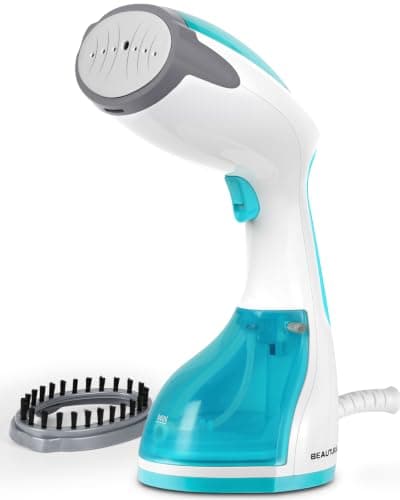
The Beautural 1200W leads because it is the best balance of the things that matter for a long hovering session: 1,200 watts with real low-end control, 260 ml so you are not refilling halfway through a shawl, and a published 2-pound weight. It is not the lightest thing here, which is the honest cost over twenty minutes of hovering.
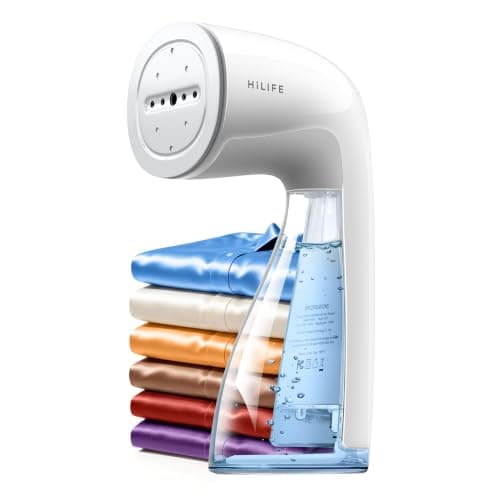
The HiLIFE HL9 carries 300 ml — the largest handheld tank on this site — at 1,100 W. For blocking a full garment's worth of pieces in one sitting that is the most useful specification on the page. HiLIFE publishes no weight at all, which costs it a metric in our scoring and matters more here than usual, because weight is exactly what you feel in this job.
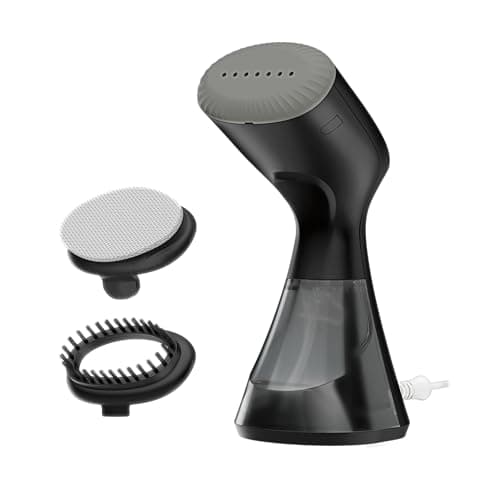
The Conair 1100W Compact is the lightest genuinely capable option at 1.3 pounds, which for hovering over a pinned-out piece is a real advantage. Its listing publishes no tank capacity, so you cannot know your run time in advance — a meaningful gap for a long session, and one we score as missing rather than fill in.
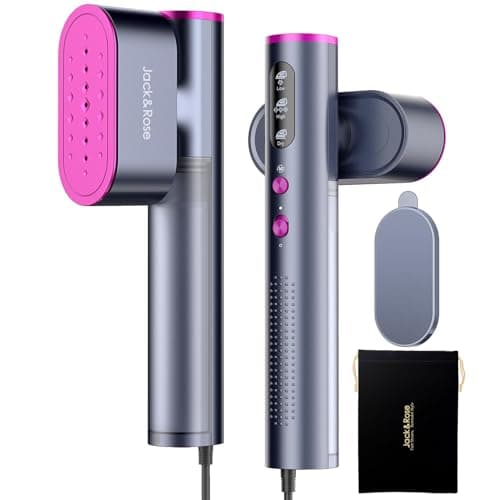
The Jack & Rose K1 is here for anyone who blocks at classes, retreats or a yarn shop rather than at home: 1.6 pounds, a published 15-second heat-up and genuine 100-240 V dual voltage. Its 150 ml tank is small, so it is a few-pieces machine rather than a whole-sweater one.
The picks
Ranked on published specifications. Tap a row for the full write-up; the price button goes to Amazon.
#
Product
Best for
Spec score
Price
1
Beautural 1200W Handheld Steamer260 ml on a 1,200W handheld — the most run time per fill here, bought with output.
Tank capacity decides whether steaming is pleasant or annoying, and this carries 260 ml against the 190 to 216 ml the 1,875W units manage. More minutes per fill, fewer trips to the sink.
1,200 watts is a real step down from 1,875. On linen and heavy cotton you will feel it — the steam is wetter and you will make more passes. On the synthetics and knits that make up most wardrobes the difference is small.
Two pounds and 30 seconds to heat are both mid-table. Nothing here is remarkable except the tank, and the tank is the point.
Good
260 ml — the largest handheld tank in this set
30-second published heat-up, faster than the 1,875W Conair
Auto shut-off published as part of a nine-point safety design
Not good
1,200W struggles where 1,875W does not — linen especially
Filling means carrying the whole unit to the tap
Two pounds in the hand, the same as the far more powerful Conair
Who should not buy it. Skip this if linen or heavy cotton is most of what you own. Below about 1,500 watts you make three passes where a stronger unit makes one.
2. Handheld · The largest tank on a mid-power handheld
HiLIFE HL9 1100W Steamer
300 ml, 1,100 watts and 30 seconds — the HL7's three weaknesses answered.
HiLIFE does not publish weight for this model, so that figure is excluded from the score rather than estimated.
What the numbers mean
This is what the HL7 should have been: four hundred more watts, sixty more milliliters of tank, and a quarter of the heat-up time.
300 ml is the biggest handheld tank in this set. On a mid-power unit that is the right pairing — lower output empties a tank more slowly, so a big tank becomes real run time rather than a heavier device you refill just as often.
HiLIFE publishes no weight for this model. That is a gap, not something to infer: we have not held one and will not estimate it, so portability goes unscored.
Good
300 ml — the largest handheld tank here
30-second published heat-up, four times faster than the HL7
Leak-proof design published explicitly, which matters on a horizontal pass
Not good
No published weight, so portability cannot be scored
1,100W still sits below what linen wants
120V only
Who should not buy it. Skip this if you plan to travel with it. It is 120V only, and a dual-voltage travel unit costs less than the transformer you would otherwise need.
3. Handheld · Small spaces
Conair 1100W Compact Steamer GS81
1.3 pounds and 30 seconds to steam — with a tank figure Conair does not publish.
Conair does not publish tank capacity for this model, so that figure is excluded from the score rather than estimated.
What the numbers mean
At 1.3 pounds this is the lightest full-size handheld here, and 1,100 watts handles the knits, synthetics and light cotton that make up most wardrobes.
Conair publishes no tank capacity for this model. That is a real hole in a spec sheet — tank size is the single best predictor of whether a session is pleasant — and it costs the unit a metric in our scoring rather than earning it a guess.
Nine inches tall. It fits in a drawer, which is most of the argument for a compact steamer.
Good
1.3 pounds, the lightest non-travel handheld here
30-second published heat-up
Nine inches tall — genuinely drawer-sized
Not good
No published tank capacity, so run time is unknowable from the specs
1,100W is mid-table output
Compact bodies mean small tanks, and the silence is not reassuring
Who should not buy it. Skip this if run time matters to you. Until Conair publishes a tank figure there is no way to know what you are buying.
4. Travel · Travel abroad
Jack & Rose K1 Travel Steamer
True 100-240V, 15 seconds to steam, 1.6 pounds — the travel spec sheet done right.
Dual voltage is the entire question for a travel steamer, and this one publishes 100-240V rather than the 120V-only that most compact units quietly ship with. In a European socket it works; a 120V unit on 230V is a fire.
Fifteen seconds is the joint-fastest published heat-up on this site. In a hotel room, before a dinner you are already late for, that is the number that matters.
150 ml is a hotel-room tank, not a wardrobe tank. Judge it as two garments per fill.
Good
Genuine 100-240V dual voltage, published on the listing
15-second published heat-up, joint-fastest here
Steamer and press plate in one 1.6 pound body
Not good
150 ml means refilling for anything beyond two garments
1,000W is modest — it will not fight linen
You still need the physical plug adapter for the country
Who should not buy it. Skip this if it will be your only steamer at home. It is built for a suitcase, and the tank says so.
Questions people actually ask
+What is the best steamer for blocking knitting?
A handheld with good low-end control rather than a powerful one. 1,000 to 1,200 watts is plenty, and what matters more is a tank large enough for a long session and a body light enough to hold while you hover. The Beautural 1200W balances those best; the HiLIFE HL9 carries the largest tank.
+Can you steam block acrylic?
You can, and it is permanent. Steam destroys acrylic's springiness and memory — the piece goes limp and drapey and never recovers. Some makers do it deliberately to get drape from a stiff acrylic, but there is no undo, so swatch first and decide before you start.
+Is steam blocking as good as wet blocking?
For most jobs it is faster and more controllable — flattening curling edges, setting seams, opening cable definition. For lace that needs opening up dramatically, wet blocking still wins because it lets you stretch far harder.
+Should the steamer touch the knitting when blocking?
No. Hover two to four inches above it. Contact flattens stitch definition, which is the opposite of what blocking is for, and on textured or cabled work the flattening is permanent.
+How long do you leave knitting pinned after steam blocking?
Until it is completely dry, which is where the shape actually sets. Unpinning while it is still warm and damp lets wool spring straight back to where it started.