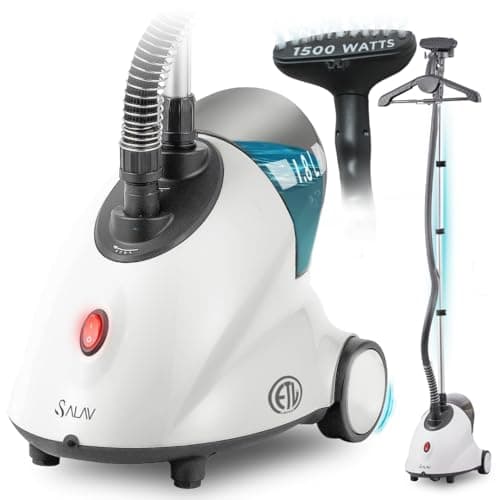
The sensible standing steamer: enough tank to change the job, not so much machine that it takes over the room. The pole is the part to think about.
By Scooter M., enthusiast, crease control · Published
The right standing steamer for most households, and the published figures say why. The GS18 carries 1.8 liters — roughly nine times what a good handheld holds — at 1,500 watts, with a 45-second heat-up, a 65-inch pole and a published one-year warranty. SALAV rates it at 60 minutes of steam per fill, and the arithmetic supports that. What you are buying is the end of refilling. What it costs you is nine pounds of assembled equipment that lives in one room, and the pole is what owners tend to complain about.
We earn a commission if you buy through the links on this page, at no extra cost to you. It does not change which steamer we rank first — the ranking comes from published specifications and the arithmetic on our method page. We have not tested these units. Full disclosure.
The published specification
SALAV GS18-DJ/120, read from the live listing, September 2026
Specification
Published
Comment
Power
1,500 W
Less than the 1,875 W handhelds — and it does not matter here, see below
Tank
1.8 L (1,800 ml)
About nine times a 200 ml handheld. The whole argument
Stated run time
60 minutes per fill
SALAV's figure; the arithmetic lands close to it
Heat-up
45 s
Respectable for heating 1.8 liters rather than 200 ml
Weight
9 lb
Assembled. On wheels, so you roll it rather than carry it
Height
65 in
A full-length dress hangs clear of the floor
Footprint
14.2" x 11.4"
Roughly a sheet of paper and a half
Voltage
110-120 V
US and Canada. Not a travel machine, obviously
Warranty
1 year
Published. Seventeen of the twenty-six listings on this site publish none
Every figure above is read off the product's own Amazon listing. We have not tested this unit — nobody sent us one and there is no lab behind this site.
Why the tank is the whole review
The specification people read first on a steamer is wattage, and on a standing unit it is the wrong one. A 1,875 W handheld boils roughly 30 ml of water a minute at full output, so its 200 ml tank is about seven minutes of continuous steam — two or three garments, then a refill, then a wait while the vessel cools enough to open safely. That refill cycle, not power, is what puts handhelds in cupboards.
Run the same arithmetic on the GS18: 1,500 W is a little slower at converting water, call it 24 ml a minute, and 1,800 ml at that rate is about 75 minutes of continuous steam. SALAV's own figure is 60. Either way it is an order of magnitude more than any handheld on this site, and it is the difference between steaming a week of shirts in one pass and steaming three, refilling, and steaming three more.
What 1,500 watts handles
Fifteen hundred watts sits in the band this site describes as everyday competence and a bit above it. It handles cotton shirting, wool tailoring, polyester, knits and most dresses in one or two passes. On heavy fabric — a wool overcoat, interlined curtains, a duvet cover on the bed — the tank matters more than the wattage, and this is the unit the heavy-fabrics page reaches for.
What it does not do is the same two things no steamer does. It will not put a crease in a trouser leg, because a crease needs pressure and vertical steam applies none. And it will not make linen look pressed, because flax has to be held flat while it dries. Both are fabric limits rather than machine ones.
The pole, honestly
Every standing steamer is a boiler on the floor with a hose up a pole, and the pole is where this class gets its complaints. Three things to know before you buy this one:
It assembles, and it stays assembled. At 65 inches it does not fold down for a cupboard. Where you build it is where it lives, so decide on the room first.
The hanger at the top is the working surface. A shirt, a dress or a jacket hangs from it at roughly chest height, which is what makes the job comfortable — you are not holding the garment and the steamer at once, as you are with a handheld.
The hose is what you move. The cord plugs in once at the base. In the hand you have a hose and a head, which is the nearest thing to a cordless steamer that actually works.
SALAV's listing describes the hanger as a 360-degree swivel type. We have not handled the unit, so we cannot tell you how the pole feels in use — only that a telescoping pole carrying a hose is the component owners of every brand in this class most often report as the weak point, and that the GS18's is not exempt from that pattern by virtue of being SALAV's.
Water, scale and the daily routine
A 1.8-liter tank holds water hot for longer than a handheld does, and the site's descaling page is explicit that standing units accumulate scale faster for that reason. Three habits matter more on this machine than on a handheld:
Empty it after every session. Water left standing in a warm tank deposits scale and grows the smell people mistake for a fault. The storage page covers why.
Descale at the shorter interval. Monthly with hard water and weekly use. It costs a bottle of vinegar and half an hour, and it is the difference between a GS18 that lasts and one that loses output within a year.
Read the manual on water.Whether you need distilled water depends on the maker's instruction and your local hardness, and getting it wrong can affect a warranty claim.
A claim on the listing we do not repeat
SALAV's listing says the GS18 "sanitizes" garments. This site does not endorse that claim for any garment steamer, and it is worth saying why on a review of a unit we otherwise recommend. Steam leaves the head at boiling point and cools rapidly across the gap to the fabric; disinfection needs a temperature held for a period, not a passing plume. The GS18 reduces odor, which is genuinely useful. It does not sanitize, and the steamer versus steam cleaner page sets out the machine that does.
GS18 or X3A?
SALAV's other upright is the X3A: 3 liters at 1,800 watts with foot pedals, on a 70.5-inch pole at 12 pounds. On specification it beats the GS18 in every row. On the question of which to buy, it usually does not.
The two SALAV uprights
GS18
X3A
Tank
1.8 L
3 L
Power
1,500 W
1,800 W
Height
65 in
70.5 in
Weight
9 lb
12 lb
Foot pedals
No
Yes
Warranty
1 year
1 year
Right for
One household's wardrobe, a bed, a pair of curtains
Several beds, a rail of coats, near-daily use
The X3A's extra 1.2 liters is another 45 minutes or so of steam, which is genuinely useful if you change several beds in a morning or steam a rail of winter coats. For a household doing a week of shirts and the occasional dress, it is capacity you will not use, on a pole five and a half inches taller in a room where ceiling height may already be a question. The SALAV brand page and the standing roundup both work through the choice.
Who should not buy it
Anyone steaming two shirts a week. A unit you assemble and park is more machine than that job needs. A handheld is the right tool.
Anyone short of a place to put it. It does not fold. If there is no corner it can live in, it will be resented.
Anyone who needs a crease. No steamer makes one. That is a 2-in-1 or an iron.
Anyone with a mostly [linen](/fabrics/linen) wardrobe. Buy an iron. We earn nothing from that recommendation and it is still the right one.
Anyone who steams a rail every day. That is daily-duty use, and the Jiffy J-2000 publishes a three-year warranty and a metal boiler for exactly that. For weekly use the GS18 produces more steam for a fraction of the price; for daily professional use the Jiffy's construction is the point.
Anyone who wants the biggest tank available. That is the X3A, and the head-to-head with Jiffy covers where the extra capacity earns its height.
The verdict
The GS18 is the standing steamer this site recommends first because it is sized to the job most people actually have. Enough tank to steam a wardrobe, a bed or a pair of curtains without stopping; enough power for everything a vertical steamer can do; a published warranty; and a pole that hangs a full-length garment clear of the floor. It is the unit that turns steaming from a chore into a habit, which is the whole reason to own one.
The honest caveats are the ones every upright carries — it is a piece of furniture rather than an appliance you put away, the pole is the component to expect complaints about, and 1,500 watts is not the biggest number on the shelf. None of those is a reason not to buy it. Whether to buy it comes down to one question: how many garments do you steam in one go? If the answer is more than three, this is the answer.
The unit reviewed
Ranked on published specifications. Tap a row for the full write-up; the price button goes to Amazon.
#
Product
Best for
Spec score
Price
1
SALAV GS18 Full-Size Steamer1.8 liters on a 65-inch pole — the point where steaming stops being a chore.
A 1.8 liter tank is roughly nine times what a good handheld carries. That is the entire argument for a standing steamer: fill it once and work through a rail without stopping.
SALAV publishes 60 minutes of steam per fill. Even discounted, that is an order of magnitude more than any handheld here.
Forty-five seconds to heat from 1,500 watts is respectable given the volume of water involved — a handheld is heating 200 ml, this is heating 1,800.
Good
1.8 liter tank — about an hour of continuous steam per the maker
65-inch pole holds a full-length dress or coat clear of the floor
1,500W with a published one-year warranty
Not good
Nine pounds and pole-mounted — this lives in one room
45-second heat-up is slower than the best handhelds
Assembly required, and the pole is what people complain about
Who should not buy it. Skip this if you steam two shirts a week. A standing unit you assemble and store is more machine than that job needs.
Questions people actually ask
+Is the SALAV GS18 a good steamer?
On published specifications, yes — 1.8 liters at 1,500 watts is about an hour of continuous steam, with a 65-inch pole and a published one-year warranty. It is the standing steamer this site recommends first for a household, because it is sized to a wardrobe rather than a rail of coats.
+How long does the SALAV GS18 steam for?
SALAV states 60 minutes per 1.8-liter fill. The arithmetic supports it: a 1,500 W element converts roughly 24 ml of water a minute at full output, which puts 1,800 ml at about 75 minutes, and nobody holds the trigger down continuously.
+How long does the SALAV GS18 take to heat up?
Forty-five seconds, per the published specification. That is slower than the fastest handhelds, but it is heating 1.8 liters rather than 200 ml, and it only happens once per session instead of after every refill.
+SALAV GS18 or X3A?
The GS18 for one household's wardrobe, a bed and the curtains. The X3A's 3 liters and 1,800 watts are worth having if you change several beds in a morning or steam a rail of winter coats, at the cost of five and a half more inches of pole and three more pounds.
+Does the SALAV GS18 sanitize clothes?
SALAV's listing says so; this site does not repeat the claim for any garment steamer. Steam cools rapidly across the gap to the fabric, and disinfection needs a temperature held for a period rather than a passing plume. It reduces odor, which is useful, but it does not sanitize.
+Is the SALAV GS18 hard to assemble?
It assembles from a boxed pole and base, and once built it does not fold down — it stays wherever you put it. We have not handled one, so we cannot describe the process; we can say that the pole is the component owners of every brand in this class most often report problems with.