A gap this site said out loud that it would close if a verifiable listing appeared. One appeared, so here is the Cirrus line on its own published numbers.
By Scooter M., enthusiast, crease control · Published
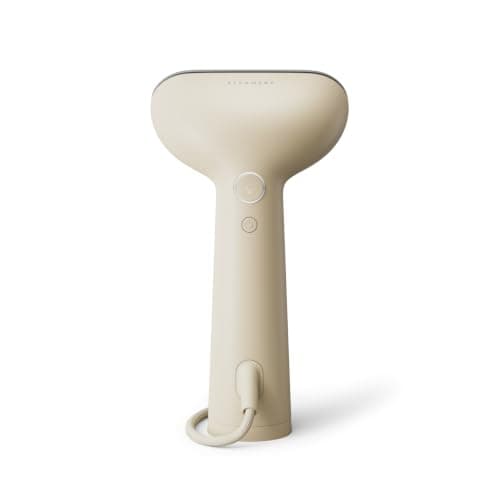
Steamery makes the design-led end of this category, and on published figures the Cirrus line trades power and water for speed, weight and finish. Four models are live in the US: the Cirrus Core (1,350 W, 85 ml, 15 s, 1.4 lb), the Cirrus Icon (no published wattage, 170 ml, 30 s, 1.5 lb), the Cirrus 3 (1,200 W, 90 ml, 25 s, 1.9 lb) and the Cirrus X (1,200 W, 85 ml, 20 s, 1.65 lb). Every one of those tanks is smaller than the smallest tank on any other handheld on this site, and no Cirrus listing publishes a warranty term. In exchange, Steamery is one of only three brands here that tells you how much steam its machines actually make.
We earn a commission if you buy through the links on this page, at no extra cost to you. It does not change which steamer we rank first — the ranking comes from published specifications and the arithmetic on our method page. We have not tested these units. Full disclosure.
Why this page did not exist until today
The compare hub has carried a short, awkward section since this site launched, headed "the brands we will not rank, and why". Steamery was on that list. The reason given was narrow: during the build research pass we could not confirm a live, currently-buyable US Amazon listing for a Steamery steamer, and this site does not publish a specification it cannot cite to a listing. The section ended with a promise — if a verifiable listing appears, the page follows.
A re-check on September 26, 2026 found four. All four served a full structured specification table on their own product pages, and all four were in stock with a live price at the moment of the check. So the page follows, and it is built exactly like every other product page here: the figures come straight from the listings, the score comes from arithmetic on those figures, and nothing in it rests on having held one.
The four models, side by side
Steamery Cirrus, read from the live listings, September 26, 2026
Model
Power
Tank
Heat-up
Weight
Published output
Warranty
Cirrus Core
1,350 W
85 ml
15 s
1.4 lb
0.74 oz/min
Not published
Cirrus Icon
Not published
170 ml
30 s
1.5 lb
Not published
Not published
Cirrus 3
1,200 W
90 ml
25 s
1.9 lb
Not published
Not published
Cirrus X
1,200 W
85 ml
20 s
1.65 lb
20 g/min
Not published
Heat-up is the figure in each listing's structured Heat Time field. The Cirrus Icon's title advertises 25 seconds; its Heat Time field reads 0.5 minutes. We publish the filed field, as we do for the Rowenta XCEL, which has the same disagreement with itself.
Steamery also lists a fifth model, the Cirrus Lite, aimed at travel. It is not in the table because we have not put its listing through the same capture as these four. When we do, it gets a row like the rest, with the same numbers filled in or the same gaps stated.
The figure Steamery publishes that almost nobody else does
Two of these four listings print a steam output in the product title: 20 g/min on the Cirrus X, 0.74 oz/min on the Cirrus Core. That is genuinely unusual. They are the only two listings here that put the rate in the title. Two other products publish one at all: the Philips 3000 files up to 20 g/min in its listing highlight, matching the Cirrus X on the raw number and beating everything here per watt, and the CHI 11590 states 18 g/min in normal mode and 26 on MAX, the highest figure anywhere on this site and the only per-mode pair. Beyond those, nothing — the Jack & Rose K1 carries an "Output Steam" field, but it holds four different figures at once because the field is shared across the listing's variants, so there is no single number to cite.
This matters more than it looks, because output is the thing a steamer actually does and nobody publishes it. Every other page on this site infers it. The arithmetic we use throughout is that a 1,875 W element boils roughly 30 ml of water a minute at full output, and that the rate scales with power.
Steamery lets us check that. At 1,200 W the convention predicts 19.2 ml a minute. Steamery publishes 20 g a minute for the Cirrus X — within four percent. At 1,350 W the convention predicts 21.6 ml a minute; the Core's 0.74 oz/min works out at about 21.9 — within two percent. Two data points are not a validation study. They are, however, the only external check available on a figure this site applies to every steamer it covers, and the check passes.
The tanks are the whole story
The handheld class on this site runs from 100 ml to 350 ml of tank, because that is the range real handhelds actually span — the ranges are published in full on the methodology page. Three of these four Steamery models are below the bottom of that range. The Core and the X hold 85 ml; the Cirrus 3 holds 90 ml. The class floor is 100.
Run the arithmetic and the consequence is plain. The Cirrus X holds 85 ml and Steamery says it makes 20 g a minute, which is four and a quarter minutes of continuous steam. The Core is under four minutes. The Cirrus 3, at the rate its 1,200 W implies, is a little under five. Only the Icon, at 170 ml, gets past that — and its maker publishes no wattage, so we cannot put a runtime on it at all without inventing the missing figure, which we will not do.
Minutes are arithmetic, not a measurement: tank capacity divided by the boil rate the wattage implies. The Cirrus X's row uses Steamery's own published 20 g/min rather than our estimate.
The Rowenta XCEL is the relevant comparison because it weighs exactly what the Cirrus Core weighs — 1.4 pounds — and costs a fraction as much. On published figures it draws 1,875 W to the Core's 1,350 and carries 189 ml to the Core's 85. If the numbers in the table are what you are buying, the Steamery is not the machine to buy.
What this site's rubric does not measure
That last sentence needs an honest qualifier, because the scores on this page are unflattering and the reason is partly structural. The rubric weighs four published figures: power, tank, heat-up and weight. It scores the Cirrus line between 4.3 and 5.8, against 7.2 for the Rowenta XCEL and 6.5 for the Conair. Steamery is selling, quite openly, things the rubric has no column for.
Dry steam. Three of these four listings lead on it, and the Core and the Icon go further and claim explicitly that it leaves no water stains. This site has a whole page on water marks because they are a real and common complaint, and a machine that genuinely spits less is solving a real problem. We cannot verify the claim from a listing, and we do not score marketing language.
A heated plate. The Cirrus 3 and the Icon both have one, which lets them press a collar as well as relax a wrinkle — the thing steam alone cannot do.
Finish and form. A flat base so the machine stands on a shelf, a visible tank, a hanging loop. These are design decisions, they cost money, and the rubric is blind to all of them.
Published output. The irony is not lost on us: the one brand that publishes the figure everybody actually wants gets no credit for it, because the rubric was built around the four fields the rest of the category files.
So read the score for what it is. It says the Cirrus line gives you less power and much less water than cheaper machines do. It does not say the machines are bad, and it cannot say whether the dry-steam claim is real. If what you want is the smallest, quickest, best-looking thing that will get a jacket presentable before you leave the house, the numbers are not the argument against it. If what you want is a rail of shirts done in one go, the numbers are the whole argument.
The Cirrus Icon publishes no wattage at all
This is worth its own heading because it is a first for this site. Across the thirty products on this site, the Cirrus Icon is the only one whose maker does not state a power draw anywhere in the structured specification table. Its title finds room for "Scandinavian design", "Dry Steam Technology" and "2 Steam Modes". It does not find room for a number in watts.
Our handling is the same as for any missing figure: the metric is dropped, the overall score is the weighted mean of what Steamery did publish, and the page says which figure was unavailable. A missing spec is never treated as a zero, because a maker's silence is not a defect in the product — it is a defect in the disclosure. It does mean the Icon's score is computed from three inputs where every other handheld here uses four, and you should weigh it accordingly.
Nobody publishes a warranty
None of the four listings states a warranty term. That is common at the marketplace end of this category — six of the eleven handhelds on this site before today published none either — but Steamery is not sold at the marketplace end. These are the most expensive handhelds on this site by a wide margin, and the buyer of the most expensive thing in a category is precisely the buyer who has been told to expect a stated warranty.
It may well exist on Steamery's own site or in the box. We report what the listing you would actually buy from publishes, and that listing publishes nothing. In practice your recourse if one fails is the retailer's returns window.
Which Cirrus, if you want one
Buy the Core if you want the line's best published figures. It has the most power, the fastest heat-up, the lightest body and a stated output. Its tank is the smallest here, so buy it knowing you will refill it inside four minutes of continuous use. Buy the Icon if the tank is what has been putting you off — 170 ml is double the rest of the line — and you can live with a listing that will not tell you its wattage. Buy the Cirrus 3 if you want the heated plate and the flat base in the model the category's design coverage actually means. Buy the X only if the Core is unavailable; on published figures the Core beats it on power, heat-up and weight while sharing its tank exactly.
Buy none of them if you are steaming a wardrobe rather than an outfit. That is not a criticism of Steamery — it is what a sub-100 ml tank means. The standing steamers start at 1.8 liters, which is about an hour of steam, and several cost less than any Cirrus.
The four Cirrus models
Ranked on published specifications. Tap a row for the full write-up; the price button goes to Amazon.
#
Product
Best for
Spec score
Price
1
Steamery Cirrus CoreThe most power, the fastest heat-up and the least weight in the line — attached to the smallest tank on this site.
Steamery publishes the figure almost nobody else in this category publishes: a steam output, 0.74 ounces a minute, printed in the listing title. Output is what a steamer actually does, and everywhere else on this site we have to infer it from wattage. The Core's tank is filed as 2.87 ounces and the Cirrus X's identical tank is filed directly as 85 ml, which tells you Steamery's ounces are fluid ounces — so read the Core as roughly 22 ml a minute.
Run that against the tank and the result is stark. 85 ml at 22 ml a minute is under four minutes of continuous steam. The smallest published tank on any other handheld here is the Rowenta XCEL at 189 ml, which is about six minutes flat out. You will refill the Core twice in the time the XCEL runs once.
1,350 W at 1.4 pounds is the most power Steamery offers in the least weight, and the 15-second published heat-up is the second fastest of any handheld on this site, behind the Rowenta Pure Force's 10 seconds. Those are real advantages. They are also the advantages of a tool built for one outfit at a time.
Good
1,350 W — the most power in the Cirrus line — in its lightest body at 1.4 lb
15-second published heat-up, second only to the Rowenta Pure Force here
Publishes a steam output figure, which almost no maker in this category does
Not good
85 ml ties the Cirrus X for the smallest published tank of any handheld here
1,350 W is well short of the 1,875 W ceiling cheaper handhelds reach
No published warranty term on the listing
Who should not buy it. Skip this if you steam more than an outfit at a time. Under four minutes per fill is a touch-up tool, not a wardrobe tool, and the price sits at the top of this site's range rather than the bottom.
2. Handheld · The only Cirrus with a usable tank
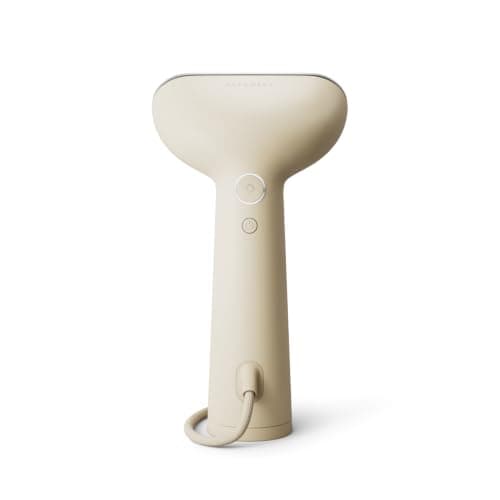
Steamery Cirrus Icon
Double the tank of the rest of the line, and the only product on this site whose maker does not publish a wattage.
Steamery does not publish power draw for this model, so that figure is excluded from the score rather than estimated.
What the numbers mean
The Icon is the one listing here with no wattage in it. Every scoring metric that depends on power is therefore dropped and the score is computed from the three figures Steamery did file — the rubric this site publishes never treats a missing figure as a zero. The gap is itself the finding: on a listing with room in its title for the phrase Scandinavian design, the power draw is absent.
It also disagrees with itself in exactly the way the Rowenta XCEL does. The title advertises a 25-second heat-up; the structured Heat Time field on the same listing reads 0.5 minutes, which is 30. We score the filed field, here as everywhere.
What it has is the line's only tank worth the name: 170 ml, double the Core and the X. That is still below the 189 ml floor set by every other handheld on this site. Without a published wattage we cannot put a runtime on it at all — at the Cirrus 3's 1,200 W it would be about nine minutes, but that is our arithmetic resting on a figure Steamery has not supplied.
Good
170 ml — double the tank of the rest of the Cirrus line
Heated front plate, two steam modes, and a descaling function the listing names
Ships with a steaming pad for collars, cuffs and hems
Not good
No published wattage — the only product on this site whose power draw its maker does not state
The title says 25 seconds to heat; the listing's own Heat Time field says 30
No published warranty term, at the highest price on this page
Who should not buy it. Skip this if you want a figure for everything before you spend. This is the least completely documented listing on the site and also the most expensive Steamery, which is an uncomfortable combination.
3. Handheld · The model the design coverage means
Steamery Cirrus 3
A heated plate and a flat base on 1,200 W, with the second-smallest tank of any handheld here.
This is the Cirrus the category's design coverage means when it says Steamery, and it is the model this site named by name when it explained which brands it could not rank. There is a live US listing now, so here it is on the same four published figures as everything else.
1,200 W and a 90 ml tank. At the arithmetic this site uses throughout — a 1,875 W element boils roughly 30 ml of water a minute at full output, and the rate scales with power — 1,200 W is a shade over 19 ml a minute, so 90 ml is a little under five minutes of continuous steam.
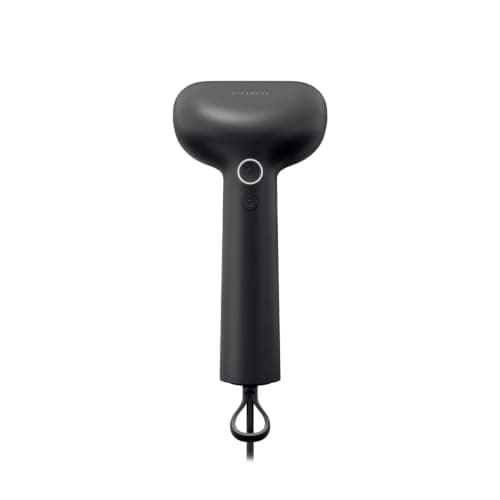
1.9 pounds makes it the heaviest Cirrus, and the flat base and heated ironing plate are why: it stands on a shelf and it presses as well as steams. It is also the only one of the four listings that states an auto shut-off, at 30 minutes.
Good
Heated ironing plate, so it can press a collar as well as relax a wrinkle
Flat base for standing storage, plus a stated 30-minute auto shut-off
25-second published heat-up
Not good
90 ml is under five minutes of steam by the arithmetic used throughout this site
1.9 lb is the heaviest of the Cirrus line, on the line's joint-lowest wattage
No published warranty term
Who should not buy it. Skip this if raw output is what you are buying. 1,200 W into a 90 ml tank is less steam, and fewer minutes of it, than a 1,875 W handheld at a fraction of the price.
4. Handheld · Checking our arithmetic against a maker's own figure
Steamery Cirrus X
The one listing here that publishes a steam rate in grams — and it lands within four percent of this site's own arithmetic.
The Cirrus X is the model that lets a reader audit this site. We assume a 1,875 W element boils roughly 30 ml of water a minute and that the rate scales with power; at 1,200 W that predicts 19.2 ml a minute. Steamery publishes 20 g a minute. The convention applied to every other steamer here lands within four percent of the one figure a maker actually supplied.
The consequence for the X itself is less flattering. 85 ml at 20 g a minute is four and a quarter minutes of continuous steam, and Steamery's listing describes that as enough to steam an entire outfit without refilling. That is a claim about how people steam, not a claim about the tank.
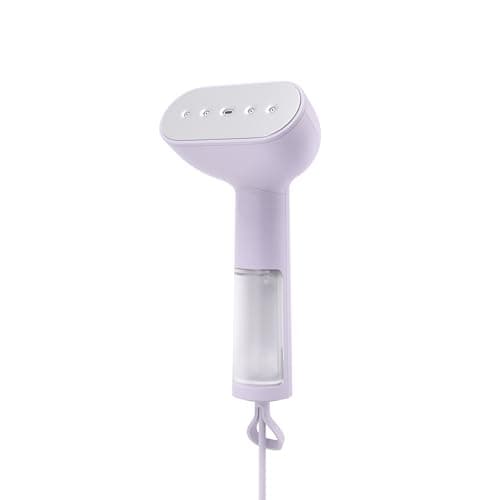
1.65 pounds, a detachable transparent tank and a hanging loop rather than a flat base. Of the four, this is the one the Core most clearly supersedes: the same 85 ml, less power, five seconds slower to heat and a quarter of a pound heavier.
Good
Publishes 20 g/min of steam output — a figure almost nobody in this category states
20-second published heat-up
Detachable transparent tank, so the water level is visible
Not good
85 ml is four and a quarter minutes of steam on Steamery's own output figure
The newer Cirrus Core is lighter, faster to heat and draws more power
No published warranty term
Who should not buy it. Skip this if the Core is on the shelf beside it. On published figures the Core beats the X on power, heat-up and weight, and shares its tank exactly.
The brands that still have no page
The same re-check that found these four also turned up live US listings for Philips and PurSteam, and both pages followed within a day. If you are weighing the Cirrus line against the other premium handheld here, Steamery against Philips puts them side by side; if the real question is whether this tier is worth the money at all, Steamery against Conair is that argument in a table. We could not find a live US Amazon listing for a Tefal or an Electrolux garment steamer at the time, so those two stayed where they were; Electrolux has since been verified and has its own page, and Tefal is the one name left in the section on the compare hub that explains which brands we will not rank and why.
Questions people actually ask
+Are Steamery steamers worth the money?
On the four published figures this site scores — power, tank, heat-up and weight — no: cheaper handhelds draw more power and hold more than twice the water. What Steamery sells on top of those figures is dry steam, a heated plate, a flat base and the finish, none of which a specification table can measure. If you want the numbers, buy elsewhere. If you want the object, the numbers are not the argument.
+Which Steamery Cirrus should I buy?
The Cirrus Core on published figures: 1,350 W, a 15-second heat-up and 1.4 pounds, the best of the line on all three. Choose the Cirrus Icon instead if the tiny tanks are the problem, because its 170 ml is double the rest, and accept that its listing publishes no wattage.
+How long does a Steamery Cirrus run on one tank?
Four to five minutes of continuous steam. The Cirrus X holds 85 ml and Steamery publishes 20 g a minute, which is four and a quarter minutes; the Core is a little under four; the Cirrus 3 is a little under five. The Icon holds 170 ml but publishes no wattage, so no honest runtime can be calculated for it.
+Does Steamery publish a warranty?
Not on any of the four US Amazon listings we captured. A warranty may exist on Steamery's own site or in the box, but the listing you would buy from does not state one, so your stated recourse is the retailer's returns policy.
+What is dry steam?
Marketing language for steam with little enough suspended water that it does not leave a mark on fabric. It is a real distinction — wet steam is the usual cause of water spotting — but it is not a published specification, no maker quantifies it, and this site does not score claims it cannot read off a specification table.