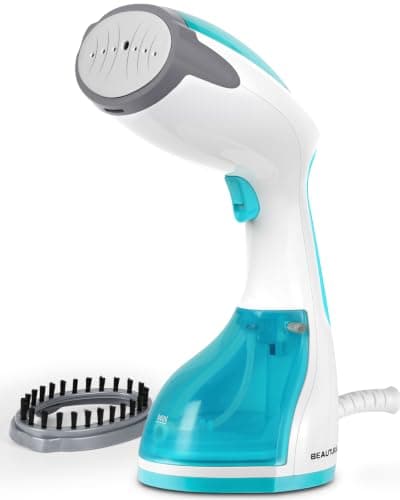
For maybe half of households, genuinely yes. For the other half it is money on a gadget that gets used twice. Here is how to tell which you are.
By Scooter M., enthusiast, crease control · Published
It depends on your wardrobe, and the honest answer is not always yes. A steamer is worth it if you own wool, knitwear, synthetics, dresses or tailoring — it is faster than an iron on all of them and better for the fabric. It is not worth it if what you actually need is a crisp collar, a trouser crease or pressed linen, because steam cannot create a crease at any price. Most disappointment in this category is that mismatch, not a bad machine. Below: the four questions that settle it, then what to buy if the answer is yes.
We earn a commission if you buy through the links on this page, at no extra cost to you. It does not change which steamer we rank first — the ranking comes from published specifications and the arithmetic on our method page. We have not tested these units. Full disclosure.
The four questions, in order
Answer these before you look at a single product. They take two minutes and they are a better predictor of whether you will still be using a steamer in a year than any specification on this site.
Is a steamer worth it for you?
Question
If yes
If no
Do you own wool, knitwear, silk, satin or polyester you actually wear?
Strong yes. Steam is the better tool for all of them, not a compromise
The case weakens sharply
Do you currently avoid ironing and just wear things creased?
Strong yes. The reason is usually the setup cost of a board, and a steamer removes it
You already have a working habit; the gain is smaller
Do you need a sharp collar, cuff or trouser crease?
Is a lot of what you own [linen](/steamer-vs-iron/linen) or heavy cotton?
No. Buy an iron. A steamer will disappoint you and we would rather say so
No obstacle
Two yeses in the first two rows and a no in the last is the profile of someone who uses a steamer for years. The reverse is the profile of a drawer ornament.
What you are actually buying: time, not results
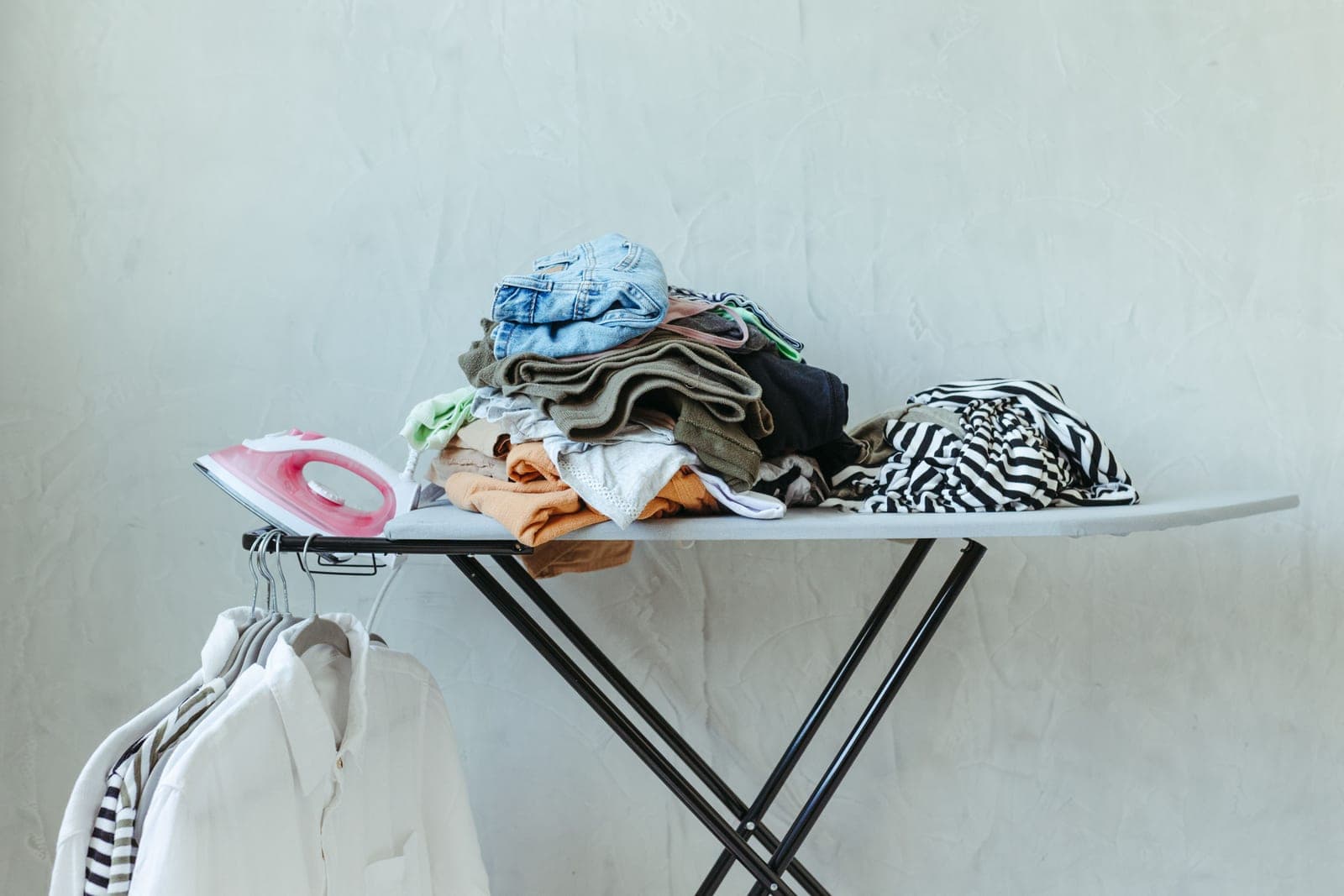
On the fabrics steam suits, an iron and a steamer both get you to presentable. The difference is what it costs you to get there. An iron needs a board found, unfolded and set up, a garment laid flat, turned, repositioned and turned again. A steamer needs a hanger and a plug.
That difference sounds trivial written down and is the entire reason people either use a steamer daily or abandon it. Three minutes on a hanger before work is a thing you will do. Fifteen minutes with a board is a thing you will keep meaning to do. If you currently leave the house in a creased shirt because ironing is a whole production, the honest value of a steamer is that it removes the production.
Where a steamer genuinely beats an iron
[Wool tailoring](/fabrics/wool). An iron flattens a lapel roll and can glaze the cloth permanently. Steam is what tailors actually use. This is not close.
[Knitwear](/steamer-vs-iron/knitwear). Pressure crushes the loft that makes a knit warm. A steamer relaxes the yarn without touching it.
[Polyester](/fabrics/polyester) and synthetics. A thermoplastic glazes under direct heat. Steam never contacts the surface.
[Silk](/fabrics/silk), [satin](/fabrics/satin), [chiffon](/fabrics/chiffon). Delicate, easily scorched, and awkward to lay flat. Steam handles all three in seconds.
Anything already hanging — curtains, a dress on a rail, a jacket you are about to wear. Taking them down is the whole job; a steamer skips it.
Between-wear refreshing. Steam relaxes the creases a day puts in and knocks back odor, which lets wool and knits go much longer between washes. An iron does not do this at all.
Where it does not, and nobody should pretend otherwise
Creases. A crease is made by pressure while the fabric cools. No vertical steamer applies pressure, so none can make one. Trouser creases, knife-edge plackets, uniform creases — an iron or a plate.
[Linen](/steamer-vs-iron/linen). Flax has almost no elastic recovery, so it must be held flat while it dries. Steam relaxes a linen wrinkle and it comes straight back. We say this despite earning nothing from the recommendation.
Heavy cotton twill and canvas. Too dense for vertical steam to reach the middle of the cloth.
Cleaning. Steam reduces odor. It does not clean, does not sanitize, and will set a stain rather than lift it.
A genuinely crisp dress shirt. You get presentable, not crisp. The dress-shirt page is specific about where the line falls.
"Do they really work?" — yes, with one common failure
The single most common complaint about steamers is that clothes come out damp rather than smooth. That is almost never a defective unit. It is one of three things, all fixable and all knowable before you buy:
Too little power for the fabric. Below about 1,000 watts a steamer is a refresher — fine on jersey and polyester, not enough for cotton shirting. Buying a 700 W unit to press cotton is the classic mismatch.
Not holding the fabric taut. Steam relaxes the fiber; something has to pull it straight. On a hanging garment that is your free hand. Most people do not do this and blame the machine.
Working too close. Closer is not stronger. A head held against the cloth delivers water rather than vapor, which is how you get a damp patch and, on silk, a water spot.
This matters, because the cheapest units are exactly the ones that produce the disappointment above. Qualitatively, the market splits three ways:
What each tier actually gets you
Tier
Typically
Worth it?
Entry
700-1,100 W, 240-300 ml
Yes if your wardrobe is knits and synthetics. No if it is cotton shirting
Mid
1,200-1,875 W, 200-260 ml
The sweet spot for most households — enough power for everyday cotton
Standing
1,500-1,800 W, 1.8-3 L
Worth it only if you steam a rail at a time, not two garments
Live prices are shown on the picks below and nowhere in this prose — a number typed into a sentence is wrong within a week. The budget guide covers the sub-$50 end in detail.
The honest verdict
If your wardrobe leans toward knitwear, wool, synthetics and dresses, and you currently do not iron much, a steamer is one of the few household purchases that genuinely changes a habit rather than sitting in a cupboard. Buy at least 1,000 W and at least 240 ml of tank and you will use it.
If your wardrobe is cotton shirting and linen and you need things sharp, buy an iron, or buy a 2-in-1 and accept that the plate is sized for a collar rather than a shirt front. Buying a plain steamer for that job is how people end up concluding the whole category is a con. It is not a con; it is a tool for a specific set of fabrics, and it is excellent at those.
If the answer is yes
Ranked on published specifications. Tap a row for the full write-up; the price button goes to Amazon.
#
Product
Best for
Spec score
Price
1
Beautural 1200W Handheld Steamer260 ml on a 1,200W handheld — the most run time per fill here, bought with output.
Tank capacity decides whether steaming is pleasant or annoying, and this carries 260 ml against the 190 to 216 ml the 1,875W units manage. More minutes per fill, fewer trips to the sink.
1,200 watts is a real step down from 1,875. On linen and heavy cotton you will feel it — the steam is wetter and you will make more passes. On the synthetics and knits that make up most wardrobes the difference is small.
Two pounds and 30 seconds to heat are both mid-table. Nothing here is remarkable except the tank, and the tank is the point.
Good
260 ml — the largest handheld tank in this set
30-second published heat-up, faster than the 1,875W Conair
Auto shut-off published as part of a nine-point safety design
Not good
1,200W struggles where 1,875W does not — linen especially
Filling means carrying the whole unit to the tap
Two pounds in the hand, the same as the far more powerful Conair
Who should not buy it. Skip this if linen or heavy cotton is most of what you own. Below about 1,500 watts you make three passes where a stronger unit makes one.
2. Handheld · The default handheld
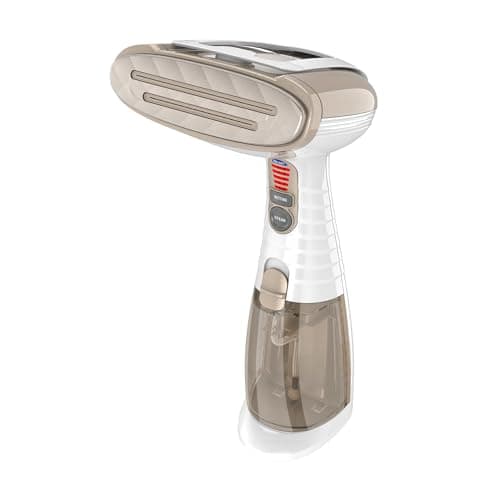
Conair Turbo ExtremeSteam GS59
The most-bought handheld in the category, and its published specs explain that rather than contradict it.
1,875 watts is the practical ceiling for a plug-in appliance on a US 15-amp circuit, and this unit sits right at it. Power is what turns water into dry steam fast enough to relax a fiber instead of soaking it, so on a handheld this is the figure that matters most.
The trade is the tank. 7.3 fluid ounces is a shade over 200 ml, which Conair pairs with a stated 20 minutes of run time. Call it two or three shirts before a refill.
40 seconds to heat is ordinary for this power class, not fast. The Rowenta Pure Force publishes a tenth of that at the same wattage.
Good
1,875W is the most power available in a handheld on a US circuit
Three attachments in the box, including a fabric brush for wool and a crease tool
Two-year limited warranty, which is unusual at this price
Not good
The tank is small for the power — high output empties it faster
40-second heat-up is beaten by several cheaper units
Over two pounds in the hand, which tells after a few garments
Who should not buy it. Skip this if you steam a whole rail at a time. At full output the tank runs dry before you get through a week of shirts, and a standing unit with a two-liter tank costs about the same.
3. Handheld · The largest tank on a mid-power handheld
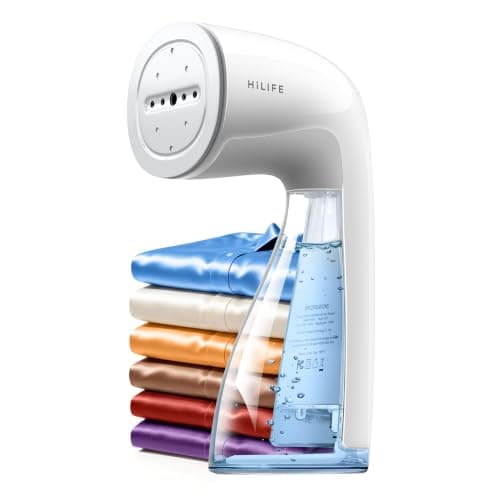
HiLIFE HL9 1100W Steamer
300 ml, 1,100 watts and 30 seconds — the HL7's three weaknesses answered.
HiLIFE does not publish weight for this model, so that figure is excluded from the score rather than estimated.
What the numbers mean
This is what the HL7 should have been: four hundred more watts, sixty more milliliters of tank, and a quarter of the heat-up time.
300 ml is the biggest handheld tank in this set. On a mid-power unit that is the right pairing — lower output empties a tank more slowly, so a big tank becomes real run time rather than a heavier device you refill just as often.
HiLIFE publishes no weight for this model. That is a gap, not something to infer: we have not held one and will not estimate it, so portability goes unscored.
Good
300 ml — the largest handheld tank here
30-second published heat-up, four times faster than the HL7
Leak-proof design published explicitly, which matters on a horizontal pass
Not good
No published weight, so portability cannot be scored
1,100W still sits below what linen wants
120V only
Who should not buy it. Skip this if you plan to travel with it. It is 120V only, and a dual-voltage travel unit costs less than the transformer you would otherwise need.
4. Standing · A whole wardrobe at once
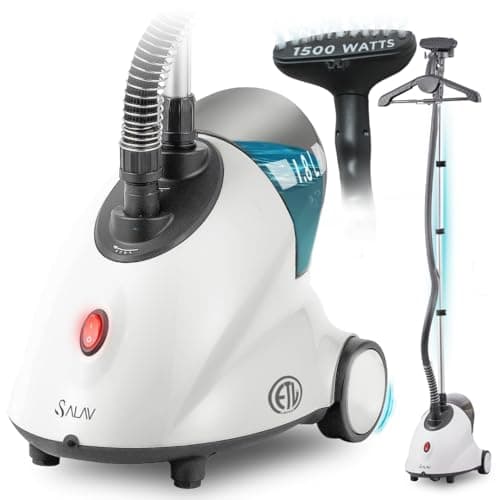
SALAV GS18 Full-Size Steamer
1.8 liters on a 65-inch pole — the point where steaming stops being a chore.
A 1.8 liter tank is roughly nine times what a good handheld carries. That is the entire argument for a standing steamer: fill it once and work through a rail without stopping.
SALAV publishes 60 minutes of steam per fill. Even discounted, that is an order of magnitude more than any handheld here.
Forty-five seconds to heat from 1,500 watts is respectable given the volume of water involved — a handheld is heating 200 ml, this is heating 1,800.
Good
1.8 liter tank — about an hour of continuous steam per the maker
65-inch pole holds a full-length dress or coat clear of the floor
1,500W with a published one-year warranty
Not good
Nine pounds and pole-mounted — this lives in one room
45-second heat-up is slower than the best handhelds
Assembly required, and the pole is what people complain about
Who should not buy it. Skip this if you steam two shirts a week. A standing unit you assemble and store is more machine than that job needs.
Questions people actually ask
+Are garment steamers worth it?
For a wardrobe of wool, knitwear, synthetics and dresses, yes — steam is the better tool for those fabrics and far quicker than setting up a board. For crisp collars, trouser creases or linen, no: a steamer cannot create a crease, and an iron is the right purchase.
+Do clothes steamers really work?
Yes, on the fabrics they suit. When they appear not to, the cause is almost always one of three things: too little power for the fabric, not holding the cloth taut while steaming, or working so close that the head delivers water instead of vapor.
+Is a handheld garment steamer worth it?
For two or three garments at a time, yes. For a full rail it is the wrong form factor — a 200 ml tank is roughly seven minutes of continuous steam, and you will spend the evening refilling. That job wants a standing unit.
+Are clothes steamers worth the money compared with an iron?
They are not really competitors. A steamer is faster and gentler on wool, knits and synthetics; an iron is the only tool that makes a crease and the only one that works on linen. Many households end up with both, and a 2-in-1 covers most of the gap in one device.
+Can a garment steamer replace an iron completely?
For a wardrobe with no linen and no need for sharp creases, effectively yes. If you need a crisp collar or a trouser crease even occasionally, keep the iron or buy a 2-in-1 with a press plate.