Lots of small items, all of them cotton, none of them needing a crease. This is the job where the biggest tank beats the biggest number.
By Scooter M., enthusiast, crease control · Published
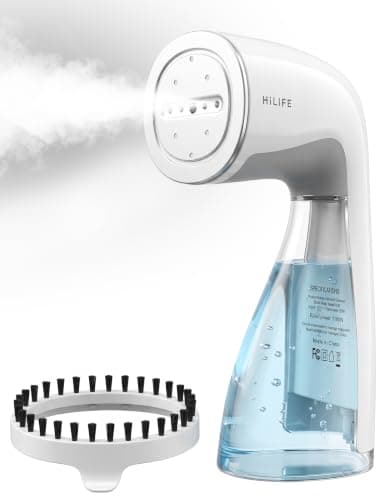
Baby clothes are the easiest fabrics in the house and the largest number of them. Almost everything is light cotton jersey, none of it needs a crease, and you will be doing twenty small items rather than four shirts. That points at a moderate-power, big-tank handheld rather than anything near the 1,875 W ceiling: the HiLIFE HL9 at 1,100 W and 300 ml runs about 17 minutes per fill, which is the whole basket. And the thing to be clear about before anything else: steaming does not sterilize a baby's clothes. It relaxes wrinkles and it reduces odor. It is not a wash and it is not a disinfection step.
We earn a commission if you buy through the links on this page, at no extra cost to you. It does not change which steamer we rank first — the ranking comes from published specifications and the arithmetic on our method page. We have not tested these units. Full disclosure.
What steam does not do, first
This site says the same thing on every page where someone might hope otherwise, and it is worth saying plainly here because the hope is strongest here. Steaming is not sanitizing. Steam leaves the head at boiling point and cools rapidly across the six inches to the fabric, and disinfection requires a temperature held for a period rather than a passing plume. What you get is a warm, moist plume that relaxes fibers and carries off odor. That is genuinely useful. It is not a hygiene process.
Nor is it a wash. Steam replaces the laundry trips that are about creases and smell, never the ones about dirt — the dry-cleaning page sets out the distinction, including the part where steaming over a stain can set it permanently. If the reason you are steaming a hand-me-down is that you do not know where it has been, the answer is a wash cycle, not a steamer.
How this list was judged
Criteria first, before any ranking, and they are different from the criteria on the main handheld roundup:
Tank capacity over wattage. A basket of babygrows is a long session of small items. Minutes per fill matters more here than peak output does.
Moderate power, deliberately. Light cotton jersey relaxes easily. 700 to 1,200 W is sufficient, and nothing here needs the 1,875 W ceiling.
Low weight. You will be holding it for a long stretch over a lot of small garments, frequently one-handed.
A published specification sheet, so the claims above can be checked rather than taken on trust.
Currently purchasable, verified against the live listing before publication.
Note what is not on that list: a press plate. Nothing in a baby's wardrobe needs a crease, so a 2-in-1 is weight you would carry for nothing.
The last row is not a pick. It is the most powerful handheld on this site, included to show what the ceiling costs you on a job like this one: a third of the run time of a 700 W unit.
That table is the argument in full. The least powerful machine on it runs three times longer than the most powerful, and on light cotton jersey you will not be able to tell the difference in result. This is the one category on the site where buying down on wattage is straightforwardly the right call.
Why the fabrics make this easy
Practically everything small children wear is cotton jersey, cotton interlock, muslin or a cotton-polyester mix, and every one of those is at the forgiving end of the fabric matrix. Jersey relaxes almost instantly. Cotton takes steam well, and the lightweight cotton in babywear takes it far more easily than shirting does because there is less cloth to heat. Polyester blends are the most steam-friendly synthetic there is, provided you keep moving and do not hold the head against the fabric.
The exceptions are worth knowing. Anything with a printed or heat-applied motif — and a lot of babywear has one — should be steamed from the reverse, because direct steam and pressure are how those lift. Knitted cardigans and wool-mix booties are knitwear: steam them flat, dry them flat, and never press. And a padded pramsuit is a down-and-puffer problem rather than a jersey one.
The picks
The HiLIFE HL9 is the one to buy for most people: 300 ml is the largest handheld tank on this site and 1,100 W is comfortably enough for everything in the basket, at the bottom of the price range. Its weakness is a real one — HiLIFE publishes no weight for it, so we cannot tell you how it feels in the hand, and we will not estimate. The full review has the detail.
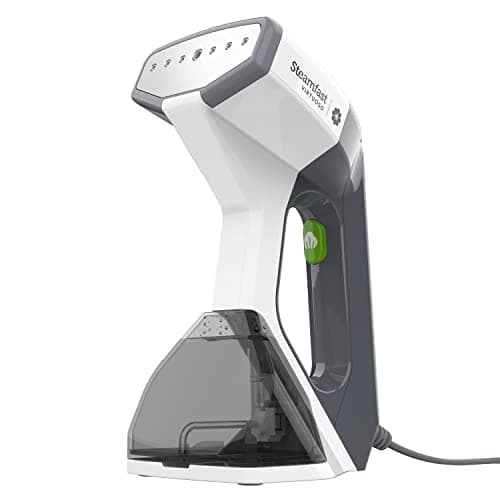
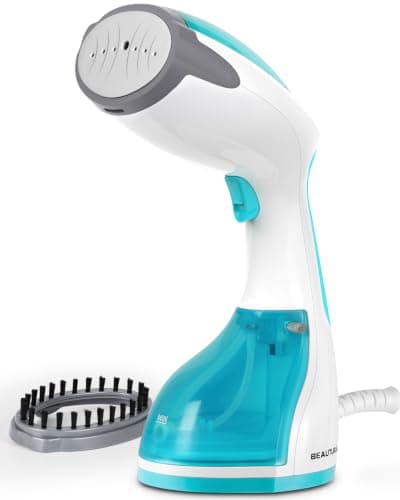
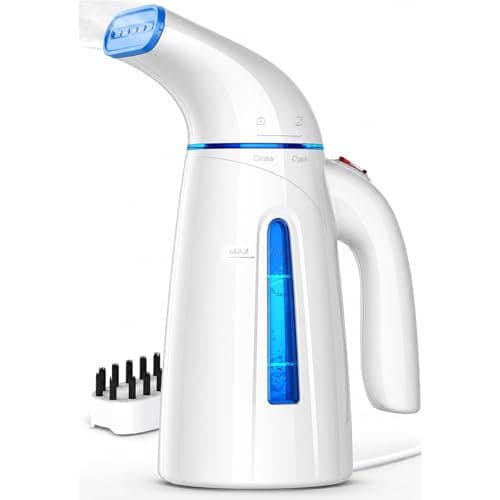
The Steamfast Virtuoso runs the longest of the picks at about 18.5 minutes, publishes both a weight and a one-year warranty, and is the choice if a stated warranty matters to you. The Beautural 1200W is the most powerful of the four and the one to take if there is adult cotton in the same basket. The OGHom HL6 is the lightest thing here at 1.26 pounds and the gentlest at 700 W — the right answer if the session is long, the fabrics are all light, and holding the machine is the part you are worried about.
Honest cons on every pick
HiLIFE HL9. No published weight and no published warranty. 120 V only.
Steamfast Virtuoso. 1,000 W is under-powered for adult shirting if you want one machine for both jobs.
Beautural 1200W. Two pounds is the heaviest of the four, which tells over a long session.
OGHom HL6. 700 W is the least power here, its listing files a runtime in the heat-up field so no heat-up time is published, and there is no warranty term.
Practical notes for this particular job
Hang the item and hold it taut with your free hand. Steam relaxes a fiber; tension is what lets the wrinkle fall out. This is why the same machine "works" for one person and not another.
Work at a few inches, not against the cloth. Too close and the head delivers water rather than vapor, which is the cause of most of the water marks people blame on the fabric.
Steam prints and appliqué from the reverse.
Let everything dry before folding. Warm, damp jersey takes the shape of whatever you do next, which on a small garment means a fresh set of creases.
If the actual job is bedding, cot sheets and blankets in volume, a handheld is the wrong form factor and a standing steamer at 1.8 liters is about an hour of steam for not much more money. If the job is nursery curtains as well, the same answer applies and the curtains page covers it. And if what you are hoping to do is kill something living in a mattress or a soft toy, no garment steamer does that — the bedding page explains why, at length, because the search results on that topic are not good.
The four picks
Ranked on published specifications. Tap a row for the full write-up; the price button goes to Amazon.
#
Product
Best for
Spec score
Price
1
HiLIFE HL9 1100W Steamer300 ml, 1,100 watts and 30 seconds — the HL7's three weaknesses answered.
Steamfast Virtuoso Handheld Steamer1,000 watts and a removable 296 ml tank, with a one-year manufacturer warranty most units at this price do not publish.
HiLIFE does not publish weight for this model, so that figure is excluded from the score rather than estimated.
What the numbers mean
This is what the HL7 should have been: four hundred more watts, sixty more milliliters of tank, and a quarter of the heat-up time.
300 ml is the biggest handheld tank in this set. On a mid-power unit that is the right pairing — lower output empties a tank more slowly, so a big tank becomes real run time rather than a heavier device you refill just as often.
HiLIFE publishes no weight for this model. That is a gap, not something to infer: we have not held one and will not estimate it, so portability goes unscored.
Good
300 ml — the largest handheld tank here
30-second published heat-up, four times faster than the HL7
Leak-proof design published explicitly, which matters on a horizontal pass
Not good
No published weight, so portability cannot be scored
1,100W still sits below what linen wants
120V only
Who should not buy it. Skip this if you plan to travel with it. It is 120V only, and a dual-voltage travel unit costs less than the transformer you would otherwise need.
2. Handheld · A published warranty at the low end
Steamfast Virtuoso Handheld Steamer
1,000 watts and a removable 296 ml tank, with a one-year manufacturer warranty most units at this price do not publish.
A 296 ml removable tank is joint fourth in the handheld class here, level with the Electrolux SnapSteam and behind only the three machines that publish 300 ml. Steamfast rates it at 15 minutes of continuous steam, and removable means you fill it at a tap rather than carrying the machine to the sink.
One thousand watts is the floor for making woven cotton look pressed rather than damp. It clears that floor and no more — this is a knits, synthetics and light-cotton machine, not a tailoring one.
The warranty is the reason to look at it. Steamfast publishes a one-year manufacturer term at a price where most listings publish nothing at all.
Good
296 ml removable tank — larger than every 1,875 W handheld on this site
One-year published manufacturer warranty, unusual at this price
Published auto shut-off and a 7.5-foot cord
Not good
1,000 W sits at the power floor — not enough for tailoring or heavy cotton
1.8 pounds, heavier than the compact travel units
The listing publishes no voltage, so we cannot tell you whether it is safe abroad
Who should not buy it. Skip this if you need to steam cotton shirting or a structured jacket. At 1,000 watts it relaxes knits and synthetics well and stops short of pressed-looking cotton.
3. Handheld · The biggest tank in the class
Beautural 1200W Handheld Steamer
260 ml on a 1,200W handheld — the most run time per fill here, bought with output.
Tank capacity decides whether steaming is pleasant or annoying, and this carries 260 ml against the 190 to 216 ml the 1,875W units manage. More minutes per fill, fewer trips to the sink.
1,200 watts is a real step down from 1,875. On linen and heavy cotton you will feel it — the steam is wetter and you will make more passes. On the synthetics and knits that make up most wardrobes the difference is small.
Two pounds and 30 seconds to heat are both mid-table. Nothing here is remarkable except the tank, and the tank is the point.
Good
260 ml — the largest handheld tank in this set
30-second published heat-up, faster than the 1,875W Conair
Auto shut-off published as part of a nine-point safety design
Not good
1,200W struggles where 1,875W does not — linen especially
Filling means carrying the whole unit to the tap
Two pounds in the hand, the same as the far more powerful Conair
Who should not buy it. Skip this if linen or heavy cotton is most of what you own. Below about 1,500 watts you make three passes where a stronger unit makes one.
4. Handheld · The lightest cheap handheld
OGHom HL6 700W Steamer
A 240 ml tank at 1.26 pounds — lighter than the HiLIFE it otherwise mirrors.
OGHom does not publish heat-up time for this model, so that figure is excluded from the score rather than estimated.
What the numbers mean
Mechanically this is the same proposition as the HiLIFE HL7: 700 watts, 240 ml, entry price. The published difference is a third of a pound less to hold.
OGHom's listing states 15 minutes in the heat-up field, which is a runtime claim filed in the wrong place rather than a specification. We score neither figure and say so instead of inventing one.
At this power the honest use is refreshing knits and synthetics between wears.
Good
1.26 pounds — light enough for a long session
240 ml tank at the bottom of the price range
Compact 6.5 inch body
Not good
700W will not touch linen or heavy cotton
No usable published heat-up figure — the field carries a runtime claim
120V only
Who should not buy it. Skip this if you need it to work on anything structured. Seven hundred watts is a refresher, not a press.
Questions people actually ask
+Can you steam baby clothes?
Yes. Almost everything in a baby's wardrobe is light cotton jersey or a cotton blend, which are among the easiest fabrics to steam. Check the care label first, steam printed motifs from the reverse, and let everything dry before folding.
+Does steaming sterilize baby clothes?
No. Steam cools rapidly across the gap between the head and the fabric, and disinfection needs a temperature held for a period rather than a passing plume. Steaming relaxes wrinkles and reduces odor. It is not a wash and it is not a hygiene step, and nothing on this site will tell you otherwise.
+What wattage steamer do I need for baby clothes?
Less than you would think. 700 to 1,200 W handles light cotton jersey comfortably. Because the job is a lot of small items rather than a few heavy ones, tank capacity matters far more than peak power: a 700 W unit with a 240 ml tank runs three times longer than a 1,875 W unit with 216 ml.
+Is a steamer better than an iron for baby clothes?
For this job, yes. Nothing in a baby's wardrobe needs a crease, which is the one thing an iron does that a steamer cannot, and a steamer is faster across a large number of small items. It also keeps a hot plate away from printed motifs, which is where irons do their damage.
+Can I steam a baby's clothes instead of washing them?
No. Steam handles creases and smell; it does not handle dirt, and steaming over a stain can set it. Treat it as a finishing step after the wash, not a replacement for one.